Journal · Buying guide · 4 min read
Which charger does the Galaxy Z Flip7 need?
A 4,300 mAh phone that folds in half. Its charging limit is lower than you might expect.
Many people reach for a 45 W charger for a new Samsung, because that is the number printed on the boxes of Samsung's top phones. For the Galaxy Z Flip7, that extra power has nowhere to go. So what does the phone actually need, and what can you safely skip?
Short answerThe Galaxy Z Flip7 charges at up to 25 W over a cable. A USB-C charger rated 25 W or more with USB Power Delivery and PPS reaches that speed. A 45 W or 65 W charger is safe but no faster. A 3 A USB-C cable is enough; a 5 A cable adds nothing here.
Galaxy Z Flip7 charging numbers
Samsung's New Zealand specification page lists the Galaxy Z Flip7 with a 4,300 mAh battery. The phone's Wikipedia entry, which summarises launch specs, lists 25 W wired charging, 15 W wireless charging and 4.5 W reverse wireless charging, with an announcement date of 9 July 2025.
Notebookcheck's review confirms the 4,300 mAh battery, describes the phone as charging over USB-C and wirelessly at up to 25 W, and lists slow charging among its drawbacks. The review's wording on wireless speed is less precise than the launch specs, so treat 15 W as the wireless figure until you have checked the spec sheet in the box or on Samsung India's site. In Notebookcheck's Wi-Fi browsing test the phone ran for almost 19 hours.
For comparison, Samsung's own support page for the Galaxy S24 series lists 25 W fast charging and 45 W super fast charging for the series, the second needing a 45 W adapter and a 5 A cable. The Flip7 sits in the 25 W tier only.
| Measure | Galaxy Z Flip7 |
|---|---|
| Battery | 4,300 mAh, dual-cell |
| Wired charging | Up to 25 W |
| Wireless charging | 15 W |
| Reverse wireless | 4.5 W |
| Charger to look for | USB PD with PPS, 25 W or more |
| Cable | USB-C to USB-C, 3 A |
Source: Samsung New Zealand; Wikipedia launch specs; Samsung India Support, accessed 22 Nov 2026
Delivered power (W)
Source: ChargerLAB, 45W compatibility test of Galaxy S24 Ultra, accessed 22 Nov 2026
How it works: why the bigger charger does not help
A USB-C charger does not push power into a phone. It offers a list of voltages and currents, and the phone picks what it wants. Samsung's India support pages ask for a USB PD charger of 25 W or more with PPS, the programmable power supply part of USB Power Delivery, where the phone asks for fine steps of voltage and current as the battery fills.
ChargerLAB's compatibility test of a Galaxy S24 Ultra shows that the headline number does not decide the result: the phone maker's own 65 W charger delivered about 44 W, while a 140 W laptop charger from another maker gave about 22 W. What counts is the protocol the charger offers and the phone accepts.
Think of it like a restaurant thali with a fixed portion. A larger kitchen does not put more food on your plate. The Flip7 orders a 25 W plate, and a 25 W kitchen serves it just as well as a 65 W one.
What you can skip
Skip the 45 W charger as a speed upgrade for this phone. It is useful only if it will also charge a tablet, a laptop or a Galaxy phone that supports 45 W.
Skip the 5 A cable as a must. Samsung ties 5 A cables to its 45 W mode. At 25 W, a well-made 3 A USB-C cable is enough.
Skip high-wattage wireless pads for this phone. Whatever the pad is rated, the phone accepts only its own wireless limit.
What you should not skip is a USB-C car charger with PD and PPS if you navigate on the phone while driving. A small 4,300 mAh battery running maps and a bright screen on a sunny dashboard drains quickly, and an old USB-A car charger will not keep up.
Heat, folding and charging in Indian summers
A flip phone packs its battery into two thin halves, split across the hinge. Wikipedia lists the Flip7's battery as dual-cell. Thin halves have less room to spread heat, so charging speed will drop sooner when the room or the phone is hot. Charge it open or closed on a hard surface with air around it, not under a pillow or in a hot car, and expect slower charging in afternoon heat.
What to check before you buy
Check for USB Power Delivery and PPS on the box or label. PPS is the part that lets recent Galaxy phones use their faster mode. A charger listing only fixed PD voltages may charge more slowly.
Check the rating of at least 25 W on the port you will use. On a multi-port charger, confirm the USB-C port still gives 25 W when another device is plugged in.
Check the cable is USB-C to USB-C and rated 3 A or more. A USB-A cable will limit you to slower modes.
Check the BIS registration number on the charger and verify it, because a charger that runs every night should be traceable.
Myth corner
Myth: a 65 W charger will damage the Flip7. It will not. The phone negotiates its own limit and takes only what it asks for, as ChargerLAB's Galaxy S24 Ultra test shows: no charger, even a 140 W one, pushed past the phone's own limit. A bigger charger is a convenience for other devices, not a risk and not a speed boost.
The right one for you
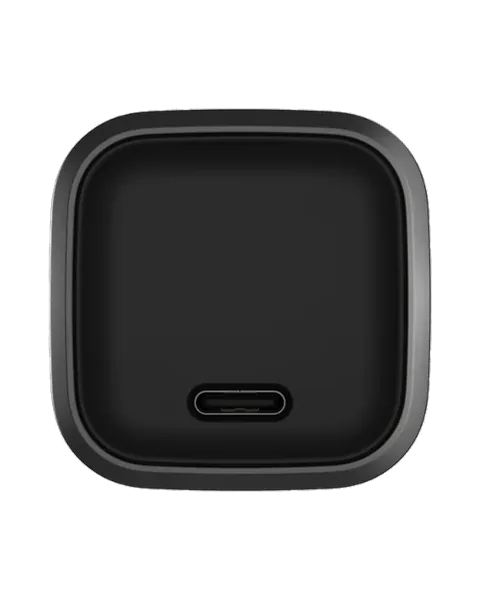
Fermi30 is the ERONIX charger matched to the Flip7. It lists PPS from 3.3 to 11 V at 3 A and 30 W from one USB-C port, so the phone gets its full 25 W.
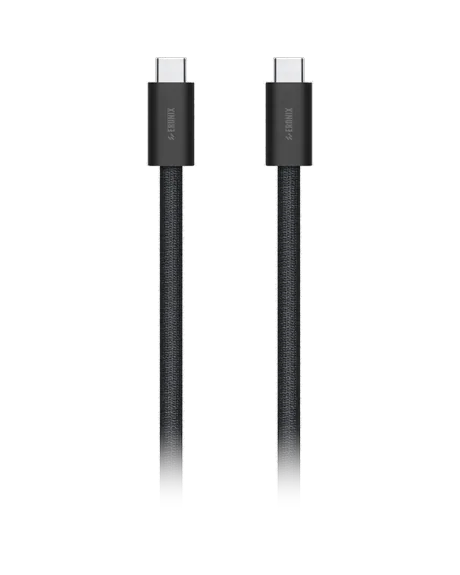
The cable is the piece the Flip7 uses everywhere. The Everyday Cable is USB-C to USB-C and rated 60 W, the 3 A class this phone needs, in a braided jacket with aluminium shells.
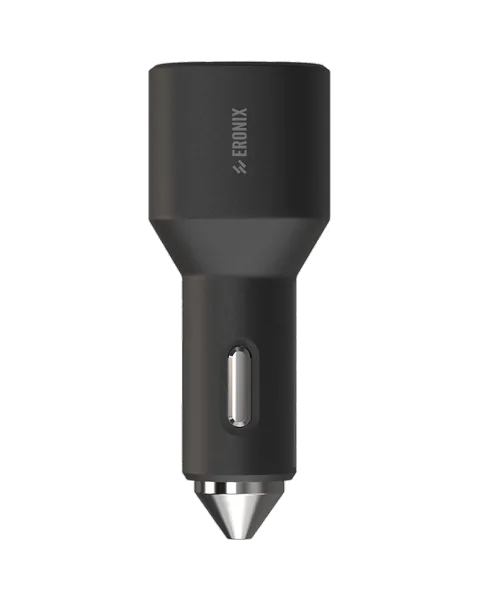
For the drive, the Car Charger offers USB Power Delivery with PPS on two USB-C ports, 65 W and 30 W, so maps and the phone keep up while a laptop charges alongside. Its aluminium body sits flush in the socket.
Step by step
- Look for a USB-C charger rated 25 W or more on one port.
- Confirm the label lists USB Power Delivery with PPS.
- Use a USB-C to USB-C cable rated 3 A or more.
- Turn on fast charging in the phone's battery settings if it is off.
- Charge on a hard surface away from heat.
Questions people ask
Does the Galaxy Z Flip7 support 45 W charging?
No. Launch specs list 25 W wired charging for the Galaxy Z Flip7. A 45 W charger is safe to use and the phone will negotiate its own limit, but charging will not be faster than with a good 25 W charger that supports USB Power Delivery and PPS.
Is there a charger in the Galaxy Z Flip7 box?
Samsung has not shipped chargers in the box of its recent flagship phones, and the box usually contains a USB-C to USB-C cable only. Check the box contents listed on Samsung India's product page before buying, and plan for a 25 W or higher USB-C PD charger with PPS.
Can I use an iPhone charger on the Galaxy Z Flip7?
Yes. A USB-C PD charger made for an iPhone will charge the Flip7 safely. Whether it reaches the full 25 W depends on whether it supports PPS. Without PPS, the phone may fall back to a slower mode; in ChargerLAB's Galaxy S24 Ultra test, a 140 W laptop charger delivered about half the power of Samsung's own charger.
How fast is wireless charging on the Galaxy Z Flip7?
Launch specs summarised on Wikipedia list 15 W wireless charging and 4.5 W reverse wireless charging. Notebookcheck's review wording is less precise, so check the spec sheet. Wireless charging is slower and warmer than cable charging, so use the cable when you need a quick top-up.
Sources
- Galaxy Z Flip7 specifications (Samsung New Zealand) · accessed 22 Nov 2026
- Samsung Galaxy Z Flip 7 (Wikipedia) · accessed 22 Nov 2026
- Compact Flip phone loses ground: Samsung Galaxy Z Flip7 review (Notebookcheck) · 4 Sep 2025, accessed 22 Nov 2026
- 45W compatibility test of Samsung Galaxy S24 Ultra (ChargerLAB) · accessed 22 Nov 2026
- How to use super fast charging on Galaxy S24 series (Samsung UK Support) · accessed 22 Nov 2026
- Pause USB PD charging when gaming feature on your Galaxy device (Samsung India Support) · accessed 22 Nov 2026
PPS — Programmable Power Supply
Power Delivery, with a fine-adjustment dial.
Read →Buying guide · 4 min readWhich charger does the Galaxy S26 Ultra need?
Sixty watts on the box. Here is what it takes to get it.
Read →Buying guide · 4 min readWhich charger does the Galaxy S26+ need?
Samsung promises 69 percent in about 30 minutes. One word on the label decides it.
Read →Buying guide · 5 min readWhich charger does the Galaxy Z Fold7 need?
A large phone with a modest charging ceiling. Spend on the right protocol, not on watts.
Read →Buying guide · 5 min readWhich charger does the Galaxy S26 need?
Three phones, three speeds, one protocol called PPS. Here is what to buy and what to skip.
Read →Buying guide · 4 min readWhich charger does the Galaxy Z Fold8 need?
Samsung's foldables now charge at 45 W. Here is the charger that gets you there.
Read →