Journal · Buying guide · 5 min read
Which car charger can fast-charge a Galaxy?
The socket in your dashboard is not the limit. The protocol on the USB-C port is.
You plug your Galaxy into a car charger that says 60 W on the box. Forty minutes later the battery has moved a few percent, and the phone never shows the words Super fast charging. What went wrong?
Short answerA Galaxy fast-charges in a car only from a USB-C port with USB PD PPS. 25 W models need PPS at 3 A. 45 W models need PPS at 5 A and a 5 A e-marked cable. The S26 Ultra needs PPS up to 20 V at 3 A. The total watts on the box do not decide it.
How many watts each Galaxy actually takes
Samsung's current flagships draw very different amounts of power. 9to5Google's launch report on the Galaxy S26 series lists 25 W wired charging for the Galaxy S26, 45 W for the S26+ and 60 W for the S26 Ultra.
Peak watts are brief. In Android Authority's test of the S26 Ultra, the full 60 W lasted about 2 minutes. Power then held near 48 W for about 16 minutes before tapering. A full charge took 42 minutes, against 54 minutes for the S25 Ultra and 62 minutes for the S24 Ultra. Android Authority reports that the phone needs a USB PD 3.1 charger with PPS that can supply 20 V at 3 A from one port.
The 45 W class is older and better mapped. In ChargerLAB's compatibility test of the Galaxy S24 Ultra, PPS chargers produced between 41.5 W and 44.45 W, with the phone holding the voltage near 9 V and pulling about 4.5 to 4.8 A. A 140 W charger without PPS, in the same test, gave only about 22 W. That gap is the whole story of car charging for Galaxy phones.
| Phone | Peak wired | Charger port needs | Cable |
|---|---|---|---|
| Galaxy S26 | 25 W | USB PD PPS at 3 A | Standard 3 A USB-C |
| Galaxy S26+ | 45 W | USB PD PPS at 5 A, low-voltage range | 5 A e-marked USB-C |
| Galaxy S26 Ultra | 60 W | USB PD 3.1 PPS, 20 V at 3 A | 3 A USB-C is enough |
Source: 9to5Google, Feb 2026; Android Authority, accessed Nov 2026; Samsung support
Power (W)
Source: ChargerLAB, Aug 2024
How Galaxy fast charging works
Most fast chargers raise the voltage to push more power. Samsung does the reverse. A Galaxy at 45 W keeps the voltage low, close to 9 or 10 V, and raises the current to nearly 5 A. PPS lets the phone ask the charger for an exact voltage in small steps, many times a minute, so the phone's own charging circuit does less conversion and makes less heat.
Think of it like ordering water by the litre rather than buying fixed-size bottles. A standard USB PD charger offers fixed bottles: 5 V, 9 V, 15 V, 20 V. A PPS charger lets the phone ask for exactly 9.2 V at 4.7 A, then 9.4 V a minute later. If the charger only sells fixed bottles, the Galaxy falls back to plain fast charging at roughly half the power.
Current is the hard part. At 5 A, the cable has to be rated for it. A USB-C cable rated above 3 A carries a small chip, called an e-marker, that tells the charger it is safe. Without that chip, the charger caps the current at 3 A, and a 45 W Galaxy drops to about 25 W. Samsung's own support page for the S24 series says super fast charging needs a 45 W adapter together with a 5 A e-marked cable.
The S26 Ultra changes the request again. Android Authority reports that it needs 20 V at 3 A, so a charger can reach 60 W with a 3 A cable. Fewer car chargers advertise PPS up to 20 V, so this is the line to read most closely.
Why the car makes it harder
A car socket supplies about 12 V in most cars and about 24 V in trucks and buses. The charger converts that to USB voltages in a space smaller than a matchbox, often in a cabin that sits well above 40 °C on an Indian summer afternoon. Heat makes the charger and the phone reduce power. Android Authority measured a peak of 39.6 °C on the S26 Ultra during fast charging on a desk, so a hot dashboard leaves less room before the phone slows down.
Two-port chargers add another trap. The headline watts are often a total across both ports. When a second device is plugged in, the main port can lose PPS or drop to a lower current, and the Galaxy falls back to standard speed.
What to check before you buy
Read the port label, not the box front. Look for PPS printed next to the USB-C port's ratings, with a low-voltage range (up to about 11 V) rated near 5 A for 45 W Galaxy phones, or a range that reaches 20 V or more at 3 A for the S26 Ultra.
Check the per-port rating. If the box says 60 W total, find out what one USB-C port delivers alone and what it delivers when the second port is in use.
Use a 5 A e-marked USB-C cable for 45 W models. The cable's packaging should state 5 A or 100 W or higher. A 3 A cable will hold a 45 W Galaxy near 25 W.
Confirm the input range. A charger rated for 12-24 V works in cars and larger vehicles. Make sure it fits firmly in the socket, because a loose fit interrupts charging on rough roads.
Test it in the car. With the phone plugged in, the lock screen should read Super fast charging, or Super fast charging 2.0 on 45 W and higher models. Also check that Super fast charging is switched on in Settings, under Battery, then Charging settings.
Myth corner
Myth: any car charger with a big wattage number will fast-charge a Galaxy. Fact: watts without PPS are wasted on Samsung phones. ChargerLAB measured a 140 W charger without PPS delivering only about 22 W to a Galaxy S24 Ultra, while PPS chargers rated 65 W and 150 W reached about 44 W.
The right one for you
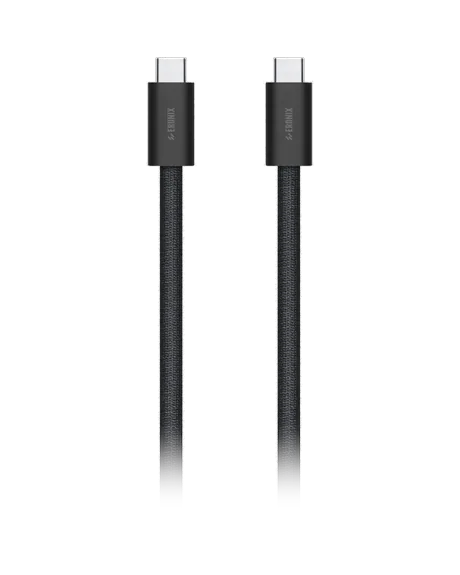
The cable is the half of this setup most often missed. The Power Cable 240 W is USB-C to USB-C with an e-marker and a 240 W EPR rating, so it clears the 5 A, 100 W line a 45 W Galaxy such as the S26+ asks for, and it carries the S26 Ultra's 20 V at 3 A with room to spare.
At 2 m it reaches from the socket to the seat without pulling tight, and the braided jacket is bend-tested to 10,000 bends. For the charger itself, read the PPS line on the port as described above.
Step by step
- Find your Galaxy's wired charging rating: 25 W, 45 W or 60 W.
- Choose a car charger whose USB-C port lists PPS at 5 A for 45 W, or PPS up to 20 V at 3 A for 60 W.
- Use a 5 A e-marked USB-C cable for 45 W models.
- Turn on Super fast charging under Settings, Battery, Charging settings.
- Plug in with the second port empty and confirm the lock screen reads Super fast charging.
Questions people ask
Can I use a 12 V car charger in a truck or bus?
Only if its input rating includes 24 V. Trucks and many buses run a 24 V system. Many car chargers are rated 12-24 V and work in both; a 12 V-only charger can overheat or fail on 24 V. Check the input line on the charger body before plugging it in.
Will a 45 W car charger damage a Galaxy that only supports 25 W?
No. A USB PD charger only supplies what the phone asks for. A Galaxy S26 rated at 25 W will request its own profile from a 45 W PPS charger and charge at its normal speed. The higher rating simply gives headroom for other devices.
Why does my Galaxy show Fast charging and not Super fast charging in the car?
The charger is not offering a PPS profile the phone accepts, the cable is limited to 3 A, or the second port is in use and has cut the main port's output. Try the phone alone, on the main USB-C port, with a 5 A e-marked cable, and check the Super fast charging setting is on.
Does the Galaxy S26 Ultra need a 5 A cable for 60 W?
Android Authority reports that the S26 Ultra reaches 60 W using 20 V at 3 A, so a good 3 A cable is enough for the phone. A 5 A cable adds thermal headroom and is still useful if the same cable also charges a laptop.
Is it safe to leave a car charger plugged in when the engine is off?
In many cars the socket switches off with the ignition, so nothing flows. In cars where the socket stays live, a charger draws a small standby current that can slowly drain the battery over days. Unplug it if you park the car for a long time.
Sources
- I tested the Galaxy S26 Ultra's 60W charging (Android Authority) · accessed 22 Nov 2026
- Samsung Galaxy S26 charging speeds and Qi2 (9to5Google) · 25 Feb 2026
- 45W Compatibility Test of Samsung Galaxy S24 Ultra (ChargerLAB) · 5 Aug 2024
- How to use super fast charging on Galaxy S24 Ultra, S24+ and S24 (Samsung UK support) · accessed 22 Nov 2026
PPS — Programmable Power Supply
Power Delivery, with a fine-adjustment dial.
Read →Buying guide · 4 min readWhich charger does the Galaxy S26 Ultra need?
Sixty watts on the box. Here is what it takes to get it.
Read →Buying guide · 5 min readWhich charger does the iPhone 18 Pro need?
Half a battery in 15 minutes, but only if your charger speaks one new word: AVS.
Read →Buying guide · 5 min readWhich charger does the Galaxy S26 need?
Three phones, three speeds, one protocol called PPS. Here is what to buy and what to skip.
Read →Buying guide · 4 min readWhich charger does the Galaxy S26+ need?
Samsung promises 69 percent in about 30 minutes. One word on the label decides it.
Read →Buying guide · 4 min readWhich charger does the Galaxy Z Fold8 need?
Samsung's foldables now charge at 45 W. Here is the charger that gets you there.
Read →