Journal · Buying guide · 5 min read
Which charger for a family of four?
Four phones, one socket and a 10 pm rush. Here is how to size the charger.
Every home has a socket that becomes the family charging point at night: a tangle of four cables, two bricks that came in phone boxes years ago, and an argument about who gets the fast one. Can one charger serve everyone without anyone waking up at 60%?
Short answerFor four phones charging overnight, one 65 W charger with three or four USB-C ports is enough. If all four need a fast top-up at once, plan for about 25 W per port, so 100 W or more in total, or two chargers in two rooms. How the charger splits its watts matters more than the total.
How many watts four phones actually draw
Start with what each phone asks for. Apple's support page on fast charging says iPhone 15 and later need an 18 W or higher USB-C adapter to fast charge, while the iPhone 17 family reaches 50% in about 20 minutes with a 40 W or higher adapter. Samsung's UK support page for the Galaxy S24 series lists 25 W fast charging and 45 W super fast charging for the series, the second needing a 45 W adapter and the 5 A cable that comes with it; the standard cable stops at 25 W.
So a typical Indian family mix, two iPhones and two Galaxy phones, wants somewhere between 18 W and 45 W each for the fastest charge. Overnight, none of them needs that: a phone has six or eight hours, and any of these rates fills it with time to spare.
The tablet changes the sum. Apple's own example for its 35 W dual-port adapter splits power evenly, up to 17.5 W each, when an iPhone and an iPad share it. A tablet on the same charger takes a big share.
| Phone | Adapter for fast charging | Note |
|---|---|---|
| iPhone 15 and later | 18 W or higher | USB-C |
| iPhone 17 family | 40 W or higher | About 50% in 20 minutes |
| Galaxy S24 series, fast | 25 W | Standard cable |
| Galaxy S24 series, super fast | 45 W | 5 A cable needed |
Source: Apple Support and Samsung UK Support, accessed Nov 2026
Power drawn (W)
Source: ChargerLAB, Samsung 65W 2C1A EP-T6530 review, accessed Nov 2026
What a shared charger really delivers
The label shows the total. What each port gets depends on how many are in use. ChargerLAB's power-distribution test of a 65 W three-port charger from a phone maker makes the point clearly. One phone on the main port drew about 37 W. With two phones on the two USB-C ports, they got about 23 W and 21 W. With a phone on USB-A alongside one USB-C device, the USB-A port got about 9 W; with all three ports busy and a laptop on the main port, it fell to under 6 W.
The same test caught a habit many multi-port chargers share: plugging a device into the second USB-C port made the first port drop to zero for a moment before recovering. For phones this is a short pause. For a laptop or a phone mid-update, it is worth knowing.
Apple's guidance on its dual-port adapter says the same thing in plain words: if one device needs more power, unplug the other.
How it works: a charger is a shared water tank
Inside a multi-port charger, one power stage feeds several outputs. A controller chip talks to each phone over USB Power Delivery, learns what voltage and current it wants, and then shares out a fixed budget.
Picture a single overhead water tank feeding four taps. Open one tap and it gushes. Open all four and each gets less, and the tap at the far end, the USB-A port, may barely trickle. The tank size is the total wattage. The plumbing is the power-sharing logic printed in small type on the charger or its box.
That is why two chargers of 35 W to 45 W in two rooms can beat one large charger in a home where everyone charges at the same hour. They also remove the single point of failure: one tripped socket no longer means four flat phones in the morning.
A simple sizing rule for Indian homes
Overnight only: 65 W with three or four USB-C ports. Every phone gets 15 W or more, which is plenty for an eight-hour night.
Morning top-ups for everyone at once: aim for about 25 W per port while all ports are busy. For four phones that means a charger whose sharing table shows 100 W or more across four ports.
A laptop in the mix: give it its own charger, or choose one whose table shows the laptop port keeping 45 W or more while the others are busy. In the ChargerLAB test, the charger could not run two laptops at once: with both USB-C ports in use, the second port gave no output.
What to check before you buy
Check the power-sharing table, not just the headline watts. It should say what each port gets when two, three and all ports are used. If the box does not show it, ask for the manual.
Check the port types. USB-C ports with USB Power Delivery serve both iPhones and Galaxy phones. A USB-A port is usually the weakest when sharing, so treat it as the port for earbuds or a watch.
Check for PPS on the USB-C ports if anyone uses a recent Galaxy phone. Samsung's India support pages tie some charging features to a USB PD charger of 25 W or more with PPS, the programmable power supply part of USB Power Delivery.
Check the plug and BIS marking. A charger that will run every night at a shared socket should carry a BIS registration number you can verify, and fit the socket firmly without a loose adapter.
Myth corner
Myth: a big charger pushes too much power into a small phone. A USB-C charger offers a menu and the phone chooses from it. In the ChargerLAB test, each phone took only the 21 W to 37 W it asked for, however large the charger's total was.
The right one for you
When everyone charges at the same hour, the sizing rule above favours two chargers in two rooms.
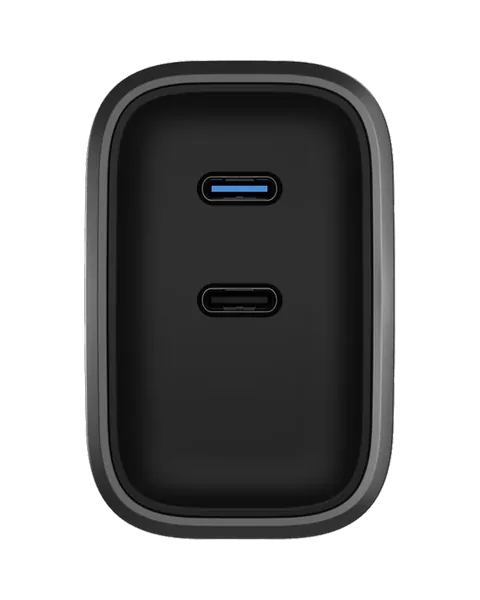
Two Fermi45 adapters give four USB-C ports between them: each delivers 45 W from one port, or splits 25 + 20 W or 30 + 15 W, with USB PD for the iPhones and PPS with Samsung Super Fast Charging 2.0 for the Galaxy phones. An iPhone 17 or a 45 W Galaxy gets full speed alone on a plug, and a pair sharing one still has a split you can read in advance.
Step by step
- List every device that charges at night and note the watts each phone maker recommends.
- Decide whether you need overnight charging only or fast top-ups for everyone at once.
- Pick a charger whose power-sharing table gives each port enough watts with all ports busy.
- Use USB-C ports for phones and keep USB-A for earbuds or a watch.
- Verify the BIS registration number before buying.
Questions people ask
Can I charge an iPhone and a Samsung phone from the same charger?
Yes, if the charger has USB-C ports with USB Power Delivery. Apple's support page lists USB-C adapters of 18 W or more for fast charging from iPhone 15 onwards. Samsung's support pages ask for a USB PD charger with PPS for some Galaxy charging features, so a charger offering both on its USB-C ports suits either phone.
Is it safe to leave four phones charging overnight on one charger?
It is, with a well-made charger that has a verifiable BIS registration and enough total watts. Each phone stops drawing current as it fills. Place the charger where air can reach it, not under a pillow or inside a drawer, and avoid cheap extension boards for a load that runs every night.
Why does my multi-port charger charge slowly with everything plugged in?
Because the total is shared. In ChargerLAB's test of a 65 W three-port charger, one phone drew about 37 W alone, but two phones together got about 23 W and 21 W, and the USB-A port fell below 6 W with all three ports busy. Unplug devices that are already full.
Should I buy one big charger or two smaller ones?
If everyone charges at the same hour, two chargers of 35 W to 45 W in different rooms often charge faster per phone than one shared charger, and one failure does not stop everyone. If charging is spread across the day, one 65 W to 100 W multi-port charger is tidier.
Sources
- Fast charge your iPhone (Apple Support) · accessed 22 Nov 2026
- How to use the 35W Dual USB-C Port Power Adapter (Apple Support) · accessed 22 Nov 2026
- How to use super fast charging on Galaxy S24 series (Samsung UK Support) · accessed 22 Nov 2026
- Power Distribution Review of Samsung 65W 2C1A Charger EP-T6530 (ChargerLAB) · accessed 22 Nov 2026
- Pause USB PD charging when gaming feature on your Galaxy device (Samsung India Support) · accessed 22 Nov 2026
USB-C Power Delivery
One connector, a negotiated contract.
Read →Buying guide · 4 min readWhich charger does the Galaxy S26 Ultra need?
Sixty watts on the box. Here is what it takes to get it.
Read →Buying guide · 5 min readWhich charger does the Galaxy S26 need?
Three phones, three speeds, one protocol called PPS. Here is what to buy and what to skip.
Read →Buying guide · 4 min readWhich charger does the Galaxy S26+ need?
Samsung promises 69 percent in about 30 minutes. One word on the label decides it.
Read →Buying guide · 4 min readWhich charger does the Galaxy Z Fold8 need?
Samsung's foldables now charge at 45 W. Here is the charger that gets you there.
Read →Buying guide · 4 min readWhich charger does the Galaxy S24 Ultra need?
Two small letters on the charger, PPS, decide whether you get 45 W or half of it.
Read →