Journal · Buying guide · 5 min read
Which charger for a work-from-home desk?
One socket, one charger, a full working day. The sum is simpler than it looks.
A typical home desk in India runs a laptop, a phone, earbuds and perhaps a tablet, all from one extension board already crowded with a router and a lamp. Most people solve it with whatever bricks came in the boxes. Is there a better way, and how big does one charger need to be?
Short answerAdd your laptop's minimum recommended wattage to about 40 W for a phone and a few watts for earbuds. For a thin laptop that sum lands near 70 W; for a bigger work laptop, near 100 W. Pick a multi-port USB-C charger at that total and check the label showing how the power splits.
How many watts a home desk really draws
Start with the laptop, because it sets the size. Apple's specification pages make a useful reference. The 13-inch MacBook Air with M5 ships with a 30 W or 35 W adapter, and fast charges with a 70 W or higher USB PD source. The 14-inch MacBook Pro lists a minimum of 60 W or 70 W depending on the chip and fast charges at 96 W or more. The 16-inch model lists a 94 W minimum on one chip and fast charges at 140 W or more.
Apple's troubleshooting page gives the plain rule: any USB-C adapter can be used, but pick one of equal or greater wattage than the one that came with your Mac. Windows laptops print the same figure on their original adapter's label.
Then add the phone. Apple's support page says iPhone 17 models fast charge with a 40 W adapter or higher. Earbuds and a smartwatch need only a few watts each.
Now the split. ChargerLAB's test of a 65 W charger with two USB-C ports and one USB-A port measured 63.4 W into a 16-inch MacBook Pro on its main port alone. With a laptop and a phone connected, it gave about 38.8 W to the laptop and 23.6 W to the phone. In a 140 W four-port charger it tested, two laptops drew about 62.9 W and 60.8 W at once.
| Device | Minimum or supplied | Fast charging |
|---|---|---|
| MacBook Air 13-inch, M5 | 30 W or 35 W supplied | 70 W or more |
| MacBook Pro 14-inch | 60 W or 70 W minimum | 96 W or more |
| MacBook Pro 16-inch | 94 W minimum (one chip) | 140 W or more |
| iPhone 17 | - | 40 W or more |
Source: Apple MacBook Air and MacBook Pro specifications (India); Apple Support, Fast charge your iPhone
Watts measured
Source: ChargerLAB, power distribution review of a 65 W 2C1A charger
How one desk charger shares its power
A multi-port charger has a fixed total and a small controller that decides how much each port gets. When you plug in a second device, it often pauses for a moment and reallocates. ChargerLAB noted that on the 65 W charger, plugging a cable into the second USB-C port briefly cut the first port to zero before charging resumed. Plugging into the USB-A port only reduced it.
Picture a water tank feeding three taps. The tank size is the charger's total watts. Open one tap and it runs at full flow. Open three and each runs slower. A good charger is like a tank with labelled taps: the label tells you which tap always gets the strongest flow, so you know where to connect the laptop.
Three desk setups, sized
Thin laptop, phone and earbuds: a 65 W to 100 W charger with two USB-C ports and one more port for small devices. Put the laptop on the main port.
Pro laptop and phone: around 100 W or more, so the laptop keeps its minimum while the phone charges. Check that the main port alone can supply the laptop's fast charging figure if you care about speed.
Two laptops, or a laptop and tablet: 140 W class. In ChargerLAB's 140 W test, two laptops each received over 60 W.
Desk details that make it easier
Apple notes that a Mac charges from only one port at a time, choosing the source with the most power, so plugging in two cables does not add speed. It also notes that a USB-C or Thunderbolt display can power the Mac instead of a separate charger. If your monitor does this, the laptop share of your charger can go to other devices.
Put the charger on the desk rather than behind it if you plug and unplug often. Use 1 m cables for the phone and a 2 m cable for the laptop if the socket is far away.
What to check before you buy
Read the per-port table on the label or box, not just the total. It shows what each port gives when several are in use.
Confirm the main port can deliver your laptop's minimum wattage on its own, and ideally while the phone charges too.
Use a USB-C cable rated for the laptop's power. USB-IF's cable logos show either 60 W or 240 W, so for a laptop that draws more than 60 W, pick a cable marked 240 W.
Check for the BIS registration mark and number on the charger itself. Power adaptors for IT equipment fall under the BIS Compulsory Registration Scheme, tested to IS 13252 (Part 1).
Leave space around it. ChargerLAB measured surface temperatures above 70 °C on a 140 W charger after an hour at full load, so do not bury it under papers.
Myth corner
Myth: a 100 W charger pushes 100 W into your phone and harms it. The phone and the charger negotiate first, and the phone takes only what it asks for. In ChargerLAB's 65 W test, a Galaxy S22+ took about 23.6 W, and Apple rates iPhone 17 fast charging from a 40 W adapter, not from the biggest one.
The right one for you
For a desk built around a 14-inch MacBook Pro and a phone, the sum points to about 100 W, and the Entropy100 is sized for it: up to 100 W from its main USB-C port, which covers the 96 W fast-charging figure Apple lists.
A second USB-C port gives 30 W to the iPhone, and a 22.5 W USB-A port looks after earbuds or a watch, all from one socket on the board.
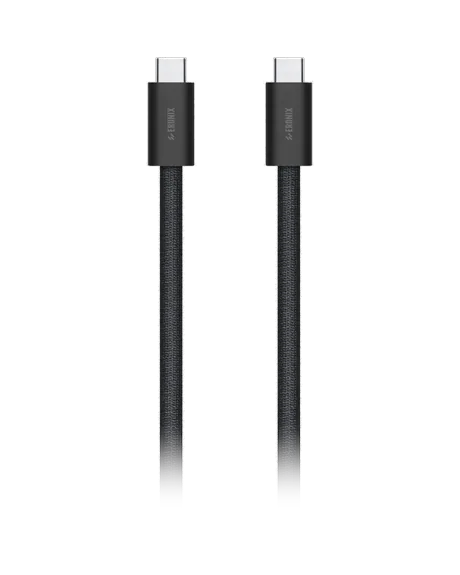
Pair it with the Power Cable 240 W, a braided 2 m USB-C cable with an e-marker, so the laptop's power reaches the far side of the desk.
Step by step
- Find your laptop's minimum wattage on its original adapter or the maker's spec page.
- Add about 40 W for a phone and a few watts for earbuds or a watch.
- Choose a multi-port USB-C charger at that total and read its per-port table.
- Connect the laptop to the main port with a cable rated for its power.
- Place the charger in open air on or beside the desk.
Questions people ask
Can I charge my laptop with my phone charger?
Often yes, if both use USB-C PD, but it will be slow. Apple allows any USB-C adapter but recommends one at least as strong as the original. A 20 W phone charger can top up a thin laptop overnight but may not keep up with heavy use during the workday.
Is a 65 W charger enough for a laptop and phone?
For a thin laptop and a phone, usually yes. In ChargerLAB's test of a 65 W two-port charger, a laptop got about 38.8 W and a phone about 23.6 W together. A laptop with a 60 W or higher minimum will charge more slowly in that setup.
Does a bigger charger use more electricity?
No, not in any meaningful way. A charger supplies the power devices ask for, not its maximum. A 100 W charger charging only a phone delivers roughly what the phone requests. The extra rating is headroom for when the laptop is also connected.
Can my monitor charge my laptop?
If the monitor has a USB-C or Thunderbolt port with power delivery, yes. Apple notes that a connected USB-C or Thunderbolt display can power a Mac instead of a separate charger. Check the monitor's power rating against your laptop's minimum wattage.
Should I unplug the desk charger at night?
It is a sensible habit if nothing is charging, especially in storms or with unstable supply. A charger with nothing connected draws very little, but switching off at the board also removes it from surges.
Sources
- Apple: MacBook Air technical specifications (India) · accessed 22 Nov 2026
- Apple: MacBook Pro technical specifications (India) · accessed 22 Nov 2026
- Apple Support: If your USB-C power adaptor isn't charging your Mac laptop · accessed 22 Nov 2026
- Apple Support: Charge your Mac laptop computer · accessed 22 Nov 2026
- Apple Support: Fast charge your iPhone · accessed 22 Nov 2026
- ChargerLAB: Power distribution review of Samsung 65W 2C1A charger · accessed 22 Nov 2026
- ChargerLAB: Charging review of MoveSpeed 140W PD3.1 4-in-1 charger · accessed 22 Nov 2026
- USB-IF: USB Type-C Cable Power Rating Logo Usage Guidelines · accessed 22 Nov 2026
- Bureau of Indian Standards: Compulsory Registration Scheme product list · accessed 22 Nov 2026
USB-C Power Delivery
One connector, a negotiated contract.
Read →Explainer · 4 min readHotel room charging: making one socket work
One socket behind the bed, three devices, a 7 am meeting. Here is the plan.
Read →Buying guide · 4 min readOne charger for phone, tablet and laptop: how many watts?
Add up what each device takes, then decide how patient you are. That is the calculation.
Read →Buying guide · 5 min readIs a 140 W charger overkill?
A big number on a small brick. Who actually uses all of it, and who never will.
Read →Buying guide · 5 min readWhich charger does your MacBook Pro 14-inch (M6 or M5 Pro/Max) need?
Three adapters, one laptop size. Here is the wattage the machine actually asks for.
Read →Buying guide · 4 min readHow many watts does a 4-port desk charger really give each port?
The wattage on the box is a shared budget. Every extra cable takes a slice.
Read →