Journal · Explainer · 5 min read
Do power banks lose charge when unused?
The power bank in the drawer leaks, slowly. Heat and a full charge make it leak faster.
You charge a power bank to full before a trip, the trip is postponed, and three months later you take it out of the drawer expecting four bars. It shows two. Did it break, or is this simply what power banks do?
Short answerYes, slowly. Battery University puts lithium-ion self-discharge at about 5% in the first 24 hours and 1% to 2% a month after that, with the protection circuit adding about 3% a month. Heat and a full charge speed it up. Store a power bank near half charge in a cool place and top it up every few months.
How fast a stored power bank empties
Battery University's article on self-discharge gives the baseline for lithium-ion: about 5% in the first day after charging, then 1% to 2% per month. The electronic protection circuit that every pack needs adds about 3% per month. So a typical pack may lose somewhere around 4% to 5% a month at room temperature after its first day.
The same article includes a table that shows how much conditions matter. At 25 °C, a fully charged cell lost about 20% a month in that data, against about 4% for a cell at 40% to 60% charge. At 60 °C, the figures rose to 35% and 15%. The two sets of numbers come from different measurements and are not directly comparable, but both point the same way: full and hot is the worst combination. Battery University also notes that self-discharge roughly doubles for every 10 °C rise.
Some charge also goes on standby electronics such as a display or indicator chip. None of the labs in our source list publishes standby drain across power banks, so treat a pack with a large screen as likely to empty faster on the shelf.
| Cause | Loss |
|---|---|
| First 24 hours after charging | About 5% |
| Each month after | 1% to 2% |
| Protection circuit | About 3% a month |
| Every 10 °C warmer | Self-discharge roughly doubles |
Source: Battery University BU-802b, accessed 22 Nov 2026
% lost per month
Full charge 40% to 60% charge
Source: Battery University BU-802b, accessed 22 Nov 2026
How it works: a battery is never perfectly sealed
Inside a lithium-ion cell, tiny unwanted chemical reactions continue even when nothing is connected. They consume a little of the stored charge, which is self-discharge. Higher temperature speeds those reactions, and a fully charged cell has more energy driving them.
Think of an earthen pot of water on a summer verandah. Even with a lid, a little water seeps and evaporates each day. In a hot afternoon it loses more than at night, and a pot filled to the brim loses more at the rim than a half-full one. The pot is not broken; it is behaving like a pot.
The protection circuit adds its own small, steady draw, because it must stay awake to guard the cells against short circuits and over-discharge.
Long storage: the part that can actually damage it
Losing charge is normal. Letting it fall to empty and stay there is the problem. Apple's battery guidance warns that storing a battery fully discharged can leave it in a deep-discharge state where it cannot hold a charge, and advises storing devices at about 50% in a cool, dry place below 32 °C, topping up to 50% every six months for long storage.
Capacity also fades with time on a shelf, separately from self-discharge. Battery University's ageing table shows a cell kept full at 25 °C retaining about 80% of its capacity after a year, but about 96% if kept at 40%. A power bank stored full in a hot cupboard comes back with both less charge and a smaller tank.
A storage routine for Indian homes
Pick a cool spot. An inside cupboard away from the kitchen and the sunny wall is better than a drawer by the window or a car glovebox. Battery University's rule that self-discharge roughly doubles with every 10 °C rise means a pack stored at 35 °C in May leaks far faster than the same pack in December.
Store it near half. If you charge a pack to full the night before a trip that gets cancelled, use it down a little or leave it; do not top it back to full each week.
Set a reminder. A quick check every two or three months, and a top-up to about half if it has fallen low, keeps the cells out of deep discharge.
Charge fully the night before you travel. Self-discharge is slow enough that a pack charged the evening before will be close to full in the morning.
What to check before you buy
Check the capacity in watt-hours as well as mAh. Android Authority recommends Wh as the more useful figure, since mAh ratings depend on the cell voltage used.
Check that the quoted capacity is realistic. CHOICE tested 31 power banks and none delivered its claimed capacity, with several far below. Android Authority's rule of thumb is to plan on about 75% of the label reaching your phone, since even good conversion rarely beats 85% to 90% end to end.
Check for a clear charge indicator, so you can see the level before a trip.
Check that it is a pack you will actually use. A power bank used every week never sits long enough to self-discharge seriously.
Myth corner
Myth: a power bank that comes out of the drawer half empty is faulty. Lithium-ion cells and their protection circuits lose a few percent a month even unused, more in heat and when full. A pack that loses most of its charge within days, or will not charge at all after storage, is the one to replace.
The right one for you
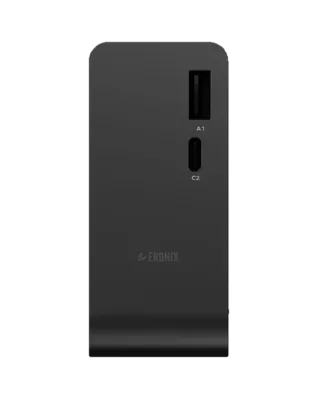
Two of the checks above, watt-hours and a clear charge reading, are the ones most labels skip. The Battery Pack for MacBook 140W states both: 20,000 mAh and 74 Wh, under the cabin limit, with a display to read its level before a trip.
Its 140 W output charges a MacBook Air or Pro at full speed, as well as an iPad or a phone.
Step by step
- Charge the power bank to about half before storing it.
- Keep it in a cool, dry place, away from sunlight and cars.
- Check the charge level every two or three months.
- Top it up to about half if it has dropped low.
- Charge it fully the night before you travel.
Questions people ask
How long can a power bank hold its charge?
Months, with gradual loss. Battery University puts lithium-ion self-discharge at about 5% in the first day, then 1% to 2% a month, plus about 3% a month for the protection circuit. In a cool place, a full pack still holds most of its charge after a few months; in heat, much less.
Should I store a power bank full or empty?
Neither. Store it at about half charge. Apple's battery guidance advises storing lithium-ion devices at about 50%, in a cool, dry place below 32 °C, because full storage ages the cell faster and empty storage risks deep discharge. Top it up every few months.
Is it bad to leave a power bank in a hot car?
Yes. Battery University notes self-discharge roughly doubles with each 10 °C rise, and heat also causes permanent capacity loss. Apple warns that temperatures above 35 °C can permanently reduce battery capacity. A parked car in an Indian summer gets far hotter than that, so keep power banks in a bag you carry.
Why will my old power bank not charge after months unused?
It may have discharged so far that its protection circuit has shut it down. Apple warns that deep discharge can leave a battery unable to hold a charge. Try charging it for a while with a known-good charger. If it stays dead, swells or gets hot, stop and dispose of it at an e-waste point.
Sources
- BU-802b: What does elevated self-discharge do? (Battery University) · accessed 22 Nov 2026
- BU-808: How to Prolong Lithium-based Batteries (Battery University) · accessed 22 Nov 2026
- Batteries: Maximizing Performance (Apple) · accessed 22 Nov 2026
- Why your power bank feels smaller than it should (Android Authority) · accessed 22 Nov 2026
- Power banks that don't live up to claimed capacity (CHOICE) · 20 Feb 2023, accessed 22 Nov 2026
Battery Management
Capacity is chemistry; longevity is software.
Read →Explainer · 4 min readInternational flights: power bank and charger rules
From Dubai to Tokyo to Singapore, the rules converged in 2026. Pack for the strictest leg.
Read →Explainer · 4 min readmAh vs Wh: reading a power bank honestly
Two power banks can both say 10,000 mAh and still hold different amounts of energy.
Read →Explainer · 4 min readLithium-ion vs lithium-polymer cells
Two names on power bank boxes, one chemistry inside. The real difference is the packaging.
Read →Explainer · 5 min readCan a 100 W charger damage your phone?
The watts on the brick are a ceiling, not a push. Heat is what your battery remembers.
Read →Explainer · 6 min readNew 14-inch MacBook Pro with M6: charger and cable guide
No charger in the box in India. Here is the wattage and the cable that unlock fast charge.
Read →