Journal · Explainer · 4 min read
mAh vs Wh: reading a power bank honestly
Two power banks can both say 10,000 mAh and still hold different amounts of energy.
ChargerLAB once reviewed a power bank sold as 10,000 mAh whose own label printed a rated capacity of 6,000 mAh. Both numbers were on the same product, and neither was a lie. If one power bank can carry two capacities, which one should you believe at the counter?
Short answerTrust watt-hours. mAh counts electric charge but says nothing about voltage, so it cannot be compared across devices. Wh measures energy and can. To convert, multiply mAh by the voltage and divide by 1,000. A 10,000 mAh bank at 3.7 V holds about 37 Wh. Airlines and battery rules use Wh, and so should you.
The numbers on a power bank label
Android Authority sets out the conversion: mAh times nominal voltage equals Wh, after dividing by 1,000. Its examples: 5,000 mAh at 3.7 V is 18.5 Wh, and 20,000 mAh at 3.6 V is 72 Wh. It gives typical nominal voltages of about 3.7 to 3.85 V for lithium-ion packs, about 3.6 V for lithium-ion phone batteries and up to about 3.9 V for newer silicon-carbon ones, and 11 to 16 V for laptops.
Voltage changes the answer. Two banks both labelled 10,000 mAh hold about 36 Wh at 3.6 V or 38.5 Wh at 3.85 V, a difference of about 7%. The ChargerLAB-reviewed bank listed 38.5 Wh, which matches 10,000 mAh at about 3.85 V.
The rated capacity line explains the 6,000 mAh. Many labels show two figures: the cell capacity at the cell's own voltage, and a rated capacity measured at the output, usually 5 V, after conversion losses. The output figure is always smaller. ChargerLAB measured 33.15 to 34.36 Wh actually discharged from that 38.5 Wh bank, 86 to 89%.
| Capacity | Voltage | Energy |
|---|---|---|
| 5,000 mAh | 3.7 V | 18.5 Wh |
| 5,000 mAh phone | About 3.85 V | About 19 Wh |
| 10,000 mAh | 3.6 V | About 36 Wh |
| 10,000 mAh | 3.85 V | 38.5 Wh |
| 20,000 mAh | 3.6 V | 72 Wh |
Source: Android Authority; ChargerLAB
Wh
Source: ChargerLAB capacity test
How mAh and Wh relate
Electrical energy is charge multiplied by voltage. mAh tells you how much charge flows; volts tell you how hard each bit of it pushes. A power bank boosts its cells' 3.7 V or so up to 5 V, 9 V or 20 V for your phone or laptop. Energy is conserved, minus losses, so as voltage goes up, the mAh available at that voltage goes down.
Picture buying rice by the number of bags, without being told the weight of each bag. Ten small bags and ten large bags are both ten bags. mAh is the bag count; volts are the bag size; Wh is the total weight on the scale. Only the scale reading lets you compare two shops fairly.
That is why a 5,000 mAh phone and a 5,000 mAh power bank are not equal. Both may sit near 3.7 to 3.9 V, but the bank must convert its energy twice, once up to the cable voltage and once down again inside the phone, losing some each time.
Why rules and airlines use Wh
IATA's passenger guidance sets lithium battery limits in watt-hours: spare batteries, which include power banks, up to 100 Wh in cabin baggage only; 100 to 160 Wh with airline approval and a limit of two; above 160 Wh not allowed as passenger baggage. A battery of 20,000 mAh at 3.6 V is 72 Wh and fits comfortably; around 27,000 mAh at the same voltage approaches the 100 Wh line.
Laptops show why mAh fails across categories. A laptop battery at 11 to 16 V can have fewer mAh than a phone and still hold several times the energy. Only Wh compares them honestly.
A worked example at the counter
Say a bank's label shows 20,000 mAh at 3.6 V. Multiply and divide: 20,000 times 3.6 is 72,000, divided by 1,000 is 72 Wh. Take 75% for losses and about 54 Wh should reach your phone.
Your phone holds 5,000 mAh at about 3.85 V, or roughly 19 Wh. Divide 54 by 19 and the honest answer is a little under three full charges, not the four the mAh figures suggest. CHOICE's tests point the same way: of 31 power banks it tested, not one delivered its advertised capacity.
What to check before you buy
Find the Wh figure. A clear Wh rating is a sign of an honest label and is needed at airport security.
If only mAh is shown, find the cell voltage, usually 3.6 to 3.85 V, and work out Wh yourself: mAh times volts divided by 1,000.
Look for the rated capacity line at 5 V. It is lower than the headline mAh and closer to what you will get.
Compare your phone in Wh too. A 5,000 mAh phone at about 3.85 V holds about 19 Wh. Divide the bank's usable Wh by that number for a realistic charge count.
Plan on about 75% of the bank's Wh reaching the phone, Android Authority's planning figure.
Myth corner
Myth: a bigger mAh number always means more energy. Fact: Wh depends on voltage too. Android Authority's formula shows that mAh at 3.6 V and mAh at 3.85 V are different amounts of energy, and a laptop battery with fewer mAh can hold far more Wh than a phone.
The right one for you
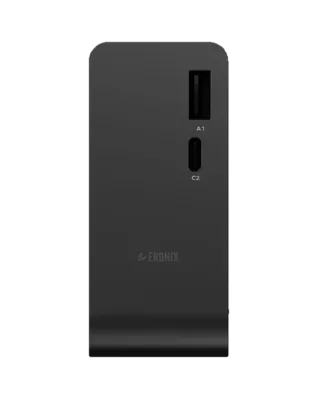
The honest label this article describes is one that prints watt-hours. The Battery Pack for MacBook 140W states both figures, 20,000 mAh and 74 Wh, under the 100 Wh cabin limit.
Its 140 W output and built-in display serve a MacBook Air or Pro, an iPad and a phone from one pack.
Step by step
- Find the cell capacity in mAh and the cell voltage on the label.
- Multiply mAh by volts and divide by 1,000 to get Wh.
- Check the rated capacity line at 5 V for a realistic figure.
- Multiply the Wh by 0.75 to estimate what reaches your phone.
- Confirm the Wh is under 100 before you fly.
Questions people ask
How many Wh is a 10,000 mAh power bank?
About 36 to 38.5 Wh, depending on cell voltage. Multiply 10,000 mAh by the nominal voltage, usually 3.6 to 3.85 V, and divide by 1,000. ChargerLAB's reviewed 10,000 mAh bank listed 38.5 Wh, consistent with a 3.85 V cell.
What does rated capacity mean on a power bank?
It is usually the capacity available at the output, often 5 V, after the bank's internal conversion losses. It is lower than the headline cell capacity. One bank reviewed by ChargerLAB was sold as 10,000 mAh and printed a rated capacity of 6,000 mAh on its label.
What is the maximum power bank size allowed on a plane?
IATA guidance allows power banks up to 100 Wh in cabin baggage without approval, and between 100 and 160 Wh with airline approval, up to two. Above 160 Wh is not allowed as passenger baggage. Power banks are never allowed in checked bags.
Is mAh or Wh better for comparing phone batteries?
Wh is more accurate, though mAh works between phones with similar voltages. Android Authority notes lithium-ion phone cells sit near 3.6 V while newer silicon-carbon cells reach about 3.9 V, so two phones with equal mAh can differ in energy by several percent.
Sources
- Android Authority: Why your power bank feels smaller than it should · accessed 22 Nov 2026
- ChargerLAB: Review of a 4-in-1 10000mAh power bank with built-in cables · accessed 22 Nov 2026
- IATA: Passenger lithium battery guidance · accessed 22 Nov 2026
- CHOICE: Power banks that don't live up to claimed capacity · 21 Feb 2023
Battery Management
Capacity is chemistry; longevity is software.
Read →Explainer · 4 min readDoes fast charging kill the battery?
The watts on the charger matter less than the temperature of the phone
Read →Explainer · 4 min readInternational flights: power bank and charger rules
From Dubai to Tokyo to Singapore, the rules converged in 2026. Pack for the strictest leg.
Read →Explainer · 5 min readCan a 100 W charger damage your phone?
The watts on the brick are a ceiling, not a push. Heat is what your battery remembers.
Read →Explainer · 6 min readNew 14-inch MacBook Pro with M6: charger and cable guide
No charger in the box in India. Here is the wattage and the cable that unlock fast charge.
Read →Explainer · 5 min readWhat to pack for a work trip: the charging and carry kit
One charger, two cables, one power bank: a kit built for the day, not the brochure.
Read →