Journal · Explainer · 4 min read
Does fast charging kill the battery?
The watts on the charger matter less than the temperature of the phone
Battery health reads 88 per cent after a year, and the first suspect is always the fast charger in the wall. One YouTube channel cycled 40 phones 500 times over 167 days to find out if it is guilty.
Short answerIn normal use, no. Phones fast-charge only while the battery is low and cool, then slow down sharply. The real wear comes from heat and long hours at 100 per cent. A 167-day test on 40 phones found fast charging added little extra wear. Keeping the phone cool protects the battery more than any charger choice.
What the tests and the chemistry show
Apple states that iPhone 15 and later batteries are designed to retain 80 per cent of their original capacity at 1,000 complete charge cycles under ideal conditions, up from 500 cycles for iPhone 14 and earlier. Those same phones fast-charge to about 50 per cent in around 30 minutes or less on Apple's own figures, so fast charging is built into the design, not an add-on.
That test came from the YouTube channel HTX Studio, reported by MacRumors and Hackaday in November 2025. Hackaday describes 40 iOS and Android phones taken through 500 cycles over 167 days, in fast-charging, slow-charging and 30 to 80 per cent groups, plus one control phone left alone. MacRumors summarised the result as minimal extra wear from fast charging and a small benefit from staying between 30 and 80 per cent. The exact capacity figures appear only in the video and its charts, not in a published table, so we do not quote them here.
Battery University, the long-running reference on battery chemistry, explains where the real stress lies. Charging lithium-ion above a rate of 1C, which means filling it in under an hour, shortens service life, and it suggests about 0.8C for longer life. It says charge current should be lowered once the battery reaches about 70 per cent. Its summary table lists 10 to 45 °C as the range for fast chargers, and it warns against fast charging a cold or hot battery; at low temperature, lithium metal can plate onto the electrode.
| Factor | Figure | Source |
|---|---|---|
| Fast-charge limit for long life | Above 1C shortens life; about 0.8C suggested | Battery University |
| When to lower current | From about 70 per cent | Battery University |
| Fast-charge temperature range | 10 to 45 °C | Battery University |
| iPhone 15 and later | 80% capacity at 1,000 cycles | Apple |
| iPhone 14 and earlier | 80% capacity at 500 cycles | Apple |
Source: Battery University; Apple Support
Charge cycles
Source: Apple Support
How a phone protects itself while fast charging
Phone makers design around those limits. ChargerLAB's measurements of the iPhone 15 Pro Max show the pattern clearly: about 26 W for the first 22 minutes, then steps down to 22 W, 15 W and 8.6 W as the battery fills. The fast part happens while the battery is empty and cool. The last 20 per cent always arrives slowly, whatever charger you use.
Think of it like a crowded train at rush hour. When the coach is empty, people pour in quickly. As it fills, boarding slows, because squeezing the last passengers in takes care. The battery's last 20 per cent is that crowded coach, and the phone's battery management controls the door.
Heat is the variable you control. Charging on a hot car dashboard, under a pillow, inside a thick case while gaming, or in direct sun all push the cell toward the conditions Battery University warns about. Most phones respond by pausing fast charging, which is why Apple notes it may not work when the phone is too hot or too cold.
What actually wears a battery
Time at high charge. A battery sitting at 100 per cent, warm, for hours every night, ages faster. That is why iPhones offer Optimised Battery Charging, and why many Android phones offer an adaptive or charge-limit mode.
Heat. Battery University links elevated temperature to faster growth of the solid electrolyte interphase, the internal film that slowly uses up capacity.
Deep discharges. Running to zero every day adds stress; topping up in the middle range is gentler.
Charger watts, on their own, are low on this list, because the phone decides how many it takes.
Cold matters too, though less often in India. Battery University warns that fast charging a very cold lithium-ion cell can plate lithium metal onto the electrode. If a phone has spent hours in a chilly car or an air-conditioned room set very low, let it warm up for a few minutes before plugging in a fast charger.
What to check before you buy
Choose a charger that uses the standard your phone supports, such as USB-C Power Delivery, or PPS for many Samsung phones. Standard protocols let the phone stay in control.
Avoid unmarked chargers with no output table. A charger that does not follow the standard cannot be trusted to respect the phone's requests.
Feel the charger and phone after 20 minutes of charging. Warm is normal; too hot to hold is a sign to stop and check the setup.
For overnight charging, a slower charger or a wireless pad is fine; speed does not matter while you sleep.
Myth corner
Myth: slow charging overnight is always best for battery health. Not if the phone sits at 100 per cent and warm for hours. Time at full charge and heat matter more than speed, which is why charge-limit and optimised-charging settings exist.
The right one for you
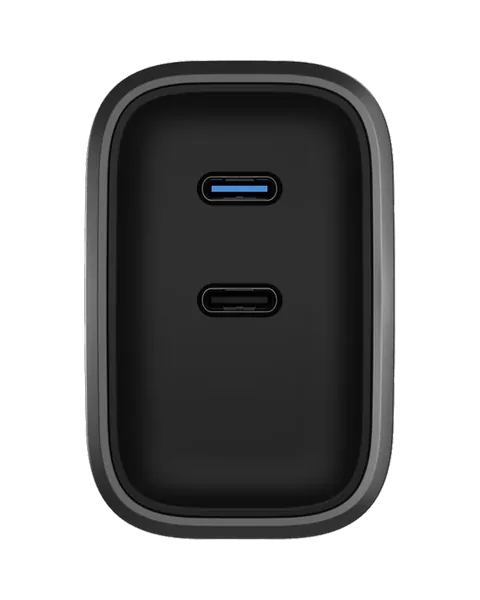
A charger that respects the battery is one that speaks the phone's standard and says so. Fermi45 publishes its full output: USB-C Power Delivery rails from 5 V to 20 V, PPS from 5 to 20 V at 3 A, and Samsung Super Fast Charging 2.0, with over-voltage, over-current, over-temperature and short-circuit protection.
It is made for the iPhone 17 series and the Galaxy phones that take 45 W, so either phone stays in charge of every watt it draws.
Step by step
- Charge with a charger that uses your phone's standard protocol.
- Keep the phone out of sun, cars and pillows while charging.
- Remove a thick case if the phone gets hot while fast charging.
- Turn on optimised or limited charging for overnight use.
- Top up in the middle range instead of running to zero.
Questions people ask
Is it bad to charge my phone to 100 per cent every night?
It is not harmful in the short term, but long hours at full charge, especially when warm, age a lithium-ion battery faster. Turning on Optimised Battery Charging on iPhone, or an adaptive or 85 per cent limit on Android, reduces that time at 100 per cent.
Does wireless charging damage batteries more than wired?
Wireless charging wastes more energy as heat, and heat is what wears batteries. In practice, phones throttle wireless charging when warm. If you charge wirelessly, remove thick cases and avoid warm places to keep temperatures down.
Can a 65 W charger damage a phone that supports only 25 W?
No, if the charger uses a standard such as USB-C Power Delivery. The phone requests only the power it can accept, so a 65 W charger behaves like a 25 W one for that phone. Unmarked chargers that ignore the standard are the risk.
At what battery health should I replace my iPhone battery?
Apple designs iPhone 15 and later batteries to keep 80 per cent capacity at 1,000 full cycles, and 500 cycles for earlier models. When maximum capacity falls well below 80 per cent, or the phone slows or shuts down unexpectedly, a battery service is worth considering.
Should I let my phone drop to 0 per cent before charging?
No. Lithium-ion batteries do not need full discharges. Battery University notes partial charges are fine, and frequent deep discharges add stress. Topping up whenever convenient is gentler on the battery.
Sources
- Apple Support: About the battery and performance of iPhone 11 and later · accessed 22 Nov 2026
- MacRumors: In-depth iPhone battery experiment pits slow charging against fast charging · 7 Nov 2025
- Hackaday: Testing whether fast charging kills smartphone batteries, and other myths · 10 Nov 2025
- Battery University: Ultra-fast chargers · 25 Oct 2021
- ChargerLAB: Charging review of iPhone 15 Pro Max · 29 Sep 2023
- Apple Support: Fast charge your iPhone · 22 Oct 2026
Battery Management
Capacity is chemistry; longevity is software.
Read →Explainer · 5 min readCan a 100 W charger damage your phone?
The watts on the brick are a ceiling, not a push. Heat is what your battery remembers.
Read →Buying guide · 4 min readWhich charger does the Galaxy S26 FE need?
Fifty-eight minutes or ninety-eight? Two reviews, one phone, and the charger in between.
Read →Explainer · 4 min readIs it safe to charge your phone overnight?
Your phone does not overcharge. It sits full for hours, and that is what to fix.
Read →Explainer · 5 min readShould you let the battery drain to 0%?
The monthly full drain is a habit from older batteries. Here is what the chemistry says.
Read →Explainer · 5 min readPPS: why Samsung phones care about it
Three letters on a charger label decide whether a Galaxy charges at full speed or half.
Read →