Journal · Explainer · 5 min read
PPS: why Samsung phones care about it
Three letters on a charger label decide whether a Galaxy charges at full speed or half.
Why would a 140 W laptop charger fill a Galaxy phone no faster than Samsung's own 25 W brick? In ChargerLAB's test of the Galaxy S24 Ultra, that is what happened. The big charger delivered about 22 W. The phone can take 45 W. The charger had power to spare, so watts were not the limit.
Short answerPPS, or Programmable Power Supply, is part of the USB Power Delivery standard. It lets the phone ask the charger for an exact voltage and current, adjusted in steps of 20 mV and 50 mA. Samsung builds Super fast charging on PPS. A charger without PPS still charges a Galaxy safely, only at a lower speed.
PPS in numbers: what ChargerLAB measured on a Galaxy
ChargerLAB put several chargers on a Galaxy S24 Ultra, a 45 W phone, and logged voltage and current. Samsung's 25 W adapter delivered about 20.6 W at 8.4 V and 2.45 A. Samsung's 45 W adapter reached about 41.6 W at 9.15 V and 4.54 A. Samsung's 65 W adapter gave about 44.5 W at 9.26 V and 4.80 A. A 140 W laptop charger managed about 22.4 W at 8.62 V and 2.59 A.
In ChargerLAB's wider compatibility test of the same phone, most chargers held about 9 V and delivered roughly 40 to 45 W. The 140 W laptop charger stayed the clear low result. ChargerLAB does not list which protocols it offered, so the test shows the outcome, not the cause.
Look at the Samsung voltages: 8.4 V, 9.15 V, 9.26 V. Samsung's own 45 W adapter page lists fixed levels of 5 V, 9 V, 15 V and 20 V, plus a separate PPS line. A reading such as 9.26 V sits between the fixed steps, which points to the phone steering the charger through PPS.
On Samsung's 65 W adapter, ChargerLAB recorded about 20 minutes to 50%, about 37 minutes to 80% and about 1 hour 18 minutes to full. Power of about 46 W lasted only the first 1 minute 19 seconds. It then stepped down to about 35 W, 31 W and 22 W as the battery filled.
Renesas, a maker of USB PD chips, describes the PPS range as 5 V to 21 V, set in 20 mV and 50 mA steps. Each charger publishes its own PPS window inside that range, so two adapters with the same headline watts can differ on this line.
| Charger | Voltage | Current | Power |
|---|---|---|---|
| Samsung 25 W adapter | 8.4 V | 2.45 A | 20.6 W |
| Samsung 45 W adapter | 9.15 V | 4.54 A | 41.6 W |
| Samsung 65 W adapter | 9.26 V | 4.80 A | 44.5 W |
| 140 W laptop charger | 8.62 V | 2.59 A | 22.4 W |
Source: ChargerLAB, Charging Review of Samsung S24 Ultra, May 2024
Power (W)
Source: ChargerLAB, Charging Review of Samsung S24 Ultra, May 2024
How PPS works: the charger takes on the phone's heat
A normal charger sends a fixed voltage, such as 9 V. The phone's internal circuit must then bring it down to what the battery wants at that moment. Renesas explains the cost: the gap between the supply voltage and the battery voltage is largely turned into heat, which lowers charging efficiency.
With PPS, the phone keeps asking for slightly different numbers as the battery fills, and the charger follows. Less conversion happens inside the slim phone, so less heat builds up there. Samsung's adapter page says Super Fast Charging 2.0 needs a phone that supports USB PD 3.0 and Direct Charging, its name for this approach.
Think of filling a glass from a tap. A fixed charger is a tap with a few set positions. You can fill the glass, but you splash. PPS is a tap you can turn a hair at a time, so the water arrives as fast as the glass can take it and no faster.
Samsung states the rule plainly on its Singapore support page: a charger with a high maximum output may still not give Super fast charging if it does not support PPS.
Which Samsung chargers and cables Samsung lists for each speed
Samsung's support table lists its 25 W adapter under Super fast charging, its 45 W, 50 W and 65 W adapters under Super fast charging 2.0, and its 60 W adapter under Super fast charging 3.0. Which level you get depends on the phone, not the charger alone.
Samsung rates its 45 W, 50 W and 65 W adapters with a 5 A cable, and its 60 W adapter with a 3 A cable. It adds that the Galaxy S25 and later reach Super fast charging 2.0 on the 3 A cable included in the box. On its multi-port 50 W and 65 W adapters, Super fast charging 2.0 works only on port 1, and not when two or more ports are in use.
What to check before you buy
Find the word PPS. It should be on the charger label or in the spec sheet, with a voltage range and a current. Samsung tells buyers to check the detailed specifications rather than trust the headline watts.
Read the amps on the PPS line. In ChargerLAB's test, a 45 W Galaxy drew about 4.5 to 4.8 A from Samsung's chargers. Spec pages are not always consistent, so if the PPS current is unclear, ask to test the charger on your phone.
Match the cable to the current. Renesas notes that a standard USB-C cable is rated for 3 A, and only cables identified for 5 A carry more. For a 45 W phone, a 5 A cable is the safe pick unless Samsung says the boxed cable is enough for your model.
On a multi-port charger, ask which port carries PPS and whether it holds when a second device is plugged in.
Test at the counter. On a Galaxy, the Fast charging switch under Settings, Battery, Charging settings must be on. The charging message on screen should change from plain charging to a fast charging message.
Myth corner
Myth: a bigger watt number always charges a Samsung faster. In ChargerLAB's test, a 140 W laptop charger gave the S24 Ultra about 22 W, close to the 20.6 W from Samsung's 25 W adapter. Samsung's 65 W adapter beat its 45 W adapter by only about 3 W. The phone sets the pace; the label only sets the ceiling.
The right one for you
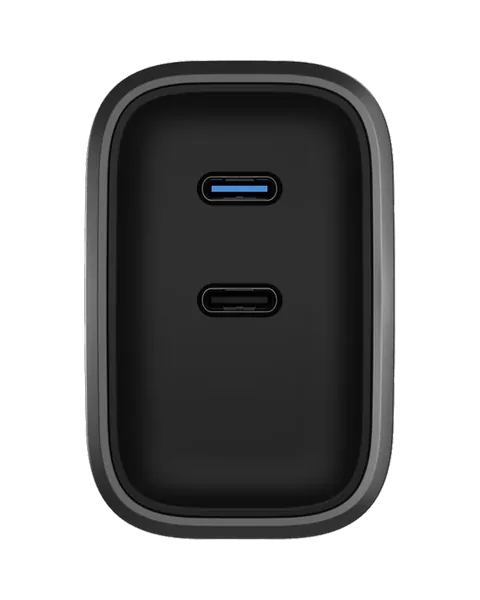
Everything above comes down to one line on the label. The Fermi45 carries it in full: PPS from 5 to 20 V with Samsung Super Fast Charging and Super Fast Charging 2.0, the mode a 45 W Galaxy uses for its top speed.
It is a 45 W GaN adapter with two USB-C ports, so the same plug also serves an iPhone 17.
Step by step
- Look up your phone's rated wired charging speed on the maker's spec page.
- Check the charger label for the word PPS and note its voltage range and current.
- Confirm the PPS current suits your phone: well above 3 A for a 45 W Galaxy, under 3 A for a 25 W one.
- Use a 5 A USB-C cable for 45 W class phones unless Samsung says the boxed cable is enough.
- Turn on Fast charging in Settings, Battery, Charging settings.
- On a multi-port charger, use the port marked for fast charging and charge one device at a time.
Questions people ask
Is PPS the same as USB Power Delivery?
PPS is a feature inside USB Power Delivery, added with version 3.0. Standard PD offers fixed levels such as 5 V, 9 V, 15 V and 20 V. PPS adds an adjustable mode in which the phone sets voltage in 20 mV steps and current in 50 mA steps. A charger can support USB PD without supporting PPS.
Will a charger without PPS damage my Samsung phone?
No. A standard USB-C PD charger still charges a Galaxy, only slower, because Super fast charging may not switch on. Samsung does warn that unapproved or counterfeit chargers can hinder charging and may cause battery issues over long use, so buy from a maker that publishes full specifications.
What is the difference between Super fast charging 2.0 and 3.0?
Samsung lists its 25 W adapter as Super fast charging, its 45 W, 50 W and 65 W adapters as Super fast charging 2.0, and its 60 W adapter as Super fast charging 3.0. The level you actually get depends on what the phone supports. A charger cannot push a phone past its own rated speed.
Do I need a 5 A cable for PPS charging?
Only for the higher power levels. Samsung rates its 45 W class adapters with a 5 A cable, because a 45 W Galaxy draws around 4.5 to 4.8 A. Samsung says the Galaxy S25 and later reach Super fast charging 2.0 with the 3 A cable in the box. A 25 W phone stays under 3 A.
Does PPS help battery health?
PPS moves much of the voltage conversion out of the phone and into the charger, which Renesas says cuts heating and conversion loss. Battery University names heat as one of the main causes of lithium-ion ageing. Less heat in the phone helps, though no published test isolates PPS alone as extending battery life.
Sources
- ChargerLAB: Charging Review of Samsung S24 Ultra · 9 May 2024
- ChargerLAB: 45W Compatibility Test of Samsung Galaxy S24 Ultra · 5 Aug 2024
- Samsung Singapore Support: How to enable Fast charging and Fast wireless charging on your Samsung Galaxy phone · 22 Nov 2026
- Samsung Ireland: 45W Super Fast Charger 2.0 (EP-T4511) specifications · 22 Nov 2026
- Renesas Engineer School: USB Power Delivery 02 - Fast Role Swap and Programmable Power Supply · 22 Nov 2026
- Battery University: BU-808 How to Prolong Lithium-based Batteries · 22 Nov 2026
- Samsung US Support: Wall chargers and charging your Samsung phone or tablet · 22 Nov 2026
PPS — Programmable Power Supply
Power Delivery, with a fine-adjustment dial.
Read →Buying guide · 4 min readWhich charger does the Galaxy S26 Ultra need?
Sixty watts on the box. Here is what it takes to get it.
Read →Buying guide · 1 min readChoosing a USB-C charger: a short, honest checklist
Five checks that outlast any marketing cycle.
Read →Buying guide · 5 min readWhich charger does the iPhone 18 Pro need?
Half a battery in 15 minutes, but only if your charger speaks one new word: AVS.
Read →Buying guide · 5 min readWhich charger does the Galaxy S26 need?
Three phones, three speeds, one protocol called PPS. Here is what to buy and what to skip.
Read →Buying guide · 4 min readWhich charger does the Galaxy S26+ need?
Samsung promises 69 percent in about 30 minutes. One word on the label decides it.
Read →