Journal · Explainer · 5 min read
GaN chargers: what changed and what did not
A new material shrank the charger. Your phone's charging speed stayed where it was.
A 65 W laptop charger used to be a brick with a cable at both ends. Today the same power fits in something closer to a matchbox that plugs straight into the wall. What happened inside, and does it change anything for your phone?
Short answerGaN, or gallium nitride, is a semiconductor material that switches power faster and with lower losses than silicon. That lets designers use smaller parts, so GaN chargers are smaller and, above about 30 W, slightly more efficient. GaN does not make your phone charge faster. The phone and the charging standard, usually USB-C Power Delivery, set the speed.
GaN vs silicon: the measured differences
The International Energy Agency's 4E Power Electronic Conversion Technology Annex measured GaN and silicon USB-C chargers side by side in a January 2024 report. At 30 W, both types ran at around 90 per cent efficiency, and the roughly 1 per cent gap was within measurement error. At 60 W, the GaN chargers averaged 92 per cent against 90 per cent for silicon. One 60 W GaN unit lost about 1.4 W less as heat than its silicon rival.
The same report found GaN chargers offered up to twice the power density of silicon ones, on average, by volume and weight. In its detailed comparison, one GaN design reached about 0.98 kW per cubic decimetre, nearly double the 0.39 of both silicon designs, while the other GaN design reached 0.48, only about a quarter higher. So the gain varies a lot by design. The report also noted an important detail: GaN chargers are not all GaN. Both units it took apart combined GaN switches with ordinary silicon rectifiers and transistors.
The material itself explains why. IEEE Spectrum lists GaN's bandgap at 3.40 eV against 1.12 eV for silicon, and notes that GaN power converters run at hundreds of kilohertz, while silicon designs typically sit around 100 kHz. Early GaN converters exceeded 92 per cent efficiency, according to the same article, and GaN has been the incumbent in phone, tablet and laptop chargers in the 25 to 500 W range since about 2019.
| Measure | GaN | Silicon |
|---|---|---|
| Efficiency at 30 W | About 90% | About 90% |
| Efficiency at 60 W | 92% average | 90% average |
| Power density, kW per dm³ | 0.48 to 0.98 | 0.39 |
| Bandgap | 3.40 eV | 1.12 eV |
| Switching speed | Hundreds of kHz | About 100 kHz |
Source: IEA 4E PECTA, Jan 2024; IEEE Spectrum, Mar 2023
kW per dm³
Source: IEA 4E PECTA, Jan 2024
How GaN shrinks a charger
Every wall charger works by chopping high-voltage DC into very fast pulses, passing them through a small transformer and smoothing the result. The faster you can switch, the smaller the transformer and capacitors can be, because each pulse carries less energy.
Think of it like carrying water in buckets. If you can make many quick trips, small buckets are enough. If every trip is slow, you need big buckets to move the same amount. GaN transistors make quicker trips with less spillage, so the buckets, the transformer and capacitors, get smaller.
A wider bandgap also means the transistor tolerates high voltage in a smaller chip and wastes less energy each time it switches. Less waste means less heat, and less heat means the charger can be packed tighter.
What did not change
Charging speed. A phone asks for a voltage and current through the charging protocol. A 30 W GaN charger and a 30 W silicon charger offer the same menu, and the phone picks the same item from it.
Safety rules. A GaN charger still needs the same protections against over-voltage, over-current and over-temperature, and the same safety testing. Android Authority's explainer stresses that GaN describes the material, while Power Delivery is the charging specification; a charger can be one without the other.
Heat at full load. Smaller chargers have less surface to shed heat. Tom's Hardware tested 20 USB-C chargers in June 2026 and found most ran at 89 to 93 per cent efficiency, but each 140 W model it tested had dropped well below its rating after 30 minutes of sustained load, to between 88 W and 118 W, with peak surface temperatures of about 67 to 76 °C. Its test did not separate GaN from silicon designs.
Standby use also stayed small. Tom's Hardware measured about 0.3 W at idle for chargers without screens and about 1 W for models with displays, so leaving a charger in the socket costs very little either way.
What to check before you buy
Read the output table, not the GaN badge. Make sure it lists the voltages your devices use, such as 9 V for phones and 20 V for laptops, under USB-C PD.
On a multi-port charger, check how power splits when two devices are connected. The total figure is often shared, not available to each port.
Feel the size against the wattage. A tiny 100 W charger is possible with GaN, but it may throttle under long, heavy loads.
Look for the maker's safety markings printed on the body, along with the input rating of 100-240 V. A charger with a blank, unmarked casing is a poor bet, GaN or not.
Match the watts to your heaviest device. A phone-only user gains little from a 100 W charger; a laptop user does.
Myth corner
Myth: a GaN charger charges your phone faster. It does not on its own. The IEA's measurements show the difference is in efficiency and size, with roughly equal efficiency at 30 W. A phone that accepts 25 W takes 25 W from either type.
The right one for you
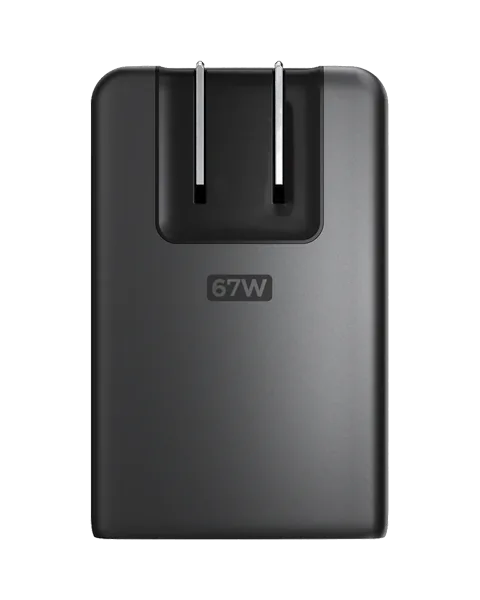
The matchbox in this story exists. Entropy67 is a GaN charger that delivers 67 W from a single port at 20 V and 3.35 A, in a body 14 mm thin, and it states the split for two devices: 45 + 20 W or 35 + 30 W.
It is one charger for an iPhone 18 Pro and a MacBook Air, with its full output table on the pack.
Step by step
- Note the highest wattage your devices accept.
- Choose a charger whose USB-C PD output covers that wattage and voltage.
- Check how power splits across ports on a multi-port model.
- Look for safety markings and the input rating on the charger body.
- Give the charger some air when running a laptop at full load.
Questions people ask
Is a GaN charger safe for iPhone and Samsung phones?
Yes, if it is a properly made USB-C Power Delivery charger with the usual protections and safety markings. GaN is only the switching material. The phone still negotiates the voltage and current it accepts, so a GaN charger delivers power the same way a silicon one does.
Do GaN chargers run cooler?
They waste a little less energy above about 30 W, according to the IEA 4E report, which measured 92 against 90 per cent average efficiency at 60 W. But because they are smaller, their surface can still get hot under heavy load. Tom's Hardware measured 67 to 76 °C on 140 W units.
Are all GaN chargers USB-C PD chargers?
No. GaN is a material and USB-C Power Delivery is a charging standard. Android Authority notes that GaN chargers can be PD chargers, but not all are, and not every PD charger uses GaN. Check the output table for PD voltages.
Why are GaN chargers more expensive?
GaN transistors and the faster controllers that drive them have cost more than mature silicon parts, and compact designs need careful thermal engineering. Android Authority expected prices to fall as production scaled, and GaN is now common across the 25 to 500 W range.
Is a GaN charger worth it for a phone only?
Mainly for size. At around 30 W, the IEA measured GaN and silicon chargers at similar efficiency. If you also charge a laptop, the size and efficiency gains of GaN become more noticeable at 60 W and above.
Sources
- IEA 4E PECTA: Energy efficiency measurement of wide bandgap-based power supplies · Jan 2024
- IEEE Spectrum: Gallium nitride and silicon carbide fight for green tech domination · 26 Mar 2023
- Android Authority: What is a GaN charger · 23 May 2023
- Tom's Hardware: We tested 20 wall chargers from 15 W to 140 W · 11 Jun 2026
GaN — Gallium Nitride
The semiconductor that let chargers shrink.
Read →Buying guide · 1 min readHow much power does your laptop actually need?
Reading watts like a spec sheet, not a horoscope.
Read →Explainer · 4 min readHotel room charging: making one socket work
One socket behind the bed, three devices, a 7 am meeting. Here is the plan.
Read →Explainer · 5 min readCan a 100 W charger damage your phone?
The watts on the brick are a ceiling, not a push. Heat is what your battery remembers.
Read →Buying guide · 5 min readWhich charger does your MacBook Pro 14-inch (M6 or M5 Pro/Max) need?
Three adapters, one laptop size. Here is the wattage the machine actually asks for.
Read →Comparison · 5 min read65 W vs 100 W for a laptop: which one do you need?
A 100 W charger has 54 percent more power. Whether you feel it depends on one number.
Read →