Journal · Explainer · 4 min read
Office desks in India: one charging setup for a whole team
Ten desks, twenty-three chargers, nobody can find a cable. There is a simpler standard.
Count the chargers in your office. Most teams find two or three per person: a laptop brick, a phone adapter, something for earbuds, and a pile of cables that belong to nobody. Every afternoon someone walks across the floor to borrow one. Is there a single setup that works for every desk?
Short answerYes. Standardise on USB-C and USB Power Delivery. Give each desk one USB PD charger sized to the team's largest laptop, typically 65 W to 100 W, one 100 W rated USB-C cable for the laptop, one shorter cable for the phone, and a labelled pouch so the kit can travel. Every device then charges from the same plug.
Sizing the charger: the numbers
Apple's support page listing Mac power adapters is a useful benchmark for any mixed office. It lists 30 W to 70 W adapters for the MacBook Air from 2022, 67 W to 96 W for the 14-inch MacBook Pro, and 140 W for the 16-inch MacBook Pro. Apple also says a USB-C Mac can charge from any USB-C adapter, higher or lower in wattage, but that the best experience comes from at least the minimum recommended wattage.
Phones need much less. Apple's fast-charging page lists 20 W or higher adapters for its lighter iPhones, and 40 W to 60 W-capable adapters for its Pro models. Earbud cases need only a few watts.
USB PD makes sharing safe. The USB Implementers Forum describes how each device negotiates only the power it needs, up to 100 W at 20 V and 5 A, or 240 W under PD 3.1. A 100 W charger on a desk with a 14-inch laptop and a phone simply shares out what each requests.
The wall side matters too. The IS 1293 standard behind common Indian sockets rates the small three-pin socket at 6 A at 250 V and the larger one at 16 A. A row of USB PD chargers is a light load; heaters, kettles and printers on the same strip are not.
| Device | Recommended adapter |
|---|---|
| MacBook Air (2022 and later) | 30 W to 70 W |
| 14-inch MacBook Pro | 67 W to 96 W |
| 16-inch MacBook Pro | 140 W |
| Lighter iPhones | 20 W or higher |
| iPhone Pro models | 40 W to 60 W capable |
Source: Apple Support, Mac power adapters and Fast charge your iPhone, accessed 22 Nov 2026
How a shared standard works in practice
The idea is the same one that made office printers easy: one standard, one spare in the cupboard. When every desk uses USB PD, a new joiner's laptop, a visiting client's phone and the meeting-room speaker all charge from the kit already on the desk.
Think of it like standard tea cups in the pantry. Nobody owns them, every cup fits every saucer, and a broken one is replaced from the same shelf. Mixed proprietary chargers are a pantry full of mismatched saucers.
The weak point is usually the cable. The USB-IF explains that 100 W charging relies on USB-C cables rated for 5 A. A 60 W cable on a 96 W laptop will hold it back. Buy one cable rating for laptops and label it.
A standard kit for each desk
One multi-port USB PD charger. For teams on MacBook Air or light Windows laptops, 65 W is enough. For 14-inch MacBook Pro or heavier laptops, 100 W. For 16-inch MacBook Pro users, 140 W or more.
One 100 W rated USB-C to USB-C cable, about 2 metres, for the laptop. One shorter cable for the phone. One USB-C to Lightning cable only if older iPhones are still in use.
A small cable pouch or desk tray, labelled with the desk number, so the kit goes into a bag for meetings and comes back.
A surge-protected strip with a printed joule rating and its own switch, mounted under the desk, kept for chargers and monitors only.
Meeting rooms and hot desks
Meeting rooms need one shared kit at the table: a multi-port USB PD charger of at least 100 W and two long USB-C cables, fixed in a grommet or tray so they stay put. Label it for the room.
For hot desks, keep the kit on the desk, not with the person. Each employee carries only a short phone cable in a pouch. The rule is simple: the desk has the laptop power, the bag has the phone cable.
What to check before you buy
List the laptops in your team and note the largest recommended adapter wattage. Size every desk's charger to that.
Check the charger's per-port split, not just its total. A 100 W charger may give only 65 W to the laptop port when a phone is also plugged in.
Buy laptop cables rated 100 W, or 240 W for 140 W laptops, and mark them so they do not wander.
Check the extension strip's rating and keep kettles, heaters and printers off it.
Keep two spare kits in the admin cupboard for new joiners and visitors.
Myth corner
Myth: a bigger charger wears out a phone faster. Under USB PD, the phone asks for its own level and receives only that. Apple explicitly says a USB-C Mac can charge from an adapter of higher or lower wattage than recommended. The charger's size sets the ceiling, not the flow.
The right one for you
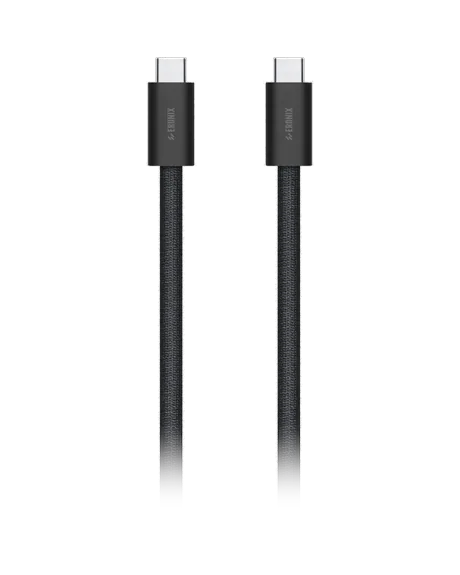
Size each desk to its largest laptop and give it a cable that will not hold it back. The Entropy100 gives 100 W from its main USB-C port, above the 96 W Apple lists for the 14-inch MacBook Pro, with a second USB-C port at 30 W for the phone and a USB-A port at 22.5 W for older accessories. The Power Cable 240 W adds the 2 m reach the desk kit calls for, braided and e-marked for full laptop power.
Step by step
- List every laptop model in the team and its recommended adapter wattage.
- Pick one multi-port USB PD charger sized to the largest of them.
- Add a 100 W rated USB-C cable for laptops and a short cable for phones to each kit.
- Label each kit with the desk number and give it a pouch.
- Keep two spare kits for new joiners and visitors.
Questions people ask
What wattage charger should an office desk have?
Size it to the team's largest laptop. Apple recommends 30 W to 70 W for recent MacBook Air models, 67 W to 96 W for the 14-inch MacBook Pro and 140 W for the 16-inch. For most mixed teams, a 65 W or 100 W USB PD charger per desk covers laptop and phone.
Can one USB-C charger safely charge a laptop and a phone together?
Yes, with USB Power Delivery. Each device negotiates its own power level, and a multi-port charger splits its output between ports. Check the per-port figures on the label so the laptop port still gets enough when the phone is connected.
Why is a laptop charging slowly on a shared desk charger?
Usually the cable or the port split. A 60 W cable caps current below what a 96 W laptop wants, and a multi-port charger may reduce the laptop port when other devices are connected. Use a 100 W rated cable and the charger's highest-output port.
Is it safe to plug many chargers into one extension board?
A row of phone and laptop chargers is a light load. The risk comes from adding kettles, heaters or printers. Keep the strip within its printed rating, use an earthed three-pin socket, avoid chaining strips together and replace any strip that feels warm.
Should an office standardise on USB-C?
For most teams, yes. Phones, tablets, laptops and accessories increasingly charge over USB-C with USB Power Delivery, and the EU's common charger rule extended USB-C to laptops from April 2026. One standard means fewer chargers, fewer spares and less borrowing.
Sources
- Find the right power adapter and cable for your Mac notebook, Apple Support · accessed 22 Nov 2026
- Fast charge your iPhone, Apple Support · accessed 22 Nov 2026
- USB Charger (USB Power Delivery), USB Implementers Forum · accessed 22 Nov 2026
- AC power plugs and sockets (IS 1293 ratings), Wikipedia · accessed 22 Nov 2026
USB-C Power Delivery
One connector, a negotiated contract.
Read →Explainer · 4 min readHotel room charging: making one socket work
One socket behind the bed, three devices, a 7 am meeting. Here is the plan.
Read →Buying guide · 5 min readWhich charger does your MacBook Pro 14-inch (M6 or M5 Pro/Max) need?
Three adapters, one laptop size. Here is the wattage the machine actually asks for.
Read →Explainer · 4 min readUSB PD 3.1 EPR and 240 W, explained
Same USB-C plug, more than twice the power. The trick is voltage, not a thicker wire.
Read →Buying guide · 4 min readOne charger for phone, tablet and laptop: how many watts?
Add up what each device takes, then decide how patient you are. That is the calculation.
Read →Explainer · 4 min readCable management for a clean desk
A tidy desk starts by removing cables, not hiding them. Then a few rules keep it safe.
Read →