Journal · Explainer · 4 min read
USB PD 3.1 EPR and 240 W, explained
Same USB-C plug, more than twice the power. The trick is voltage, not a thicker wire.
For years, the ceiling for USB-C was 100 W. That was enough for most laptops, but not for big gaming machines or a 16-inch workstation, which kept their bulky barrel-plug bricks. Then cables started appearing with 240 W printed on them. How does the same small plug carry more than twice the power?
Short answerUSB PD 3.1 adds an Extended Power Range (EPR) with fixed voltages of 28 V, 36 V and 48 V at up to 5 A, lifting USB-C from 100 W to 240 W. The charger, the device and a 240 W e-marked cable must all support it. Miss any one and charging stays at 100 W or below.
The voltages and watts in USB PD 3.1
The USB Promoter Group announced USB PD Revision 3.1 on 26 May 2021. Its announcement states that the previous limit was 100 W, reached with 20 V on 5 A cables. The existing fixed voltages, 5, 9, 15 and 20 V, now form what is called the Standard Power Range.
EPR adds three new fixed voltages. Per the announcement, 28 V is used above 100 W, 36 V above 140 W and 48 V above 180 W. At 5 A, those voltages give 140 W, 180 W and 240 W. It also adds an adjustable mode, called AVS, which can be set anywhere from 15 V up to the maximum allowed for the charger's rating, in steps of 100 mV.
Granite River Labs, a USB test laboratory, notes in its technical summary that EPR cables must be built for 50 V and 5 A, with a minimum working voltage of 53.65 V. It also notes the tiers are strict: products under 140 W cannot offer 36 V or 48 V, and products under 180 W cannot offer 48 V.
Apple's 140 W adapter for the 16-inch MacBook Pro, launched in October 2021, was the first Apple adapter built on USB PD 3.1, according to MacRumors. Since standard USB-C stops at 100 W, anything above that needs EPR.
| Range | Fixed voltage | Maximum power at 5 A |
|---|---|---|
| Standard Power Range | 5, 9, 15, 20 V | 100 W |
| Extended Power Range | 28 V | 140 W |
| Extended Power Range | 36 V | 180 W |
| Extended Power Range | 48 V | 240 W |
| EPR adjustable (AVS) | 15 V up to the rated maximum, 100 mV steps | Up to the charger's rating |
Source: USB Promoter Group, May 2021; Granite River Labs
Power (W)
Source: USB Promoter Group, May 2021
How EPR raises power without a thicker cable
Power is voltage multiplied by current. The size of the wire limits current, because current makes heat in the wire. USB-C cables were already rated for 5 A, so the only way to go further was to raise the voltage.
Think of a water pipe of fixed width. You cannot push more water through by widening it, so you raise the pressure instead. The pipe carries more in the same time, but only if it was built to take the higher pressure. That is why EPR cables have a higher voltage rating and a new e-marker chip.
EPR is also careful by design. Granite River Labs describes the sequence: the device must ask to enter EPR, and the charger must check that both the device and the cable report EPR support. Only then does the voltage rise above 20 V. Plugable's explainer adds that the device must send a keep-alive message about every half second. If the charger does not hear one within about a second, it resets the link and drops back to 5 V standard power.
Who actually needs 240 W
Phones do not. The phones covered on this Journal draw well under 100 W. Most tablets and thin laptops sit between 30 and 100 W.
EPR matters for large laptops, mobile workstations, gaming laptops and some monitors or docks that pass power through. Plugable's explainer points to gaming laptops and all-in-one machines as the main beneficiaries.
A 240 W cable is still useful to own. It works at every lower level, so one cable can serve a phone today and a big laptop tomorrow.
What to check before you buy
Find the 240 W mark on the cable. The USB-IF introduced approved cable logos showing 60 W or 240 W in October 2021, reported Tom's Hardware. Plugable notes that EPR cables must be visibly marked.
Check your laptop's input, not just its charger. If the laptop's original adapter is 100 W or less, an EPR charger will not make it faster.
Read the charger's output label for 28 V, 36 V or 48 V. A charger rated 140 W should list 28 V at 5 A. Without an EPR voltage, it cannot exceed 100 W from one port. Look for USB PD 3.1 EPR named on the charger itself.
On multi-port chargers, check the single-port figure. A 240 W total spread across four ports may never give 240 W to one device.
Keep old 100 W cables for 100 W jobs. They remain safe; the charger simply will not enter EPR through them.
Myth corner
Myth: plugging a phone into a 240 W charger sends 48 V into it. Fact: EPR can only start when the device asks for it, and the charger must confirm the cable can handle it. A phone that does not ask for EPR stays at its normal 5 to 20 V.
The right one for you
Going past 100 W takes an EPR charger and an EPR cable together. The Entropy140 is built on USB PD 3.1 EPR and delivers 140 W, the level the 16-inch MacBook Pro charges at full speed, with two more ports for a phone and a watch.
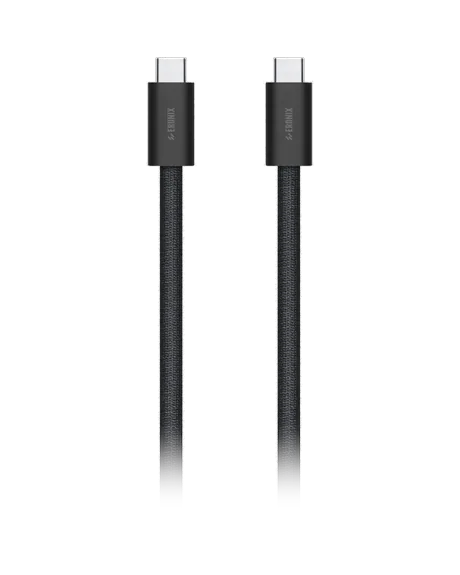
The Power Cable 240 W completes the chain: USB-C to USB-C, rated 240 W EPR, with the e-marker the charger checks before it raises the voltage. It runs 2 m, braided and bend-tested to 10,000 bends, and it works at every lower level too.
Step by step
- Check your device's maximum charging input in watts.
- If it is above 100 W, choose a charger that lists 28 V, 36 V or 48 V on its USB-C output.
- Use a cable marked 240 W.
- On multi-port chargers, plug the high-power device into the port rated for it and confirm the single-port figure.
Questions people ask
Can I use a 240 W cable with a 20 W phone charger?
Yes. A 240 W cable works at every lower power level. The charger and phone agree on the power, and the cable simply carries it. The only drawback is that 240 W cables can be thicker and stiffer than a basic 60 W cable.
What is the difference between a 100 W and a 240 W USB-C cable?
Both are rated for 5 A. The 240 W cable is built and e-marked for up to 50 V, so it can carry EPR voltages of 28, 36 and 48 V. A 100 W cable is limited to 20 V. A charger will not enter EPR unless it detects an EPR-capable cable.
What is AVS in USB PD 3.1?
AVS, Adjustable Voltage Supply, lets a device ask for any voltage from 15 V up to the charger's limit, in 100 mV steps. It works like a high-power cousin of PPS, but per Granite River Labs it does not support current-limit operation, which PPS does.
Is 48 V on USB-C safe?
The standard is built to make it safe. Granite River Labs describes the checks: the device must request EPR, the charger must confirm the cable is EPR-rated, and a keep-alive message must arrive regularly. If anything fails, the charger resets and falls back to standard power.
Does my MacBook need a 240 W charger?
No. Apple's 16-inch MacBook Pro shipped with a 140 W adapter, which uses USB PD 3.1, per MacRumors. Smaller MacBooks use adapters of 100 W or less. A higher-rated charger is safe but will not charge faster than the laptop is designed to accept.
Sources
- USB Promoter Group announces USB Power Delivery Specification Revision 3.1 (USB-IF) · 26 May 2021
- USB Power Delivery Specification 3.1 (Granite River Labs technical blog) · 14 Sep 2021
- What is 240W USB Extended Power Range (EPR)? (Plugable) · accessed 22 Nov 2026
- Teardown of 140W MacBook Pro Power Adapter Shows What's Inside (MacRumors) · 29 Oct 2021
- New USB Logos Show Charging Capabilities Up to 240W (Tom's Hardware) · 1 Oct 2021
USB-C Power Delivery
One connector, a negotiated contract.
Read →Buying guide · 5 min readWhich charger does the iPhone 18 Pro need?
Half a battery in 15 minutes, but only if your charger speaks one new word: AVS.
Read →Buying guide · 4 min readWhich charger does your MacBook Pro 16-inch (M5 Pro or M5 Max) need?
The one MacBook where a 100 W charger works but never fast-charges.
Read →Explainer · 4 min readHotel room charging: making one socket work
One socket behind the bed, three devices, a 7 am meeting. Here is the plan.
Read →Explainer · 5 min readUSB Power Delivery explained in one page
How a charger and a phone agree on power before it flows, and how to read the label.
Read →Buying guide · 5 min readWhich charger does your MacBook Pro 14-inch (M6 or M5 Pro/Max) need?
Three adapters, one laptop size. Here is the wattage the machine actually asks for.
Read →