Journal · Explainer · 4 min read
How to store a power bank you rarely use
The emergency power bank is only useful if it still works on the day of the emergency.
Most homes in India have one: a power bank bought for a trip, then pushed to the back of a drawer for the next power cut or the next journey. When that day comes, will it hold a charge, or will it refuse to wake up at all?
Short answerStore it at about half charge, somewhere cool and dry, away from sunlight and the kitchen. Never store it full and never let it sit empty. Every three months, top it back up to around half and check for swelling. Stored this way, a power bank keeps most of its capacity through a year in the drawer.
What a year in a drawer does to capacity
Battery University, the long-running battery chemistry reference, publishes estimates of how much capacity lithium-ion keeps after a year of storage. At 25 °C, a typical Indian indoor temperature for much of the year, a cell stored at 40% charge keeps about 96% of its capacity. The same cell stored at 100% keeps only about 80%.
Heat makes the gap wider. At 40 °C, a cell at 40% keeps about 85%, while one at 100% keeps about 65%. At 0 °C the losses shrink to 98% and 94%. Battery University recommends about 15 °C for storage and notes that most chemistries tolerate a range from minus 40 °C to 50 °C, but 50 °C is a limit, not a target.
The danger at the other end is deep discharge. Battery University warns that lithium-ion must not sit below 2 V per cell for any length of time, and advises discarding cells kept below 2.00 V per cell for more than a week, because copper shunts can form inside, raising self-discharge or causing a partial short.
| Storage temperature | Stored at 40% | Stored at 100% |
|---|---|---|
| 0 °C | 98% | 94% |
| 25 °C | 96% | 80% |
| 40 °C | 85% | 65% |
Source: Battery University, BU-702
Capacity kept (%)
Stored at 40% Stored at 100%
Source: Battery University, BU-702
Why half charge is the sweet spot
A lithium-ion cell is under the most chemical stress when it is full. At high voltage, the electrolyte slowly reacts with the electrodes, and that reaction is what eats capacity in storage. Battery University notes there is virtually no self-discharge below about 4.0 V per cell at 20 °C, and that around 3.7 V gives long life. A cell at 40% sits at about 3.82 V.
An empty cell has the opposite problem. The power bank's own circuits and natural self-discharge slowly pull it lower, and if it drifts far enough, the protection circuit shuts it down or the cell itself is damaged.
Think of a car tyre stored for winter. Over-inflate it and the rubber stays stretched for months; leave it flat and it deforms under its own weight. Moderate pressure keeps it in shape. Half charge is the moderate pressure of batteries.
Where to keep it at home
Choose an inside drawer or cupboard away from exterior walls and windows. A shelf in direct afternoon sun can run far above room temperature.
Avoid the kitchen, the top of the fridge, the car glovebox and anywhere near a geyser or inverter battery. Heat and humidity are the two enemies.
Keep it away from metal objects such as keys and coins, and put it in a pouch or its box, so nothing presses its buttons or ports.
How to bring it to half charge
Most power banks show four LEDs, each worth about a quarter. Two lit LEDs, or a display reading near 50%, is the target. You do not need precision: Battery University says hitting exactly 40 or 50 percent is not that important.
If it is full after a trip, use it to charge your phone once or twice until two LEDs remain. If it is nearly empty, charge it for a short while and stop at two LEDs. Either way takes minutes, not hours.
Phones follow the same logic. Google's Pixel battery page advises keeping a phone at least 50% charged if you will store it for more than 30 days. The chemistry inside a phone and a power bank is the same family, so the same rule of moderation applies.
What to check before you buy
Look for a clear charge-level display, either percentage or four LEDs. It makes the half-charge rule easy to follow.
Check that the rated capacity in watt-hours is printed on the case, not just mAh. It helps when you travel and tells you what you actually own.
Choose a model with a firm, flat case and no gaps at the seams, so you can spot swelling early.
Ask about the warranty period and keep the GST invoice. A power bank that fails after months in a drawer is easier to claim with proof of purchase.
Myth corner
Myth: an emergency power bank should always be kept full, ready for use. Full storage is what ages it fastest. Battery University's figures show a cell stored at 100% at 25 °C losing about a fifth of its capacity in a year, against about 4% at 40%. Store at half, and charge it fully the day before you need it.
The one habit that matters
Put a reminder in your phone every three months: check the power bank, top it to half, look for swelling. Five minutes a season keeps it ready.
The right one for you
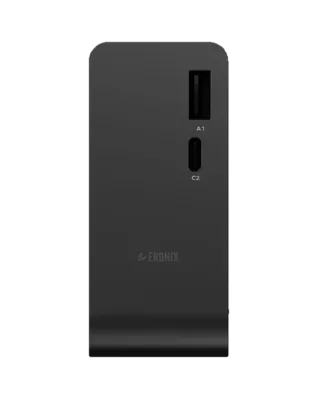
The half-charge rule is easiest with a pack that shows its level. The ERONIX Battery Pack for MacBook 140W has a display and holds 20,000 mAh, stated as 74 Wh and cabin-safe, for the day the drawer becomes a trip. Its 140 W output charges a MacBook Air or Pro as well as an iPad or a phone, so one stored pack covers a power cut for the whole desk.
Step by step
- Charge or discharge the power bank to about half.
- Store it in a pouch in a cool, dry, shaded drawer, away from metal objects.
- Set a three-month reminder to check the level and top it back to half.
- Inspect the case for swelling or heat each time; retire it if you see either.
- Charge it fully the day before a trip or expected power cut.
Questions people ask
Should I store a power bank fully charged?
No. Battery University estimates that lithium-ion stored at 100% and 25 °C keeps about 80% of its capacity after a year, while one stored at 40% keeps about 96%. Store it near half, and charge it fully shortly before you need it.
How often should I charge a power bank I do not use?
Check it every two to three months. If the level has dropped well below half, top it back up to about half. This prevents it from drifting into deep discharge, which Battery University warns can permanently damage lithium-ion cells.
My power bank will not turn on after months in storage. What now?
Connect it to a charger and leave it for a while; some packs wake slowly from a protective sleep. If it does not respond, or gets warm, stops charging or looks swollen, stop using it. Battery University advises discarding cells that have sat below 2 V per cell for over a week.
Is it safe to keep a power bank in a hot room or car?
Heat speeds up capacity loss and is a safety risk. Battery University's figures show heavy losses at 40 °C, and a parked car in an Indian summer can get much hotter. Keep power banks indoors in a cool drawer, never in the glovebox.
How do I dispose of an old power bank?
Do not put it in household waste. Take it to an e-waste collection point or a brand's take-back programme. Tape over its ports first. Never pierce, crush or burn a lithium-ion pack.
Sources
- Battery University: BU-702 How to Store Batteries · accessed 22 Nov 2026
- Google Pixel Help: Battery health (storage at least 50% for over 30 days) · accessed 22 Nov 2026
Battery Management
Capacity is chemistry; longevity is software.
Read →Explainer · 4 min readDoes fast charging kill the battery?
The watts on the charger matter less than the temperature of the phone
Read →Explainer · 4 min readLithium-ion vs lithium-polymer cells
Two names on power bank boxes, one chemistry inside. The real difference is the packaging.
Read →Explainer · 5 min readCan a 100 W charger damage your phone?
The watts on the brick are a ceiling, not a push. Heat is what your battery remembers.
Read →Explainer · 4 min readIs it safe to charge your phone overnight?
Your phone does not overcharge. It sits full for hours, and that is what to fix.
Read →Explainer · 5 min readShould you let the battery drain to 0%?
The monthly full drain is a habit from older batteries. Here is what the chemistry says.
Read →