Journal · Explainer · 5 min read
Why the EU and India moved to USB-C
One port, one protocol, one drawer of cables fewer. The long story of the common charger.
Open any drawer in an Indian home and you will find the history of charging: a round-pin Nokia charger, a micro-USB cable, a Lightning cable, a laptop brick with its own odd tip. For two decades, every new device meant a new plug. Why did that stop, and why did it stop in Brussels first?
Short answerThe European Union passed Directive (EU) 2022/2380, which makes USB-C the common charging port and USB Power Delivery the common fast-charging protocol for phones, tablets, earbuds, cameras and other small devices from 2024, and for laptops from 28 April 2026. India is following the same USB-C route, so one charger and cable can serve most devices.
The timeline, date by date
The European Parliament's legislative record sets out the path. The European Commission tabled its proposal on 23 September 2021. Parliament and Council reached a provisional agreement on 7 June 2022. Parliament adopted it on 4 October 2022 and Council on 24 October 2022. The act was signed on 23 November 2022 and published as Directive (EU) 2022/2380, amending the Radio Equipment Directive of 2014.
EUR-Lex, the EU's official law database, records publication on 7 December 2022 and entry into force on 27 December 2022. Parliament's record says member states had until 28 December 2023 to write it into national law, and the rules applied to devices a year after that. Laptops received a later deadline: 28 April 2026.
The covered list is broad. It names mobile phones, tablets, e-readers, earbuds, digital cameras, headphones and headsets, handheld video game consoles and portable speakers that charge over a cable. Laptops follow on their own date.
| Date | Step |
|---|---|
| 23 Sep 2021 | Commission proposal |
| 7 Jun 2022 | Provisional agreement |
| 4 Oct 2022 | Adopted by Parliament |
| 24 Oct 2022 | Adopted by Council |
| 7 Dec 2022 | Published as Directive (EU) 2022/2380 |
| 27 Dec 2022 | Entry into force |
| 28 Apr 2026 | Applies to laptops |
Source: European Parliament Legislative Train; EUR-Lex
What the law actually requires
Three requirements do most of the work. First, a USB-C port on the device. Second, for devices that support fast charging, a common fast-charging protocol, USB Power Delivery, so that any compliant charger can fast-charge any compliant device. Third, a choice at the shop: devices can be sold with or without a charger, and a pictogram must show which.
A label must also state the device's charging capability and which chargers are compatible, so a buyer can tell whether a charger at home is strong enough. The Commission must also request common standards for wireless charging within two years of adoption, and keep reviewing whether more devices should be added.
None of this bans faster proprietary systems inside a device. What it bans is a world where only the maker's charger works.
How a common port and protocol work together
The port alone was never enough. USB-C is a 24-pin reversible connector, first published by the USB Implementers Forum in August 2014. The power conversation that rides on it is USB Power Delivery. The USB-IF describes how PD lets a device negotiate only the power it needs, and how PD 3.1 in 2021 raised the ceiling from 100 W to 240 W by adding 28 V, 36 V and 48 V levels.
That is why the law names both. A common plug with incompatible protocols would still leave phones charging slowly on each other's chargers. A common protocol over a common plug means a 65 W laptop charger, a phone and a pair of earbuds can share one brick, each drawing what it can take.
Think of it like standard railway gauge. A single track width let any carriage run on any line; India's own decades-long project to convert metre-gauge lines to broad gauge shows how much friction mismatched standards cause. USB-C is the track. USB PD is the timetable that tells each train how fast it may go.
Why governments cared: waste, cost and choice
The stated reasons are practical. Old chargers become waste the moment a new device needs a different one. Buyers pay again for a charger they already own. And a proprietary port locks a household to one brand's accessories.
Unbundling addresses the first two. If you already have a good USB PD charger, you can skip the new one in the box. The pictogram makes that choice visible at the counter rather than after opening the box.
India's path to USB-C
India has chosen to follow the same technical route rather than invent a local plug. The work runs through the Bureau of Indian Standards and the Department of Consumer Affairs, which issue the standards and the dates that apply to each device type. A shared international standard lets manufacturers build one design for both markets, so check their current notices for the exact Indian timetable.
For Indian buyers this means the same thing it means in Europe: the USB-C cable that charges a phone also fits the tablet, the earbuds case, the camera and, increasingly, the laptop. The detail that matters is the protocol. A charger with USB PD is the one that will fast-charge across brands.
What to check before you buy
Look for USB PD on any new charger. A USB-C plug with only a brand's own fast-charge system may still charge other devices, but slowly.
Match the charger to your largest device. A phone may need 20 W to 60 W; a laptop may need 65 W or more. One charger sized for the laptop can usually serve all three.
Check the cable rating. Many USB-C cables are rated for 60 W; laptops above that need a 100 W or 240 W cable.
Keep your existing USB PD charger when you upgrade. If a device box offers no charger, that is the common-charger rule working as intended.
Myth corner
Myth: the EU rule forced every device to charge at the same speed. It did not. It requires a common port and, for fast-charging devices, a common protocol. A phone can still charge faster or slower than another; what changed is that a compliant charger from one brand can fast-charge a compliant device from another.
The right one for you
The common-charger rules reward one USB PD charger sized for your largest device. The Entropy140 supports USB PD 3.1 EPR, the revision that lifted the ceiling past 100 W, with 140 W for a MacBook Pro 16 and two more ports for the phone and earbuds, in an aluminium-clad body.
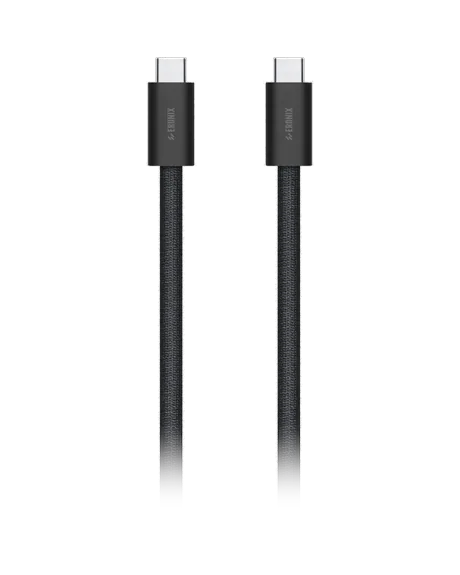
Pair it with the Power Cable 240 W, e-marked and rated 240 W EPR, so the cable never sets the limit.
Step by step
- Check that your current charger supports USB PD.
- Note the wattage of your largest device and pick a charger that covers it.
- Choose a cable rated for that wattage: 60 W for phones, 100 W or 240 W for laptops.
- When buying a new device, look for the pictogram showing whether a charger is included.
- Skip the boxed charger if your existing USB PD charger already meets the label's charging capability.
Questions people ask
When did USB-C become mandatory in the EU?
Directive (EU) 2022/2380 entered into force on 27 December 2022. Member states had to transpose it by 28 December 2023, and it applied to phones and other small devices a year later, at the end of 2024. Laptops followed on 28 April 2026.
Which devices does the EU common charger rule cover?
The European Parliament lists mobile phones, tablets, e-readers, earbuds, digital cameras, headphones and headsets, handheld video game consoles and portable speakers that charge over a cable. Laptops are covered on a later timetable, from 28 April 2026.
Does the EU rule mean phones come without chargers?
It means buyers must be offered the choice. Devices can be sold with or without a charger, and a pictogram on the packaging must show which. A label must also state the device's charging capability so you can check an existing charger.
Is USB-C mandatory in India?
India is following the same USB-C route through the Bureau of Indian Standards and the Department of Consumer Affairs. The dates that apply to each device type are set in their official notices, so check the latest ones before relying on a deadline. In practice, most new phones sold in India already use USB-C.
Does the common charger rule cover wireless charging?
Not directly. The law fixes the wired port and the fast-charging protocol. It asked the European Commission to consider common wireless charging standards within two years of adoption, which is a separate step from the USB-C requirement.
Sources
- Common chargers for mobile phones and similar devices, European Parliament Legislative Train · accessed 22 Nov 2026
- Directive (EU) 2022/2380, EUR-Lex · accessed 22 Nov 2026
- USB Charger (USB Power Delivery), USB Implementers Forum · accessed 22 Nov 2026
- USB-C, Wikipedia (connector history and pin count) · accessed 22 Nov 2026
USB-C Power Delivery
One connector, a negotiated contract.
Read →Explainer · 4 min readUSB PD 3.1 EPR and 240 W, explained
Same USB-C plug, more than twice the power. The trick is voltage, not a thicker wire.
Read →Explainer · 6 min readNew 14-inch MacBook Pro with M6: charger and cable guide
No charger in the box in India. Here is the wattage and the cable that unlock fast charge.
Read →Explainer · 4 min readHotel room charging: making one socket work
One socket behind the bed, three devices, a 7 am meeting. Here is the plan.
Read →Buying guide · 4 min readWhich charger does your MacBook Pro 16-inch (M5 Pro or M5 Max) need?
The one MacBook where a 100 W charger works but never fast-charges.
Read →Explainer · 4 min readWhat an e-marker chip does inside a USB-C cable
Two cables look identical. A tiny chip in the plug decides if your laptop fast-charges.
Read →