Journal · Comparison · 4 min read
10,000 vs 20,000 mAh power banks: which should you carry?
Double the mAh gives about double the charges, and double the weight in your bag.
A 20,000 mAh power bank sounds like it should fill a 5,000 mAh phone four times. Australia's consumer group CHOICE tested 31 power banks and found that none delivered its claimed capacity. So how many charges do you really get from each size, and is the bigger one worth carrying?
Short answerPlan on about 60 to 75% of the printed capacity reaching your phone. That makes a 10,000 mAh bank worth about 1.5 charges of a 5,000 mAh phone, and a 20,000 mAh bank about 3. Both sit under the 100 Wh cabin limit. Carry 10,000 mAh daily; take 20,000 mAh for travel days or several devices.
The one number that decides it: watt-hours
mAh alone is misleading because it ignores voltage. Android Authority gives the conversion: multiply mAh by the cell's nominal voltage and divide by 1,000. A 20,000 mAh bank at 3.6 V holds 72 Wh. A 10,000 mAh bank at about 3.7 V holds roughly 37 Wh. ChargerLAB's review of a 10,000 mAh bank lists 38.5 Wh, which matches a cell near 3.85 V.
Phones are measured the same way. A 5,000 mAh phone battery at around 3.85 V holds about 19 Wh. That number, the phone's watt-hours against the bank's usable watt-hours, decides how many charges you get.
Watt-hours also decide whether you can fly. IATA's passenger guidance allows spare lithium batteries up to 100 Wh in cabin baggage only, never in checked bags. Both a 37 Wh and a 72 Wh bank qualify. Between 100 and 160 Wh, airline approval is needed.
| Measure | 10,000 mAh | 20,000 mAh |
|---|---|---|
| Energy | About 37 Wh | About 72 Wh |
| Reaching the phone at 75% | About 28 Wh | About 54 Wh |
| Charges of a 5,000 mAh phone | About 1.5 | About 3 |
| Cabin baggage (100 Wh limit) | Yes | Yes |
Source: Android Authority; IATA passenger lithium battery guidance
Wh
Stored Reaching the phone
Source: Android Authority conversion and 75% planning figure
How much actually reaches the phone
Power banks lose energy converting the cell's 3.6 to 3.85 V up to the 5 V, 9 V or more that a phone asks for, and the phone loses more converting it back down to charge its own battery. Android Authority puts good end-to-end setups at roughly 85 to 90% and cheaper ones in the 70s or lower, and suggests planning on about 75% of rated capacity.
Lab results back the range. ChargerLAB measured 33.15 to 34.36 Wh out of a 38.5 Wh bank, 86 to 89% at the bank's output, before the phone's own losses. CHOICE's rule of thumb is that a 10,000 mAh bank may give only 6,000 to 7,000 mAh in real use.
So, using 75%: a 10,000 mAh bank delivers around 28 Wh, enough for about 1.5 charges of a 19 Wh phone. Android Authority reaches the same answer, calling it a charge and a half or thereabouts. A 20,000 mAh bank delivers around 54 Wh, close to 3 charges. For a 4,000 mAh phone, such as the base Galaxy S25, add roughly a quarter more.
The trade-off in your bag
Think of the two sizes as a water bottle and a water can. The bottle fits a pocket and covers the day. The can sees you through a long trip but needs a bag and a spare hand. Neither is better; they do different jobs.
The bigger bank also takes longer to refill. ChargerLAB recorded 4 hours 23 minutes to fully recharge a 10,000 mAh bank from its built-in plug. A 20,000 mAh bank needs about twice the energy, so fast input charging matters more at that size.
Carrying either size on Indian flights
Both sizes fly, but only in the cabin. Business Today reported in January 2026 that India's DGCA has banned passengers from using power banks to charge phones or other gadgets during flights, including through seat power outlets, under a dangerous goods circular issued in November 2025.
The same report says power banks must travel in hand baggage and should not go in overhead bins, where a fire is harder to spot. In practice, that means a bank that lives in the bag at your feet, switched off, and a phone charged before boarding. For a long journey, the larger bank earns its place at the gate and in the hotel, not in the air.
What to check before you buy
Find the Wh figure on the label. If it is missing, multiply mAh by the stated cell voltage and divide by 1,000, then plan on about 75% reaching your phone.
For flights, check that the Wh rating is printed clearly. Security staff use it to apply the 100 Wh rule, and a bank with no rating can be refused.
Check the output protocols. A bank with USB PD for iPhone or PPS for Samsung charges much faster than a plain 5 V bank.
Check input speed, especially on 20,000 mAh banks. A higher USB-C input rating means fewer hours tethered to the wall.
Match the size to your longest day unplugged. One day of heavy use suits 10,000 mAh; two or three days, or several devices, suit 20,000 mAh.
Myth corner
Myth: a 20,000 mAh bank charges a 5,000 mAh phone four times. Fact: voltage conversion and heat take a share. With Android Authority's 75% planning figure, the real answer is closer to three, and CHOICE has yet to find a bank that matches its printed capacity.
The right one for you
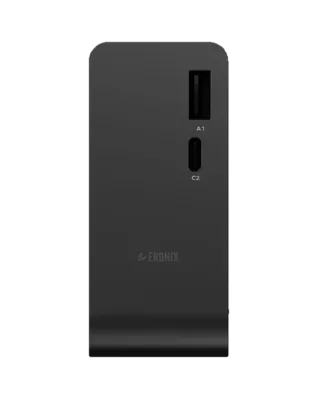
For the everyday carry this guide recommends, Levitate holds 10,000 mAh, with a 30 W USB-C port and Qi2.2 magnetic charging at up to 25 W on iPhone 17 and later. Made for iPhone 12 and later, it has a kickstand that holds the phone upright while it charges.
For travel days with a laptop in the bag, the Battery Pack for MacBook 140W holds 20,000 mAh, rated 74 Wh, under the 100 Wh cabin limit. Its 140 W output serves a MacBook Air or Pro as well as a phone.
Step by step
- Find the power bank's Wh rating, or multiply mAh by cell voltage and divide by 1,000.
- Multiply by 0.75 to estimate the energy that reaches your phone.
- Divide by your phone's battery Wh to get the number of charges.
- Check that the bank is under 100 Wh if you will fly.
- Choose a bank with fast USB-C input if it is 20,000 mAh or larger.
Questions people ask
Is a 20,000 mAh power bank allowed on flights in India?
Under IATA's guidance, yes in cabin baggage, because a typical 20,000 mAh bank is about 72 Wh, below the 100 Wh limit. It is not allowed in checked bags. India's DGCA has also banned using power banks to charge devices during flights, so keep it switched off on board.
How many times can a 10,000 mAh power bank charge an iPhone?
Divide the bank's usable energy by the iPhone's battery energy. At about 75% efficiency, a 10,000 mAh bank delivers around 28 Wh. A phone with a 4,000 to 5,000 mAh battery holds roughly 15 to 19 Wh, so expect about 1.5 to 2 charges.
Why does my power bank give fewer charges than advertised?
The mAh figure is for the internal cells at about 3.7 V, but phones charge at 5 V or more. Converting voltage, cable losses and the phone's own charging circuit all turn some energy into heat. Android Authority suggests planning on about 75% of rated capacity.
How long does a 20,000 mAh power bank take to charge?
It depends on its input wattage. ChargerLAB measured 4 hours 23 minutes for a 10,000 mAh bank charging from its built-in plug, and a 20,000 mAh bank holds about twice the energy. Banks with fast USB-C input can refill much faster with a matching wall charger.
Sources
- Android Authority: Why your power bank feels smaller than it should · accessed 22 Nov 2026
- CHOICE: Power banks that don't live up to claimed capacity · 21 Feb 2023
- ChargerLAB: Review of a 4-in-1 10000mAh power bank with built-in cables · accessed 22 Nov 2026
- IATA: Passenger lithium battery guidance · accessed 22 Nov 2026
- Samsung NZ: Galaxy S25 specifications · accessed 22 Nov 2026
- Business Today: Airlines told to tighten fire safety as DGCA bans inflight charging · 4 Jan 2026
Battery Management
Capacity is chemistry; longevity is software.
Read →Comparison · 5 min read65 W vs 100 W for a laptop: which one do you need?
A 100 W charger has 54 percent more power. Whether you feel it depends on one number.
Read →Buying guide · 5 min readWhat size power bank do you need for a full phone charge?
Why a 10,000 mAh power bank never gives two full charges, and how to size one honestly
Read →Buying guide · 4 min readCan a power bank charge a MacBook? What to check
Two numbers decide it: output watts for speed, watt-hours for how much you get
Read →Explainer · 4 min readRoad-trip power planning
Maps, music, two phones and a dashcam. How to arrive with more charge than you left with.
Read →Explainer · 5 min readCan a 100 W charger damage your phone?
The watts on the brick are a ceiling, not a push. Heat is what your battery remembers.
Read →