Journal · Explainer · 5 min read
AVS and USB PD 3.2: what is new
A phone asked a power bank for 18 V. Here is the rule that made it possible.
In October 2026, ChargerLAB connected an iPhone 18 Pro Max to a power bank and saw the pair settle on 18 V at 3 A. That voltage is not one of USB Power Delivery's fixed steps. The rule that allows it is called AVS, and its phone-sized version arrived with USB PD 3.2.
Short answerAVS, adjustable voltage supply, lets a device ask a charger for any voltage in 100 mV steps instead of a few fixed ones. USB PD 3.1 introduced it at 15 to 48 V for laptops. USB PD 3.2 extends it down to 9 to 20 V, up to 100 W, for phones and tablets.
AVS by the numbers: volts, steps and watts
Classic USB PD offers fixed steps. Texas Instruments' design note lists 5, 9, 15 and 20 V in the Standard Power Range, up to 100 W. Extended Power Range, added in PD 3.1, brought fixed steps at 28, 36 and 48 V and a ceiling of 240 W, according to the USB Promoter Group's announcement.
Alongside those, PD 3.1 added an adjustable mode. The USB-IF describes it as letting a device request any voltage from 15 V up to the charger's highest fixed voltage, and the USB Promoter Group's announcement sets the step at 100 mV. This is EPR AVS, and it is built for laptops.
PD 3.2 brings the same idea to smaller devices. ChargerLAB and Granite River Labs, a test lab, both describe SPR AVS as running from 9 to 20 V in 100 mV steps, within 27 to 100 W. Granite River Labs adds a tier: 9 to 15 V for chargers up to 45 W, and 9 to 20 V above 45 W.
For comparison, ChargerLAB gives the older PPS mode as 5 to 20 V in 20 mV steps, with 50 mA current steps. Tom's Hardware gives PPS as 3.3 to 21 V. The two describe the same mode with different boundaries.
| Mode | Voltage | Step | Power or use |
|---|---|---|---|
| SPR fixed | 5, 9, 15, 20 V | Fixed | Up to 100 W |
| EPR fixed (PD 3.1) | 28, 36, 48 V | Fixed | Up to 240 W |
| PPS | 5 to 20 V | 20 mV, 50 mA | Phones, direct battery charging |
| EPR AVS (PD 3.1) | 15 V to top fixed step | 100 mV | Laptops |
| SPR AVS (PD 3.2) | 9 to 20 V | 100 mV | 27 to 100 W |
Source: Texas Instruments; USB Promoter Group; ChargerLAB; Granite River Labs
Where the sources disagree
The sources do not agree on the dates or the scope of PD 3.2. ChargerLAB and Granite River Labs' iPhone article date SPR AVS to the October 2024 update. Granite River Labs' technical blog dates PD 3.2 version 1.0 to October 2023 and names version 1.1 as current in April 2025. Tom's Hardware goes further and says PD 3.2 did not change the electrical standards at all, describing it as a terminology release.
Granite River Labs also reads the specification as requiring every charger above 27 W to support SPR AVS. ChargerLAB's summaries do not mention that requirement, and the full specification sits behind the USB-IF document library. Until that is settled, treat AVS as a feature to look for on the label, not one to assume.
Which devices use AVS today
On the laptop side, ChargerLAB lists Apple's 140 W adapter, the one Apple ships with the 16-inch MacBook Pro, as supporting AVS from 15 to 28 V.
On the phone side, the picture moved quickly. ChargerLAB's launch coverage in September 2025 paired Apple's 40 W Dynamic Power Adapter, which Granite River Labs lists at 60 W maximum, with PD 3.2 AVS. A month later, ChargerLAB read the iPhone 17 Pro's charging curve as a sign that the phone did not yet use SPR AVS, and noted Apple could add it by software update. By October 2026, ChargerLAB's test of the iPhone 18 Pro Max saw it trigger an 18 V, 3 A AVS profile and charge at about 52 W.
AVS versus PPS: who does the fine-tuning
PPS and AVS are both programmable, but they split the work differently. Texas Instruments explains that with PPS the voltage keeps changing as the battery fills, and the phone can use it to charge the battery directly, bypassing its own charger circuit. That is why PPS needs fine 20 mV steps.
AVS holds a steady supply voltage, and the device's own charging circuit does the final adjustment. ChargerLAB argues that the 20 mV steps of PPS are often lost anyway to cable loss and ripple, and that PPS designs can lose power sharply at low voltages. AVS uses coarser 100 mV steps and is designed to avoid that drop. ChargerLAB does not publish test data for either point.
Think of a geyser. With PPS, the phone sets the tank temperature degree by degree. With AVS, the geyser delivers water at a steady temperature the phone has chosen, and the phone's own mixer tap does the last adjustment.
What to check before you buy
Read the output label for the word AVS and a voltage range, such as 9 to 20 V or 15 to 28 V. If the label lists only fixed steps and PPS, the charger does not offer AVS.
Check what your phone or laptop actually uses. The iPhone 17 and iPhone 18 Pro Max examples show that support depends on the device and its software, not only the charger.
Match the cable to the power. SPR AVS stays within 100 W, so a 3 A cable covers up to 60 W at 20 V, and above that you need a 5 A cable. EPR AVS above 100 W needs an EPR cable rated for 240 W.
Expect backward compatibility. An AVS charger still offers the standard fixed steps, so older devices charge normally on it. They simply do not use the adjustable range.
Myth corner
Belief: AVS is just PPS with a new name. Tested: Texas Instruments and ChargerLAB describe different designs, with PPS using 20 mV steps to drive the battery directly and AVS using 100 mV steps as a steady input to the device's own charger. A charger can support one, both or neither, so read the label for each.
The right one for you
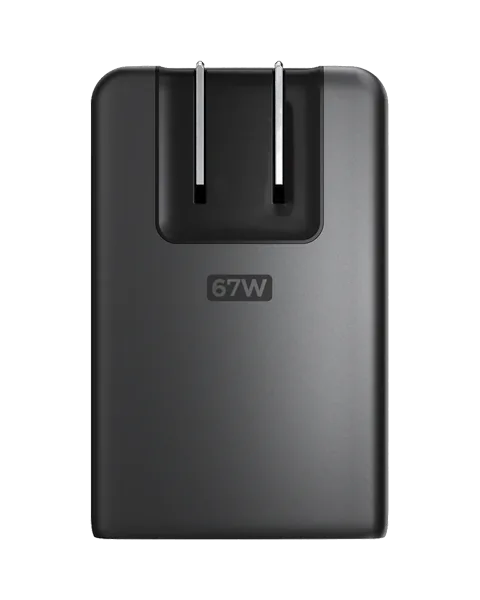
The label check above is the whole test, and the Entropy67 passes it in print: PPS and AVS from 5 to 20 V at up to 3.35 A.
That range takes in the 18 V, 3 A profile in ChargerLAB's test, and the adapter is matched to the iPhone 18 Pro and the MacBook Air, with 67 W from a single port.
It does this in a body 14 mm thin.
Step by step
- Read the charger's output label for the word AVS and its voltage range.
- Check whether your phone or laptop supports AVS on the maker's spec page.
- Use a 5 A cable for anything above 60 W, and an EPR cable above 100 W.
- Plug in and, if you have a USB tester, confirm an AVS contract is negotiated.
Questions people ask
Do I need an AVS charger for my phone?
Only if your phone uses AVS and you want its top speed. ChargerLAB measured an iPhone 18 Pro Max charging at about 52 W on an 18 V, 3 A AVS profile. On a charger without AVS, a USB PD phone still charges on the standard fixed steps, usually more slowly.
Is AVS the same as Extended Power Range?
No. EPR is the power range above 100 W, up to 240 W, with fixed steps at 28, 36 and 48 V. AVS is a way of requesting voltage in 100 mV steps. PD 3.1 used AVS inside EPR at 15 to 48 V, and PD 3.2 adds an SPR version at 9 to 20 V.
Will an AVS charger work with older devices?
Yes. An AVS charger still advertises the standard USB PD fixed voltages, such as 5, 9, 15 and 20 V, so older phones, tablets and laptops negotiate one of those as usual. They charge normally but do not use the adjustable range.
How can I tell if a charger supports USB PD 3.2 AVS?
Look at the output label and spec sheet for AVS and a voltage range, such as 9 to 20 V. ChargerLAB notes that its POWER-Z KM003C tester can detect PD 3.2 and SPR AVS after a firmware update. If only fixed voltages and PPS are listed, AVS is not offered.
Is AVS safer than PPS?
ChargerLAB argues that AVS is the safer design, because it avoids the sharp power drop some PPS chargers show at low voltage, and that its 100 mV steps are more practical than 20 mV steps lost to cable drop. ChargerLAB gives no test data for these points, so treat them as an engineering argument, not a measurement.
Sources
- iPhone 18 Pro Max AVS Compatibility Test, ChargerLAB · 10 Oct 2026
- AVS Protocol Explained: The Standard Making Fast Charging Faster and Safer, ChargerLAB · 21 Oct 2025
- Complete PD 3.2 SPR AVS Specification, ChargerLAB · 17 Sep 2025
- AVS tag archive (incl. Apple iPhone 17 Series Debuts With 40W Dynamic Power Adapter and PD 3.2 AVS Fast Charging, 2025-09-15), ChargerLAB · accessed 22 Nov 2026
- USB PD Spec 3.2, Granite River Labs · 29 May 2025
- SPR AVS and iPhone 17, Granite River Labs · 14 Oct 2025
- USB Type-C and USB Power Delivery: Designing for both EPR and battery-powered systems (SSZTD49A), Texas Instruments · Oct 2024
- USB PD 3.1 DevUpdate Announcement, USB Promoter Group · 26 May 2021
- USB Charger (USB Power Delivery), USB-IF · accessed 22 Nov 2026
- The USB Power Delivery (PD) Specification: everything you need to know, Tom's Hardware · 20 Dec 2025
PPS — Programmable Power Supply
Power Delivery, with a fine-adjustment dial.
Read →Buying guide · 4 min readWhich charger does the Galaxy S26 Ultra need?
Sixty watts on the box. Here is what it takes to get it.
Read →Buying guide · 5 min readWhich charger does the iPhone 18 Pro need?
Half a battery in 15 minutes, but only if your charger speaks one new word: AVS.
Read →Explainer · 5 min readPPS: why Samsung phones care about it
Three letters on a charger label decide whether a Galaxy charges at full speed or half.
Read →Buying guide · 5 min readWhich charger does the Galaxy S26 need?
Three phones, three speeds, one protocol called PPS. Here is what to buy and what to skip.
Read →Buying guide · 4 min readWhich charger does the Galaxy S26+ need?
Samsung promises 69 percent in about 30 minutes. One word on the label decides it.
Read →