Journal · Explainer · 4 min read
Battery health percentage: what it measures
The number in Settings is not a grade for your habits. It is a ruler held against day one.
A friend shows you her phone: battery health 84%. Yours says 91%. Is hers broken? Should she replace the battery, change how she charges, or ignore it? And what is that number measuring in the first place?
Short answerBattery health compares how much energy your battery can hold now with what it held when new. At 84%, a full charge holds roughly 84% of the original amount, so the phone runs out sooner. It falls slowly with cycles, heat and time. Apple and Google both build their battery-life targets around keeping 80%.
What Apple and Google publish
Apple's iPhone battery page calls the number Maximum Capacity and defines it as the battery's capacity relative to when it was new. It notes that a brand-new iPhone can show slightly under 100% depending on how long it sat between manufacture and activation. Apple designs iPhone 14 and earlier batteries to keep 80% of original capacity at 500 complete charge cycles, and iPhone 15 and later at 1,000 cycles, under ideal conditions.
Google's Pixel battery health page estimates remaining capacity against new and shows a status. Normal means capacity is within normal limits; Reduced means it has fallen below 80%. Google rates Pixel 3 to Pixel 8 Pro for about 800 cycles and Pixel 8a and later for about 1,000 cycles while keeping at least 80% capacity.
Google defines a cycle the same way most makers do: a full discharge and recharge, counting partial ones. Using 100% down to 50% and recharging counts as half a cycle.
The two makers present it differently. iPhone shows an exact percentage. Pixel 8a and later show a status rather than a figure, and Google says Pixel 6a to 8 Pro do not show the status at all. So a missing number on an Android phone does not mean a missing battery check; it may simply be presented as Normal or Reduced.
| Phone | Rated cycles | Capacity kept |
|---|---|---|
| iPhone 14 and earlier | 500 | 80% |
| iPhone 15 and later | 1,000 | 80% |
| Pixel 3 to Pixel 8 Pro | About 800 | At least 80% |
| Pixel 8a and later | About 1,000 | At least 80% |
Source: Apple Support; Google Pixel Help
Charge cycles
Source: Apple Support; Google Pixel Help
How the phone measures it
The phone cannot open the battery and count its lithium. Instead, a fuel-gauge chip tracks how much charge flows in and out, and watches how the battery's voltage responds. Over many charges, it learns how much charge actually fits between empty and full, and compares that with the design figure.
That is why the number is an estimate and why it moves in steps. Google notes that initial values come from lab results and may differ from your battery's actual state. Apple, for example, used iOS 14.5 to recalibrate battery health reporting on the iPhone 11 family to correct inaccurate estimates.
Think of it like a water tank that slowly furs up inside with scale. The tank looks the same, but each time you fill it, a little less fits. Battery health is the tank's current volume divided by the volume printed on it at the factory.
What really lowers the number
Cycles are the steady wear. Every full cycle uses up a small share of the battery's life, which is why the makers quote figures such as 500, 800 or 1,000 cycles.
Heat is the accelerator. Google advises charging in a cool place, about 25 °C, and avoiding six hours or more in ambient temperatures above 35 °C.
Time at full charge adds stress. Apple's Optimized Battery Charging and Google's charging optimisation both reduce the time a phone spends at 100%, and Google's battery health assistance gradually lowers the maximum charging voltage from 200 cycles up to 1,000 to stabilise ageing on supported Pixels.
What the other number in Settings means
On iPhone, Apple shows a second line called Peak Performance Capability. It reports whether the battery can still deliver bursts of power for demanding moments. If an older battery causes an unexpected shutdown, iOS can apply performance management to prevent another, and Apple says that may lower speaker volume by up to 3 dB.
This is why two phones at the same health percentage can feel different. One battery may still deliver peak power cleanly; another, often older or kept hot, may struggle under load.
What to check before you buy
When buying a used phone, ask to see battery health and, where shown, the cycle count. A phone at 82% with many cycles is near replacement.
Check whether the phone supports a charge limit or optimisation feature. Apple lets iPhone 15 and later set a charge limit from 80% to 100% in 5% steps, and Google's battery health assistance runs automatically on Pixel 6a and later.
Choose a charger that supports your phone's standard properly. Google's battery advice for Pixels, for example, is to charge in a cool place with a compatible USB-C PD or PPS charger.
Keep the warranty in mind. Apple's one-year warranty covers a defective battery; outside it, battery service is paid. Google likewise covers defective batteries only within the warranty period.
Myth corner
Myth: fast charging is what drops battery health. Heat and time at full charge matter far more. Makers design phones to manage fast charging, then slow down as the battery fills. Keeping a phone cool and not sitting at 100% for hours protect the number better than avoiding fast chargers.
The right one for you
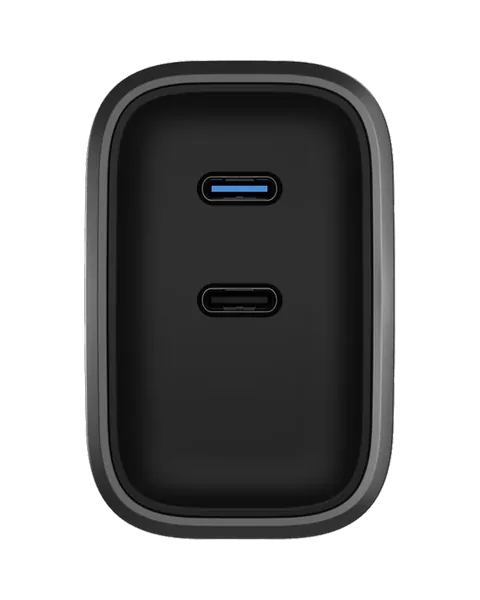
A charger that lets the phone set the pace helps protect the number. The Fermi45 offers PPS from 5 to 20 V at 3 A, so a 45 W Galaxy can adjust its voltage in fine steps, and fixed steps up to 45 W for an iPhone 17. Over-temperature protection is listed alongside its over-voltage and over-current safeguards.
Step by step
- Open Settings, then Battery, then Battery Health on iPhone or Pixel.
- Note the percentage or status and, where shown, the cycle count.
- Turn on optimised charging or an 80% limit if your day allows it.
- Charge in a cool place and avoid leaving the phone in heat.
- Plan a battery replacement near 80% or when the phone no longer lasts your day.
Questions people ask
Is 85% battery health good?
It is normal for a phone that has been in use for a year or two. Apple designs recent iPhones to keep 80% capacity at 1,000 cycles under ideal conditions, and Google rates newer Pixels similarly. At 85%, a full charge holds about 85% of the original energy.
When should I replace my phone battery?
Google suggests considering replacement when capacity falls below 80% or the rated cycle count is reached: 800 cycles for older Pixels and 1,000 for Pixel 8a and later. Apple shows a message when health is significantly degraded. If the phone no longer lasts your day, it is time.
What is a charge cycle?
A cycle is a full discharge and recharge, counting partial ones. Google gives the example that using 100% to 50% and charging back to 100% counts as half a cycle. Two such half-days make one cycle.
Why does a new phone show less than 100% battery health?
Apple says a new iPhone may show slightly under 100% depending on how long it sat between manufacture and activation. Batteries age a little even in storage. It does not mean the phone is faulty.
Can battery health go up again?
The real capacity does not recover, but the estimate can change. Google notes that initial values come from lab results, and Apple used iOS 14.5 to recalibrate battery health reporting on the iPhone 11 family. Small upward jumps are usually recalibration, not repair.
Sources
- Apple Support: iPhone battery and performance · accessed 22 Nov 2026
- Google Pixel Help: Battery health and battery health assistance · accessed 22 Nov 2026
- Apple Support: About iPhone charge limits and Optimized Battery Charging · 8 Dec 2025
Battery Management
Capacity is chemistry; longevity is software.
Read →Explainer · 4 min readDoes fast charging kill the battery?
The watts on the charger matter less than the temperature of the phone
Read →Explainer · 4 min readIs it bad to use the phone while charging?
Scrolling on charge is fine. Gaming on charge in a hot car is the habit to break.
Read →Explainer · 4 min readDoes airplane mode charge faster?
The trick is real, but small. On a fast charger it saves seconds, not minutes.
Read →Explainer · 4 min readWhy your phone charges fast to 50% and slow after 80%
The slowdown is not your charger failing. It is the battery asking to be treated gently.
Read →Explainer · 4 min readHow to check a Galaxy's battery health
Two built-in checks, under five minutes, and what Normal, Weak and Bad really mean.
Read →