Journal · Explainer · 4 min read
Why your phone charges fast to 50% and slow after 80%
The slowdown is not your charger failing. It is the battery asking to be treated gently.
In ChargerLAB's test, an iPhone 17 on a 20 W adapter went from empty to 50% in 27 minutes. The last 20% alone took another 58. Same phone, same charger, same cable. So why does the end of a charge crawl when the start flies?
Short answerA lithium-ion cell can accept high current only until it reaches its voltage limit, which happens at roughly 70% full. After that the charger holds the voltage steady and lets the current shrink, so each extra percent takes longer. Phones also slow down when warm. The slow finish protects the battery; it is not a fault.
The minutes behind the slowdown
Notebookcheck summarised ChargerLAB's iPhone 17 test at 25 °C. On a 20 W adapter the phone reached 50% in 27 minutes, 80% in 52 minutes and 100% in 1 hour 50 minutes. On a 40 W adapter it reached 50% in 19 minutes, 80% in 44 minutes and full in about 1 hour 42 minutes. The last 20% took close to an hour on both chargers, which is why the bigger charger saved only about eight minutes overall.
Android phones show the same shape. Android Authority's test of the Galaxy S26 Ultra on its 60 W charger recorded 37% after 10 minutes and 85% after 30 minutes, then needed another 12 minutes for the last 15%. The phone peaked at 60 W for about two minutes and then settled near 48 W.
Apple's own claims follow the curve too. Apple quotes iPhone fast charging as 50% in a set number of minutes, never 100%, because the first half is where speed lives.
| Stage | What the charger does | Roughly how far it fills |
|---|---|---|
| Constant current | Pushes a steady current while cell voltage rises | Up to about 70% |
| Constant voltage | Holds the cell at its limit, about 4.20 V, while current falls | The rest, slowly |
| Full | Ends when current drops to about 3 to 5% of rated capacity | 100% |
Source: Battery University, BU-409
Battery %
20 W adapter40 W adapter
Source: ChargerLAB test at 25 °C, via Notebookcheck
How it works: constant current, then constant voltage
Battery University describes the standard two-stage method used for lithium-ion cells. In stage one, constant current, the charger pushes a steady current while the cell's voltage rises. In stage two, constant voltage, the charger holds the cell at its limit, usually 4.20 V per cell for cobalt-blend chemistry, and the current falls away on its own.
According to Battery University, a high charge current fills the cell to about 70% quickly in stage one. Stage two then adds the rest, and the charge counts as full when the current has dropped to about 3 to 5% of the cell's rated capacity. Battery University puts the saturation stage at roughly the last 10% of capacity, and it is slow by design.
Why not just keep pushing hard? Battery University explains that the cell's voltage runs ahead of its actual state of charge, like a weight lifted on a rubber band, and the lag grows at higher currents. So a fast charge hits the voltage ceiling while the cell is only partly full. Holding a cell above its rated voltage for long plates metallic lithium on the anode, which wears the battery and can, in extreme cases, cause a short.
Picture filling a glass from a tap. You open the tap fully while the glass is empty, then turn it down near the top so it does not spill. The tap is the charger, the rim is the voltage limit, and slowing down near the rim is what keeps the glass, and the battery, from overflowing.
Heat makes the slowdown bigger
Temperature is the second brake. Battery University advises charging lithium-ion at a moderate temperature and never at freezing. Apple's MagSafe support page notes that if the battery gets too warm, software might limit charging above 80%.
That is why a phone left in a hot car or under a pillow may sit at 80% for a long time. The charger is fine; the phone is cooling off before it continues.
Using the curve at the counter and at home
The practical lesson is that short top-ups are efficient. Fifteen or twenty minutes on a fast charger, starting from a low battery, delivers far more percentage than the same time spent near full.
The other lesson is to judge chargers by minutes to 50%, not to 100%. That is where a faster charger earns its price. Near the top, every charger looks about the same, because the battery, not the charger, sets the pace.
What to check before you buy
Compare chargers on time to 50%. If a box or listing only promises a full charge time, ask what the 50% figure is.
Buy a charger that matches your phone's top wired speed. Beyond that point, as ChargerLAB's iPhone 17 numbers show, the extra watts mostly vanish in the slow final stage.
Check that the charger and cable support your phone's fast-charging standard, USB Power Delivery for iPhone and PPS for recent Samsung phones. Otherwise even the first half will be slow.
Plan around heat. A charger that stays cool lets the phone stay in its fast stage longer, so look for stated temperature behaviour or independent thermal tests.
Myth corner
Myth: if charging slows after 80%, the charger or battery is weak. Fact: Battery University's charge profile shows every lithium-ion cell switching from constant current to constant voltage near 70% full. The slowdown is expected on every phone and charger.
The right one for you
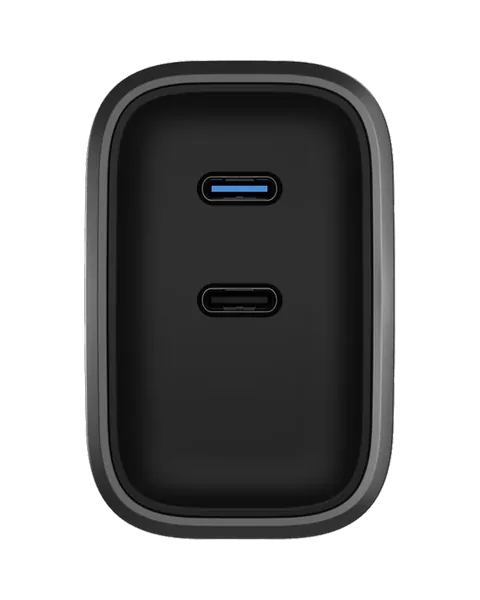
If your phone is an iPhone 17, ChargerLAB's curve says to buy for the fast first half and stop there. Fermi45 gives 45 W from one USB-C port, above the 40 W Apple lists for the iPhone 17 family, and adds PPS with Samsung Super Fast Charging 2.0 for the Galaxy phones that take 45 W.
Because heat is the second brake, it matters that it lists over-temperature protection alongside over-voltage, over-current and short-circuit protection, on a GaN3 power stage.
Step by step
- Start fast charging when the battery is low, not near full.
- Use a charger that matches your phone's top wired speed and fast-charging standard.
- Charge in a cool, shaded place, never in direct sun or under a pillow.
- For quick top-ups, unplug at 70 to 80% and save time.
Questions people ask
Is it bad to charge my phone to 100%?
Not dangerous, but it adds wear. Battery University notes that the saturation stage keeps the cell at high voltage for longer, which adds stress. Many phones offer an optimised or 80% charging limit for this reason. Occasional full charges are fine when you need the range.
Why does my phone stop charging at 80%?
Usually because of heat or an optimised charging setting. Apple says software may limit charging above 80% when the battery is warm, and many phones pause near 80% overnight to finish just before you wake. Move the phone somewhere cooler or check the battery settings.
Does a bigger charger make the last 20% faster?
Barely. In ChargerLAB's test, the iPhone 17 took about 58 minutes for the last 20% on a 20 W adapter and about 58 minutes on 40 W as well. In the constant-voltage stage the battery sets the current, so extra charger capacity simply goes unused near full.
What does CC-CV mean in charging?
It stands for constant current, constant voltage. Battery University describes it as the standard lithium-ion method: a steady current until the cell reaches its voltage limit, usually 4.20 V per cell, then a fixed voltage while the current tapers to 3 to 5% of rated capacity.
Sources
- Battery University: BU-409 Charging lithium-ion · accessed 22 Nov 2026
- Battery University: Ultra-fast chargers · accessed 22 Nov 2026
- Notebookcheck: iPhone 17 charging test shows negligible improvement with Apple's new 40 W charger · 8 Nov 2025
- Android Authority: Galaxy S26 Ultra 60W charging tested · accessed 22 Nov 2026
- Apple Support: How to use your MagSafe Charger · accessed 22 Nov 2026
- Apple Support: Fast charge your iPhone · accessed 22 Nov 2026
Battery Management
Capacity is chemistry; longevity is software.
Read →Explainer · 4 min readDoes fast charging kill the battery?
The watts on the charger matter less than the temperature of the phone
Read →Explainer · 5 min readCan a 100 W charger damage your phone?
The watts on the brick are a ceiling, not a push. Heat is what your battery remembers.
Read →Explainer · 4 min readRoad-trip power planning
Maps, music, two phones and a dashcam. How to arrive with more charge than you left with.
Read →Explainer · 4 min readCharging in the car on long drives
Navigation, sunlight and fast charging all make heat. On a highway they arrive together.
Read →Explainer · 4 min readIs it bad to use the phone while charging?
Scrolling on charge is fine. Gaming on charge in a hot car is the habit to break.
Read →