Journal · Buying guide · 4 min read
Which charger works best in a car with a 12 V socket?
The dashboard USB port was built for music, not charging. The 12 V socket can do far more.
Navigation on, music streaming, a phone in a hot windscreen mount, and a cable into the car's built-in USB port. An hour later, the battery is lower than when you started. The charger is working; it just cannot keep up. Is the 12 V socket the answer, and what should go in it?
Short answerFor most phones, use a USB-C car charger with USB Power Delivery and PPS, rated for 12 V to 24 V input and about 30 W to 45 W on the phone's port. Built-in car USB ports often supply only 0.5 A to 1 A. Choose by per-port watts, input range and heat handling.
Why the built-in USB port struggles
Digital Trends explains that many factory-fitted car USB ports follow the old USB 2.0 data specification, which allows about 500 mA. It quotes a Mazda engineer confirming that the port in a 2015 model supplied 0.5 A, or 1 A when an Apple device was connected, and notes How-To Geek measured similar outputs across several vehicles. The same carmaker said the port could charge a phone at rest, but GPS, Bluetooth streaming and calls drain faster than it refills.
At 5 V, 0.5 A is 2.5 W and 1 A is 5 W. A phone running navigation with a bright screen in sunlight can use more than that. Newer cars with USB-C ports may supply more; check your car's manual.
| Source or phone | Power | Note |
|---|---|---|
| Older built-in car USB port | 2.5 W to 5 W | 0.5 A to 1 A at 5 V |
| iPhone fast charging | 18 W or more | USB Power Delivery |
| iPhone 17 family, fastest | 40 W or more | USB Power Delivery |
| Galaxy with 45 W charging | 45 W | PPS and a 5 A cable |
Source: Digital Trends; Apple Support; Samsung, accessed 22 Nov 2026
Minutes held (test ended at 60)
Source: lygte-info.dk, accessed 22 Nov 2026
What a good 12 V charger must handle
A car's 12 V socket is not a steady 12 V. Lygte-info.dk, a long-running independent charger test site, tested a 45 W USB-C car charger from about 11.6 V, roughly a battery with the engine off, to about 14.6 V, a typical running-engine level, and at 24 V, the level used in trucks and buses. Its 20 V USB-C output needed more than about 11.5 V of input to hold, while its 12 V output kept working down to about 6 V input, with high losses.
Heat is the other limit. In the same test, from a 12 V input, the charger's 20 V output held a 2 A load for only about 3 minutes and 1.5 A for about 10 minutes, but completed an hour at 1 A, with internal temperatures around 45 °C to 54 °C. The tester judged the printed ratings overrated, found the PD values it reported to devices higher than it could deliver, and advised keeping fast-charging laptops and tablets away from it.
The lesson is not about one model. A car charger lives in a hot, cramped socket with poor airflow. Its sustained output can be well below its label, especially on a summer afternoon.
How it works: turning 12 V into 9 V, 15 V or 20 V
A car charger is a small DC-to-DC converter. To give a phone 9 V from a 14 V supply, it steps the voltage down. To give a laptop 20 V from 12 V, it must step it up, which is harder and hotter. Lygte-info.dk found that boost path the source of the highest losses in its test.
Think of it like pumping water up to a rooftop tank. Letting water flow down to a lower tap is easy. Pushing it up to the roof takes work, and the pump heats up if you run it hard for long. Phones mostly need the easy downhill direction, which is why a car charger handles phones far better than laptops.
Matching the charger to the phone
Galaxy phones with 45 W charging need a USB-C port that offers PPS at 45 W and a 5 A cable. Samsung sells a dual car charger rated 45 W plus 15 W, which shows the size of port these phones are designed around.
iPhones fast charge over USB Power Delivery from 18 W upwards, according to Apple, and the iPhone 17 family fastest with 40 W or more. A 30 W to 45 W PD port covers them.
Two passengers: choose a dual charger whose table gives each USB-C port enough watts when both are in use, not just the total.
What to check before you buy
Check the input range printed on the charger: 12 V to 24 V suits cars and larger vehicles.
Check the per-port rating and protocol: USB-C with PD, and PPS for Galaxy phones, at the wattage your phone needs.
Check the fit. It should sit firmly in the socket without wobbling on bumpy roads. A loose fit causes intermittent charging and heat at the contacts.
Check the build. A charger that feels very light for a high wattage may struggle with sustained output in a hot cabin.
Myth corner
Myth: leaving a car charger in the socket drains the car battery. In lygte-info.dk's test, the idle charger drew about 28 mA at 12 V, a tiny load. In many cars the socket also switches off with the ignition. If yours stays live, unplug the charger when parking for weeks.
The right one for you
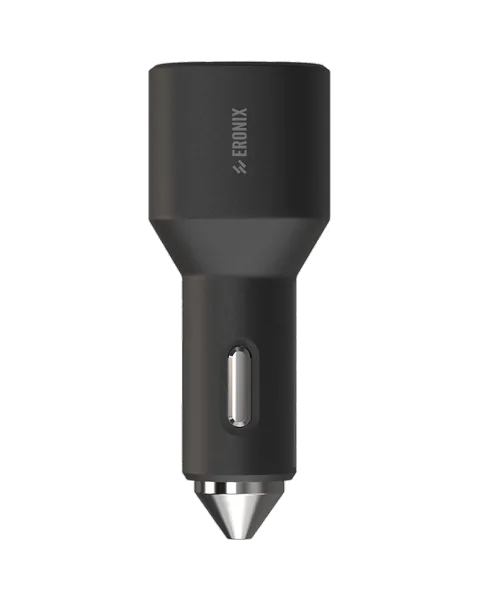
The Car Charger takes 12 V or 24 V input and gives two USB-C ports, 65 W and 30 W, with PD and PPS, and SUPERVOOC on the second port for OnePlus phones.
The 65 W port leaves headroom for a laptop or a fast-charging phone while a passenger uses the 30 W port. The body is aluminium and sits flush in the socket.
Step by step
- Find the wattage and protocol your phone fast charges with.
- Choose a USB-C PD car charger, with PPS for Galaxy phones, rated at that wattage per port.
- Check the input range covers 12 V to 24 V.
- Use a cable rated for the current: 3 A for most phones, 5 A for 45 W Galaxy modes.
- Keep the phone out of direct sun on the dashboard while it charges.
Questions people ask
Why does my phone charge so slowly from the car USB port?
Many built-in car USB ports follow the old USB 2.0 data specification. Digital Trends reports factory ports supplying about 0.5 A, or 1 A for some phones, which is 2.5 W to 5 W at 5 V. Navigation and streaming can use more than that. A USB-C PD charger in the 12 V socket supplies far more.
What wattage car charger do I need for my phone?
Match the phone. Recent iPhones fast charge from 18 W and fastest at 40 W or more; Galaxy phones with 45 W charging need PPS at 45 W and a 5 A cable; many others need 25 W. A car charger with 30 W to 45 W on a USB-C PD port covers most phones.
Can a car charger charge a laptop?
Some can, but it is the hardest job for a car charger, because it must boost 12 V up to 20 V. Lygte-info.dk's test of a 45 W car charger found the boost path ran hot and could not sustain high laptop-level loads for long. For laptops, choose a charger designed and rated for that power.
Is it safe to leave a phone charging in a parked car?
Not in the heat. Apple warns that ambient temperatures above 35 °C can permanently reduce battery capacity, and a parked car's cabin in an Indian summer can be much hotter. Take the phone with you. Leaving only the charger in the socket draws very little, but unplug it for long parking.
Sources
- Why your USB car charger hardly works at all (Digital Trends) · accessed 22 Nov 2026
- Test of a USB-C PD 45W car charger (lygte-info.dk) · accessed 22 Nov 2026
- Super Fast Dual Car Charger (45W+15W) EP-L5300 (Samsung Singapore) · accessed 22 Nov 2026
- Fast charge your iPhone (Apple Support) · accessed 22 Nov 2026
- How to use super fast charging on Galaxy S24 series (Samsung UK Support) · accessed 22 Nov 2026
- Batteries: Maximizing Performance (Apple) · accessed 22 Nov 2026
USB-C Power Delivery
One connector, a negotiated contract.
Read →Buying guide · 4 min readWhich charger does the Galaxy S26 Ultra need?
Sixty watts on the box. Here is what it takes to get it.
Read →Buying guide · 4 min readWhich car charger can fast-charge an iPhone?
Why the USB port in your dashboard loses to the satnav, and what to plug in instead
Read →Buying guide · 4 min readWhich charger does the Galaxy Z Flip7 need?
A 4,300 mAh phone that folds in half. Its charging limit is lower than you might expect.
Read →Buying guide · 5 min readWhich charger does the Galaxy S26 need?
Three phones, three speeds, one protocol called PPS. Here is what to buy and what to skip.
Read →Buying guide · 4 min readWhich charger does the Galaxy S26+ need?
Samsung promises 69 percent in about 30 minutes. One word on the label decides it.
Read →