Journal · Buying guide · 4 min read
Which car charger can fast-charge an iPhone?
Why the USB port in your dashboard loses to the satnav, and what to plug in instead
Two hours of Google Maps on the Mumbai-Pune Expressway, the phone plugged into the car's USB port the whole way, and you arrive with less charge than you started. How is that possible?
Short answerMany built-in car USB ports supply about 0.5 A at 5 V, roughly 2.5 W, which navigation can outrun. Use a car charger in the 12 V socket with a USB-C Power Delivery port of at least 20 W. A 30 W port suits most iPhones; iPhone 17 Pro models need 40 W for Apple's quickest claim.
Car charging power, in numbers
Digital Trends asked a carmaker why built-in ports are so slow. A Mazda infotainment engineer said its USB data ports supply 500 mA, in line with the USB 2.0 specification, while a connected Apple device gets 1 A. How-To Geek's measurements across several vehicles also found about 0.5 A from dashboard data ports. At 5 V, that is about 2.5 W, or 5 W for the Apple case. The USB Battery Charging 1.2 specification allows dedicated charging ports up to 1.5 A, which is still only about 7.5 W.
Compare that with what an iPhone accepts. Apple's support page says iPhone fast charging needs an 18 W or higher USB-C adapter with USB-PD. It lists about 50 per cent in around 20 minutes for iPhone 17 Pro models with a 40 W or higher adapter, and the iPhone 18 Pro models reach their fastest speeds only with a 60 W-capable charger that supports Adjustable Voltage Supply. ChargerLAB's tests show the iPhone 16 settling at about 23 W, and the iPhone 15 Pro Max at about 25 to 27 W.
Labels on car chargers do not always match reality. In an independent bench review published on lygte-info.dk, one 45 W USB-C car charger advertised lower currents to the phone than its printed rating, and the reviewer found even those overstated. On a 12 V input, its 20 V output held a 2 A load for only about 3 minutes and 1.5 A for about 10 minutes; only at 1 A did it finish an hour. The reviewer rated it usable only. A printed number is a claim; a sensible margin protects you.
| Source or need | Current | Power |
|---|---|---|
| Dashboard USB data port | 0.5 A at 5 V | about 2.5 W |
| Apple device on a Mazda data port | 1 A at 5 V | about 5 W |
| USB BC 1.2 charging port, maximum | 1.5 A at 5 V | about 7.5 W |
| iPhone fast-charge minimum | USB-C PD | 18 W |
| iPhone 16, measured | USB-C PD | about 23 W |
| iPhone 17 Pro, Apple's quickest claim | USB-C PD | 40 W |
Source: Digital Trends; Apple Support; ChargerLAB; accessed 2026
Watts
Source: Digital Trends; USB BC 1.2; Apple Support
How a car charger turns 12 V into fast charging
A car's socket supplies about 12 V from the battery, a little more with the engine running, or 24 V in many trucks and buses. A car charger converts that down to 5 V or 9 V for a phone, or up to 15 or 20 V for laptops, and then negotiates over USB-C Power Delivery just as a wall charger does.
Think of it like a water tanker filling a building's tank. The tanker has plenty of water, but the size of the hose decides how fast the tank fills. The car battery is the tanker. A 0.5 A dashboard port is a garden hose. A 30 W USB-C PD charger is a proper fire hose with a valve the phone controls.
Heat is the car's special problem. A charger in a sun-baked dashboard runs hot, and so does a phone in a windscreen mount. Both will slow charging to protect themselves, so shade and airflow matter in summer.
MagSafe and wireless car chargers
Magnetic car mounts are convenient for navigation, but wireless charging wastes more energy as heat than a cable, and a phone in direct sun on the windscreen is already warm. For long highway drives with navigation running, a cable from a USB-C PD port is the dependable option; use the magnetic mount for short trips.
What to check before you buy
Look for at least one USB-C port with Power Delivery rated 20 W or more. For two phones, choose a charger whose total output covers both, and check the per-port split.
Match your model. Most iPhones settle at about 20 to 27 W, so 30 W is plenty. iPhone 17 Pro owners who want Apple's 20-minute claim need 40 W, and iPhone 18 Pro owners need an AVS-capable 60 W-class port for top speed.
Check the input range. A 12-24 V rating covers cars and most commercial vehicles.
Make sure it sits firmly in the socket. A loose fit on rough roads interrupts charging and heats the contacts.
Prefer clear output tables and safety markings. As the independent bench test shows, an unverified label can overstate what a car charger delivers.
Mounts deserve the same care as chargers. A vent mount keeps the phone in moving air, which helps in summer, while a windscreen mount in direct sun is the hottest spot in the car. Whichever you use, place it where the phone does not block your view of the road.
Myth corner
Myth: the car's USB port is as good as a charger. Often it is not. Carmakers told Digital Trends that many data ports follow the USB 2.0 limit of 500 mA, about 2.5 W, which is less than an iPhone can use while running maps. A USB-C PD car charger in the 12 V socket fixes it.
The right one for you
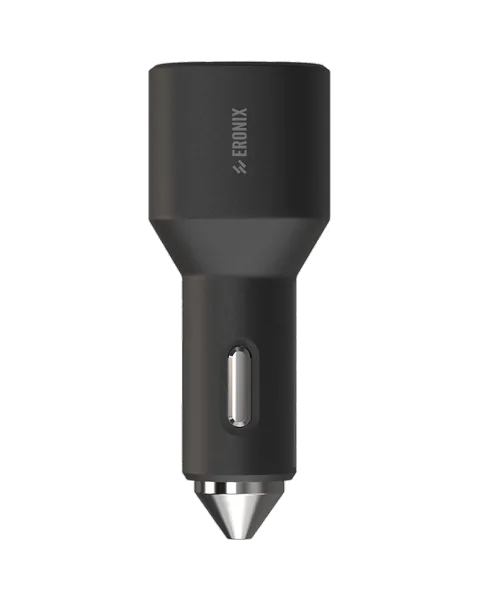
The ERONIX Car Charger answers each check above. Its two USB-C ports give 65 W and 30 W over PD and PPS, so a phone on the 30 W port charges at full speed while the 65 W port covers the 40 W an iPhone 17 Pro needs for Apple's quickest claim, or a laptop.
It runs on 12 V and 24 V sockets, and its aluminium body sits flush in the socket.
Step by step
- Plug a USB-C PD car charger into the 12 V socket, not the dashboard USB port.
- Use a USB-C to USB-C cable to the iPhone.
- Choose 20 W minimum, 30 W for most iPhones, 40 W for iPhone 17 Pro.
- Keep the phone and charger out of direct sun.
- Use a cable rather than wireless on long drives with navigation.
Questions people ask
Can a car charger damage my iPhone?
Not a well-made USB-C Power Delivery car charger. The iPhone negotiates the power it accepts. Poorly made units can overheat or behave unpredictably, so choose a charger with clear output markings and keep it out of direct sun on the dashboard.
Why does my iPhone lose charge while connected in the car?
The car's built-in USB port may supply about 0.5 A at 5 V, roughly 2.5 W, according to carmakers quoted by Digital Trends. Navigation, a bright screen and mobile data can use more than that. A 20 W or higher USB-C PD charger in the 12 V socket solves it.
Is a 20 W car charger enough for an iPhone?
Yes, for Apple's standard fast-charge claim on most models, since Apple says fast charging needs an 18 W or higher USB-C PD adapter. For iPhone 17 Pro models, Apple's 50 per cent in about 20 minutes needs 40 W or more.
Can I charge a laptop from a car charger?
Yes, if the charger has a USB-C PD port offering 20 V at the laptop's wattage, such as 45 W or 65 W. Expect output to drop under long, heavy loads. In one lygte-info.dk bench test, a 45 W car charger held 20 V at 2 A for only about 3 minutes.
Does a car charger drain the car battery?
A connected charger with nothing plugged in draws very little. The lygte-info.dk review measured one car charger idling at 28 mA from 12 V. Many cars also cut socket power when the ignition is off. Unplug it if the car stands unused for weeks.
Sources
- Digital Trends: Why your USB car charger hardly works at all · 4 Feb 2022
- Apple Support: Fast charge your iPhone · 22 Oct 2026
- ChargerLAB: Up to 40W? Charging review of iPhone 16 · 2 Oct 2024
- ChargerLAB: Apple iPhone 15 Pro Max charging test, Compatibility 100 · 25 Sep 2023
- lygte-info.dk: Test of a USB-C PD 45W car charger · accessed 22 Nov 2026
USB-C Power Delivery
One connector, a negotiated contract.
Read →Buying guide · 4 min readWhich charger does the Galaxy S26 Ultra need?
Sixty watts on the box. Here is what it takes to get it.
Read →Buying guide · 5 min readWhich charger does the iPhone 18 Pro need?
Half a battery in 15 minutes, but only if your charger speaks one new word: AVS.
Read →Explainer · 5 min readCan a 100 W charger damage your phone?
The watts on the brick are a ceiling, not a push. Heat is what your battery remembers.
Read →Explainer · 4 min readHotel room charging: making one socket work
One socket behind the bed, three devices, a 7 am meeting. Here is the plan.
Read →Explainer · 5 min readGaN chargers: what changed and what did not
A new material shrank the charger. Your phone's charging speed stayed where it was.
Read →