Journal · Comparison · 5 min read
Car charger vs power bank on a road trip
One is a tap, the other is a bottle. A road trip needs both, for different hours.
Bengaluru to Coorg, six hours, Maps running the whole way, music on Bluetooth, and a stop at a viewpoint where everyone wants photos. Do you pack a power bank, buy a car charger, or both?
Short answerBoth. A car charger supplies steady power while the engine runs, so it covers the driving hours. A power bank holds a fixed store, and tests show you often get 60 to 75% of the label, but it works at the dhaba, the trail and the hotel. The deciding number is hours away from the car.
The numbers side by side
Start with the car. Digital Trends explains that many built-in car USB ports follow the old USB data standard of about 500 mA, which at 5 V is roughly 2.5 W. That can lose ground against a phone running navigation and Bluetooth. A charger in the 12 V socket is a different tool. In lygte-info.dk's test of one 45 W USB-C PD car charger, it advertised USB PD outputs up to 20 V and ran at 20 V and 1 A from a 12 V input for a full hour, with case hot spots of about 45 to 54 °C. With nothing connected, it drew only about 28 mA from the 12 V supply.
Now the power bank. Android Authority explains that the mAh rating on a power bank describes its internal cells at around 3.7 V, and that converting up to USB voltages, plus losses in the phone, means you should plan on about 75% of the rating as usable. That makes a 10,000 mAh bank good for about one and a half charges of a 5,000 mAh phone. Australia's consumer group CHOICE tested 31 power banks and found none delivered its claimed capacity; it warns a 10,000 mAh bank may give only 6,000 to 7,000 mAh of actual charge.
So the car charger wins on volume: it does not run out while you drive. The power bank wins on reach: it works where the car is not.
| Measure | Car charger | Power bank |
|---|---|---|
| Energy | Unlimited while the engine runs | Fixed at departure |
| Real output | Up to its USB PD rating | About 60 to 75% of the mAh label |
| Works away from the car | No | Yes |
| Idle draw | About 28 mA at 12 V (tested 45 W unit) | Slow self-discharge |
Source: lygte-info.dk; Android Authority; CHOICE
How each one works
A car charger converts the car's 12 V supply into USB voltages through a small DC-to-DC converter. While the engine runs, the alternator keeps feeding that supply, so the charger can work for hours. Its limits are heat, because a dashboard socket in sunlight is a hot place, and the car's socket rating.
A power bank is a battery plus a converter. Its energy is fixed when you leave home, and every conversion between its cells and your phone costs some of it.
Think of drinking water on a long drive. The car charger is a tap at a roadside stop: endless water, but only while you are standing there. The power bank is the bottle in your bag: limited, but with you on the walk to the waterfall.
A simple plan for the day
Leave home with the phone and the power bank full. In the car, run the phone from the car charger, so the phone arrives with a full battery and the bank stays untouched. Use the bank only when you are away from the car for long, or at the hotel if sockets are scarce. Recharge the bank overnight. On this plan, a mid-size bank lasts the whole trip.
Sizing the power bank for your trip
Work out the longest stretch you will spend away from the car in a day, such as a trek, a day at a fort or a long evening out, and how much battery your phone uses in that time. If your phone drops from full to about 30% on a busy day, you need roughly 70% of a charge in reserve. On a 5,000 mAh phone that is about 3,500 mAh at the phone, which a 10,000 mAh bank covers comfortably even at the lower end of real-world capacity. Two phones, or a camera that charges by USB-C, double the need.
What to check before you buy
For the car charger, check the USB-C PD output per port and match it to your phone's fast-charging needs. Avoid relying on the car's built-in USB-A port for navigation days.
Check the car charger's input range. The tested unit was rated for 12 to 24 V, which covers cars and many larger vehicles.
For the power bank, look for the rated energy in watt-hours as well as mAh, and plan on roughly 60 to 75% of the label reaching your phone.
Check the power bank's own recharge input. A bank that refills fast overnight is more useful on a multi-day trip than a larger one that takes all night and more.
Never leave either in a parked car in the sun. Apple warns that parked-car temperatures can exceed a phone's storage range, and the same heat harms power bank cells.
Myth corner
Myth: a car charger left plugged in will drain the car battery overnight. Fact: a well-made charger draws very little at idle; the tested 45 W unit used about 28 mA at 12 V with nothing connected. Many cars also cut power to the socket when the ignition is off. If yours does not and the car will stand for days, unplug it.
The right one for you
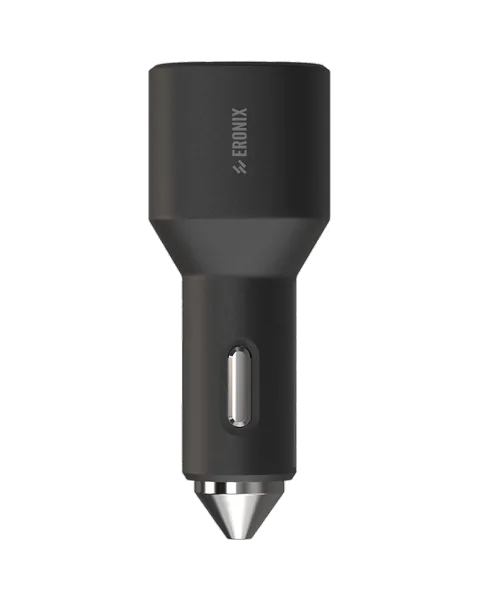
The plan needs two things: steady USB-C PD from the 12 V socket, and a mid-size bank for the hours away from the car. The ERONIX Car Charger gives two USB-C ports, 65 W and 30 W, with PD and PPS, takes 12/24 V input and sits flush in an aluminium body. The Levitate holds 10,000 mAh, the size the sizing section above shows covers a busy day, with a 30 W USB-C port and magnetic charging at up to 25 W for iPhone 17 and later.
Step by step
- Leave home with the phone and the power bank full.
- Plug a USB-C PD car charger into the 12 V socket, not the car's USB-A port.
- Charge the phone from the car charger while driving.
- Use the power bank only away from the car.
- Recharge the power bank overnight and keep both out of a parked car.
Questions people ask
How many times can a 10,000 mAh power bank charge my phone?
Plan on about one and a half full charges of a 5,000 mAh phone. Android Authority suggests treating roughly 75% of the rating as usable because of voltage conversion and losses. CHOICE found real power banks often deliver less, 6,000 to 7,000 mAh from a 10,000 mAh label, which means a little over one charge.
Is the car's USB port enough to charge a phone?
Often not on a navigation day. Many built-in ports supply about 500 mA, roughly 2.5 W, which Digital Trends notes can fall behind a phone running maps and Bluetooth. A USB-C PD charger in the 12 V socket supplies far more power and keeps the phone charging while in use.
Can I charge a power bank from the car charger?
Yes, if the car charger's output matches the power bank's input, ideally USB-C PD on both. This is a good way to refill the bank on long drive days. Keep the bank out of direct sun while it charges, because heat and charging together stress lithium-ion cells.
Does a car charger work when the engine is off?
It depends on the car. Many cars cut power to the 12 V socket when the ignition is off; some keep it live. Where it stays live, charging then draws from the car battery alone, so avoid long charging with the engine off, and unplug the charger if the car will stand for days.
Sources
- Why your USB car charger hardly works at all (Digital Trends) · accessed 22 Nov 2026
- Test of a USB-C PD 45W car charger (lygte-info.dk) · accessed 22 Nov 2026
- Why your power bank feels smaller than it should (Android Authority) · accessed 22 Nov 2026
- Power banks that don't live up to claimed capacity (CHOICE) · accessed 22 Nov 2026
- If your iPhone or iPad gets too hot or too cold (Apple Support) · accessed 22 Nov 2026
USB-C Power Delivery
One connector, a negotiated contract.
Read →Explainer · 4 min readRoad-trip power planning
Maps, music, two phones and a dashcam. How to arrive with more charge than you left with.
Read →Comparison · 4 min read10,000 vs 20,000 mAh power banks: which should you carry?
Double the mAh gives about double the charges, and double the weight in your bag.
Read →Comparison · 5 min read65 W vs 100 W for a laptop: which one do you need?
A 100 W charger has 54 percent more power. Whether you feel it depends on one number.
Read →Buying guide · 5 min readWhat size power bank do you need for a full phone charge?
Why a 10,000 mAh power bank never gives two full charges, and how to size one honestly
Read →Explainer · 4 min readCharging in the car on long drives
Navigation, sunlight and fast charging all make heat. On a highway they arrive together.
Read →