Journal · Explainer · 4 min read
Earbuds for flights: what actually matters
The engine hum is the easy part. Fit, battery and volume decide how you land.
At cruise, the cabin of a jet is about as loud as a busy road. Researchers who measured it on a commercial flight recorded 80 to 85 dB(A) of continuous noise. Most people respond by turning their music up. Is there a better way?
Short answerYes. Choose earbuds with active noise cancellation, use the ear tip size that seals best, and check the battery life with noise cancellation switched on. Steady engine hum is exactly the kind of sound ANC cancels well, so you can listen at a lower, safer volume and land less tired.
How loud a flight really is
A study published in Canadian Acoustics in 2006 by H. Kurtulus Ozcan and Semih Nemlioglu of Istanbul University measured in-cabin noise on commercial flights. It found about 60 to 65 dB(A) before take-off, 80 to 85 dB(A) during flight and 75 to 80 dB(A) during landing, with short peaks of up to 81 to 88 dB(A).
Now set that against hearing guidance. The World Health Organization says adults can listen at 80 dB for up to 40 hours a week safely, but only four hours a week at 90 dB, and advises keeping a device at no more than 60 per cent of maximum volume. On a long flight, music played loudly enough to mask an 85 dB(A) cabin can easily go past that.
The WHO's own advice in noisy places is direct: use well-fitted noise-cancelling headphones to reduce the need to raise the volume. That is the case for ANC on a plane in one line.
| Phase | Measured noise |
|---|---|
| Before take-off | 60 to 65 dB(A) |
| Cruise | 80 to 85 dB(A) |
| Landing | 75 to 80 dB(A) |
| Short peaks | Up to 81 to 88 dB(A) |
Source: Ozcan and Nemlioglu, Canadian Acoustics, 2006
dB(A)
Source: Ozcan and Nemlioglu, Canadian Acoustics, 2006
How noise cancellation handles engine hum
SoundGuys' explainer describes the method. Small microphones on the earbud sample the noise around you, and the electronics produce a sound wave that is its mirror image, offset by half a wavelength. When the two meet, they cancel.
It works best on steady, predictable sound, and an aircraft's drone is about as steady as sound gets. Sudden, irregular sounds such as voices, a trolley or a crying baby change too quickly to cancel fully. For those, the physical seal of the ear tip does more of the work.
Think of it like noise-cancelling for a ceiling fan. A constant whirr is easy to predict and erase; a door slamming is not. The fan is the engine; the door is the person in the next row.
Fit matters because ANC and the tip work as a team. A loose tip lets outside sound leak past, so the electronics have more to cancel and bass from your music drains away. A good seal does half the job before any processing starts.
Earbuds or over-ear headphones on a plane
Over-ear headphones usually have bigger batteries and a larger seal around the ear. Earbuds win on size, weight and sleeping on your side against a headrest. For a two-hour domestic hop, earbuds are the easy choice. For an overnight long-haul, many travellers carry over-ears for the flight and earbuds for the airport.
Both are fine in the cabin. IATA's battery guidance treats power banks as spare batteries because their job is to power other devices; a battery built into the earbuds or headphones you are wearing is part of the device, so the power bank limits are a separate matter.
Using earbuds to rest on a night flight
Noise cancellation does not need music. Switched on with nothing playing, ANC earbuds work like electronic earplugs: the engine drone drops away while you sleep, and nothing loud is going into your ears for hours. That is the gentlest way to use them on an overnight sector.
Comfort decides whether this works. Earbuds that sit flush with the ear press less against a headrest or a travel pillow. If your ear aches after an hour, try a smaller tip, since an over-tight seal can feel like pressure. And plan the battery: running ANC through a long night may need a case top-up before landing, so charge the case fully before you leave home.
What to check before you buy
Look for active noise cancellation, not only noise isolation or call noise reduction. Call noise reduction cleans your voice for the other person; it does nothing for what you hear.
Try every tip size in the box. The tip that seals best often is not the one fitted at the factory.
Read the battery life with ANC on, plus how many recharges the case holds. Plan for the full door-to-door journey, not just the flight time.
Check whether the earbuds have a transparency or ambient mode, so you can hear the crew without removing them.
For seatback entertainment, see whether your airline's screen supports Bluetooth; many still use a wired socket, so you may need a small wireless transmitter or a wired pair.
Myth corner
Myth: noise-cancelling earbuds silence a plane completely. They do not. SoundGuys notes ANC is best at steady noise such as engine hum, and less effective with sudden sounds like voices. Expect the drone to fade sharply, and the cabin's chatter to soften rather than vanish.
The right one for you
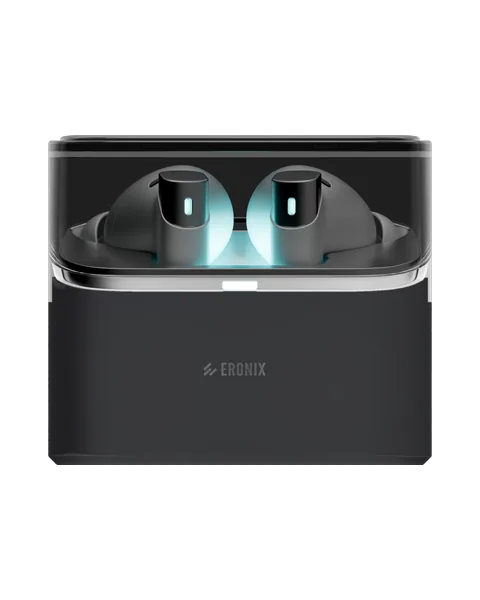
For the flight, Euphoria is built around the two things this guide puts first. Its noise cancelling is rated at 45 dB, set against exactly the steady drone of a cabin, and it gives 5.5 hours of playback on a charge.
It suits iPhone and Galaxy S, plays aptX HD on Android phones that support it, and carries an IPX6 rating for the journey.
Step by step
- Fully charge the earbuds and the case before you leave.
- Fit the tip size that seals best and run any fit test in the companion app.
- Turn on ANC once the cabin door closes.
- Keep the volume at or below 60 per cent of maximum.
- Switch to transparency mode when crew speak to you.
Questions people ask
Can I use Bluetooth earbuds during a flight?
Generally yes, once the crew allows personal electronic devices, but airline rules vary. Phones are usually set to flight mode, and Bluetooth can typically stay on. Check your airline's onboard device policy, especially during take-off and landing.
Does ANC help with ear pain on take-off and landing?
No. Ear pain on climb and descent comes from pressure changes in the middle ear, not noise. ANC reduces sound, not pressure. Swallowing, yawning or chewing during descent is the usual advice; see a doctor if pain is severe or persistent.
What volume is safe on a long flight?
The WHO advises keeping a personal device at no more than 60 per cent of maximum volume and says adults can listen at 80 dB for up to 40 hours a week. With cabin noise of 80 to 85 dB(A) at cruise, ANC lets you stay well below loud settings.
Why does ANC make some people feel pressure or dizziness?
SoundGuys reports one theory that very low-frequency effects from ANC can stimulate balance receptors in some people. Many companion apps let you lower ANC strength, which often eases the sensation. Taking the earbuds out briefly also helps.
Can I connect wireless earbuds to the in-flight screen?
Only if the screen supports Bluetooth. Many seatback systems still use a wired socket, so you would need wired headphones or a small Bluetooth transmitter that plugs into the socket and pairs with your earbuds.
Sources
Active Noise Cancellation
Silence, computed in real time.
Read →Explainer · 1 min readHow active noise cancellation actually works
A race measured in fractions of a millisecond.
Read →Explainer · 5 min readWhat ANC can and cannot block
Why the bus engine fades but the conductor's voice does not, and what to check.
Read →Explainer · 4 min readTransparency mode: how earbuds let the world back in
Your earbuds can hear the platform announcement for you. Here is how, and where it stops.
Read →Explainer · 5 min readLDAC, aptX, AAC: which codec your phone really uses
The logo on the earbud box is a promise. Your phone decides whether it is kept.
Read →Explainer · 5 min readCan a 100 W charger damage your phone?
The watts on the brick are a ceiling, not a push. Heat is what your battery remembers.
Read →