Journal · Explainer · 4 min read
Why earbuds sound different on iPhone and Android
Same earbuds, same song, two phones. The difference starts before the sound reaches you.
You pair the same earbuds with a friend's phone and the song suddenly sounds brighter, or thinner, or louder. Nothing about the earbuds changed. So what did?
Short answerThe phone did. iPhone and Android phones send audio to earbuds using different Bluetooth codecs: iPhone uses AAC as its high-quality option, while many Android phones can also use LDAC, aptX or, on newer models, LC3. Each phone also applies its own volume, EQ and processing, and the earbuds' companion app may offer different features on each platform.
The codec numbers
Bluetooth audio has to be compressed before it travels to your ears, and the codec is the method used. SoundGuys' 2024 explainer gives typical bit rates: about 240 to 345 kbps for SBC, the basic codec every device supports; about 279 to 420 kbps for aptX Adaptive; and about 330 to 990 kbps for LDAC. It puts the newer LC3 codec at roughly 160 to 345 kbps.
The same explainer notes that Apple's iPhones and iPads support only AAC as their high-quality codec, falling back to SBC when the earbuds lack AAC. TechRadar reported in June 2025 that Apple had not enabled LE Audio or LC3 on iPhone or AirPods. On Android, Google announced in September 2025 that LE Audio sharing works on Pixel 8 and newer, recent Samsung flagships and selected Xiaomi and POCO models, so LC3 is available there when the earbuds support it.
Higher bit rates do not automatically mean better sound. The Bluetooth SIG says listening tests found LC3 beats SBC even at half the bit rate, because a smarter codec needs fewer bits for the same quality. What you hear depends on the codec, how well each phone implements it, and how strong the connection is.
| Codec | Typical bit rate | Where you find it |
|---|---|---|
| SBC | 240 to 345 kbps | Every device |
| aptX Adaptive | 279 to 420 kbps | Many Android phones |
| LDAC | 330 to 990 kbps | Many Android phones |
| LC3 | 160 to 345 kbps | Pixel 8 and newer, recent Samsung flagships; not on iPhone |
Source: SoundGuys, 2024; Google, September 2025; TechRadar, June 2025
How a codec changes what you hear
A codec decides which parts of the music to keep and which to discard so the stream fits through Bluetooth. Good codecs remove detail your ear is unlikely to notice. At low bit rates or with a weak signal, more audible detail goes, and cymbals or reverb can sound smeared.
Think of it like sending photos on a messaging app. The same photo can arrive crisp or noticeably compressed, depending on the app's settings and your network. The camera, the earbuds in this case, did not change; the delivery did.
Then come the extras. Phones apply their own volume curves and sometimes their own EQ or loudness processing. Earbuds may run different firmware features or app settings on each platform. Any of these can make one phone sound bassier or brighter than another.
What you can control
On Android, the Bluetooth device settings usually show which codec is in use, and developer options can display or change it. If your earbuds support LDAC or aptX, check that it is active; some phones and earbuds default to a stable, lower-bit-rate mode.
On iPhone, AAC is used automatically with earbuds that support it, so the main levers are the earbuds' app EQ and iPhone's own headphone audio settings.
On both, a good seal matters more than any codec. A loose ear tip leaks bass, and no amount of bit rate brings it back.
Why the same phone can sound different on the train
Bluetooth shares crowded airwaves. On a packed metro, in an airport or at a busy office, many phones and earbuds compete for the same radio space. Adaptive codecs, as the name aptX Adaptive suggests, lower their bit rate to keep the music playing without dropouts, so detail can dip when the radio environment is busy.
Where your phone sits matters too. A phone in a back pocket, with your body between it and the earbuds, gives a weaker signal than one in a shirt pocket or on a desk. If sound quality changes on the move, the codec may simply be protecting the connection. LE Audio adds a further change on phones and earbuds that support it: the Bluetooth SIG says its multi-stream design sends synchronised streams to each earbud, which it credits with better stereo imaging.
What to check before you buy
Match the codec to your phone. For iPhone, make sure the earbuds support AAC well. For Android, look for LDAC, aptX or LC3 if you want more than SBC and AAC.
See whether the companion app is available and full-featured on your phone's platform. Some features differ between iOS and Android.
Ask whether the app has a user EQ. It lets you correct the tonal balance to your taste on either phone.
Try several tip sizes. Fit changes bass more than any codec does.
If you switch between iPhone and Android, pick earbuds that sound good on AAC, since that is the codec both commonly share.
Myth corner
Myth: iPhones make all earbuds sound worse. Not so. AAC on iPhone is a capable codec, and the Bluetooth SIG's own research shows codec efficiency matters more than raw bit rate. Differences usually come from codec choice, processing and fit together, not from one phone being simply better.
The right one for you
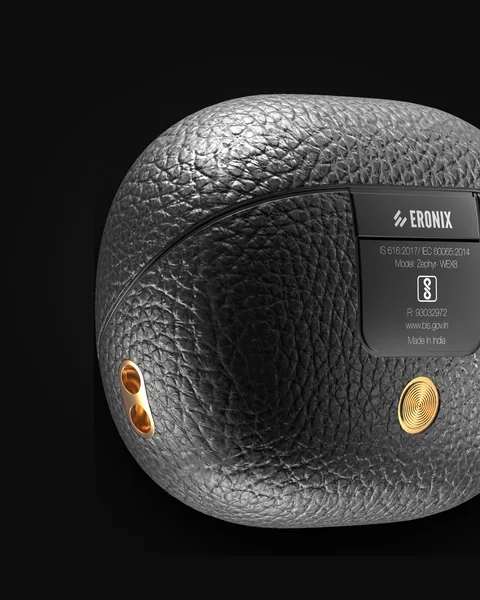
If your household moves between iPhone and Android, Zephyr covers both sides of the codec question: AAC for the iPhone, aptX HD for Android phones that support it, and SBC as the fallback.
Its 13 mm bio-cellulose driver with a composite titanium film runs on Bluetooth 5.4, and it travels in a NeoLeatherette case.
Step by step
- Check which codecs your earbuds support on the spec sheet.
- On Android, confirm the active codec in Bluetooth or developer settings.
- On iPhone, use the earbuds' app EQ to adjust tone.
- Try every ear tip size for the best seal.
- Compare phones at matched volume before judging sound.
Questions people ask
Does iPhone support LDAC or aptX?
No. SoundGuys notes that iOS supports AAC as its high-quality Bluetooth codec, and TechRadar reported in June 2025 that Apple had not enabled LE Audio or LC3. Earbuds with LDAC or aptX fall back to AAC or SBC on iPhone.
Is LDAC better than AAC?
LDAC can carry far more data, up to about 990 kbps according to SoundGuys, against AAC's lower rates. At its highest setting and with a strong connection, it can preserve more detail. Its actual rate depends on the settings chosen and the strength of the connection, so the gain you hear varies from setup to setup.
Why do my earbuds sound louder on Android?
Phones apply different volume curves and processing, and some Android phones offer absolute volume or loudness features. The earbuds' firmware may also behave differently per platform. Matching volume levels carefully is the only fair way to compare.
How do I check which codec my Android phone is using?
Open the paired earbuds in Bluetooth settings, where many phones show the active codec, or enable developer options to view and change it. If LDAC or aptX is supported by both devices, you can select it there.
Will LE Audio make iPhone and Android sound the same?
Not yet. Google supports LE Audio and LC3 on selected Android phones, but TechRadar reported Apple had not enabled it as of June 2025. Until both platforms support the same codec, differences remain.
Sources
- SoundGuys: Bluetooth LE Audio and LC3 explained · 11 Jul 2024
- TechRadar: AirPods still did not get this obvious update (LE Audio) · 9 Jun 2025
- Google: Share your world of sound with LE Audio on Android · 3 Sep 2025
- Bluetooth SIG: LE Audio, the next generation of Bluetooth audio · accessed 22 Nov 2026
Wireless Audio
Bluetooth, codecs, and the milliseconds that matter.
Read →Explainer · 1 min readHow active noise cancellation actually works
A race measured in fractions of a millisecond.
Read →Explainer · 5 min readLDAC, aptX, AAC: which codec your phone really uses
The logo on the earbud box is a promise. Your phone decides whether it is kept.
Read →Explainer · 5 min readWhat ANC can and cannot block
Why the bus engine fades but the conductor's voice does not, and what to check.
Read →Explainer · 4 min readTransparency mode: how earbuds let the world back in
Your earbuds can hear the platform announcement for you. Here is how, and where it stops.
Read →Explainer · 5 min readLE Audio and Auracast in plain words
The biggest change to Bluetooth sound in years, and why your earbuds may not have it yet
Read →