Journal · Explainer · 5 min read
The history of the phone charger, 2007 to now
Two decades, a hundredfold jump in power, and finally one plug. The long read
In 2007 a computer's USB port could offer a phone 2.5 W. Today the same family of standards allows 240 W through one small plug, nearly a hundred times more. How did we get from a drawer full of incompatible chargers to one cable that charges almost everything?
Short answerIn three waves. First, USB became the common source of power, with Micro-USB arriving in 2007. Second, brands raced ahead with their own fast-charging systems between 2013 and 2020. Third, USB-C and USB Power Delivery pulled everyone back to one standard, helped by EU law from 2024. Today the plug is shared; the speed still depends on the phone.
The timeline in numbers
2007: a modest start. Wikipedia's summary of USB hardware records that the USB-IF announced Micro-USB on 4 January 2007. A USB 2.0 port supplied up to 500 mA at 5 V, or 2.5 W, and only after the computer had set the device up; before that, the limit was 100 mA. Many phones still used their maker's own round pin or wide flat plug.
2010: more current. The USB Battery Charging 1.2 specification allowed up to 1.5 A at 5 V, or 7.5 W, which is when dedicated USB wall chargers became the norm. The same year, the Wireless Power Consortium released Qi 1.0 at a maximum of 5 W.
2012: two new connectors of a different kind. Apple introduced Lightning on 12 September 2012 with the iPhone 5, replacing the 30-pin dock connector. In July 2012, USB Power Delivery 1.0 was finalised, the first USB system to negotiate higher voltages. The first Qi phones, such as Nokia's Lumia 920 and the Nexus 4, appeared that year.
2013 to 2016: the fast-charging race. Qualcomm's Quick Charge 1.0 arrived in 2013 at 10 W, QC 2.0 in 2014 at 18 W, and QC 3.0 in 2016 at up to 36 W. Oppo unveiled VOOC in 2014, and its SuperVOOC of 2016 reached 50 W at 10 V and 5 A, using a two-cell battery. Each brand needed its own charger to go fast.
2014 to 2018: USB-C and programmable power. The USB Type-C connector, from 2014, brought 3 A at 5 V, about 15 W, as standard. USB PD 3.0 added the Programmable Power Supply mode, with a 3.3 to 21 V range, and on 8 January 2018 the USB-IF announced a fast-charger logo for PPS chargers that pass its testing. Quick Charge 4, from 2017, became USB PD compatible.
2017 to 2025: wireless matures. Apple adopted Qi with the iPhone 8 and iPhone X in 2017. The Qi Extended Power Profile, added in 2015, had already allowed 15 W. Qi2, in April 2023, added a Magnetic Power Profile based on Apple's MagSafe, and Qi2.2, in April 2025, supported up to 25 W.
2021 to now: one plug, more power. USB PD 3.1, announced in May 2021, raised the ceiling to 240 W at 48 V and 5 A. The EU's common charger rules require USB-C on hand-held devices sold from 2024, and Apple moved the iPhone 15 to USB-C on 22 September 2023. Oppo's 240 W SuperVOOC, shown in 2022, and Samsung's 60 W PPS charging on the Galaxy S26 Ultra, tested by Android Authority at 42 minutes from 0 to 100 per cent, show how far phones have come.
| Year | Standard or system | Maximum power |
|---|---|---|
| 2007 | USB 2.0 port | 2.5 W at 5 V |
| 2010 | USB Battery Charging 1.2 | 7.5 W at 5 V |
| 2013 | Quick Charge 1.0 | 10 W |
| 2014 | USB Type-C connector | About 15 W at 5 V 3 A |
| 2016 | Quick Charge 3.0 | Up to 36 W |
| 2016 | SuperVOOC | 50 W at 10 V 5 A |
| 2021 | USB PD 3.1 | 240 W at 48 V 5 A |
Source: Wikipedia summaries of USB hardware, Quick Charge and VOOC
W
Source: Wikipedia summaries of USB hardware, Quick Charge and VOOC
How charging got faster without frying phones
Power is voltage times current. The early USB port was fixed at 5 V, so the only way to add power was more current, and current makes heat in thin cables and small connectors. Every leap since has been a way around that limit.
The brands took two routes. Qualcomm's Quick Charge raised the voltage, to 9 V and 12 V, so the same cable carried more power. Oppo's VOOC kept voltage low and pushed high current through a special cable and battery, keeping heat out of the phone. Both worked; neither worked with the other.
USB Power Delivery made it a conversation. The charger lists what it can do, the phone asks for what it wants, and nothing above 5 V flows until both agree. PPS went further, letting the phone ask for an exact voltage in small steps, so the conversion happens in the charger, not the phone.
Think of the history of Indian railway gauges. For decades, broad, metre and narrow gauge lines meant changing trains at every junction. Unigauge conversion did not make every train faster, but it let any train run on any line. USB-C and USB PD are the unigauge of charging: one track, with the speed still set by the engine.
What the history means for you today
You can share chargers. A USB-C PD charger will charge most current phones, tablets and many laptops safely, even if not at each one's top speed.
Brand modes still exist. Some phones reach their fastest speeds only with their maker's own system or with a specific PPS range, so a generic charger may give a good but not maximum speed.
Cables matter again. At higher power, a USB-C cable must be rated for the current, which is why 5 A cables with an e-marker chip exist.
What to check before you buy
Look for USB PD, and PPS if you use an Android phone that needs it. These are the shared standards that history has settled on.
Match the charger to your fastest device, not your slowest. A charger with headroom will serve the next phone too.
Choose USB-C at both ends. Micro-USB and USB-A are the past; a USB-C cable carries more power and works with almost everything new.
Check the BIS mark and R-number. Whatever the standard, a charger sold in India should be registered.
Myth corner
Myth: USB-C means every charger charges every phone at full speed. USB-C is the plug. The speed depends on the charging system inside: USB PD, PPS or a brand's own mode. The common connector ended the drawer of incompatible plugs, but not the need to match charger and phone.
The right one for you
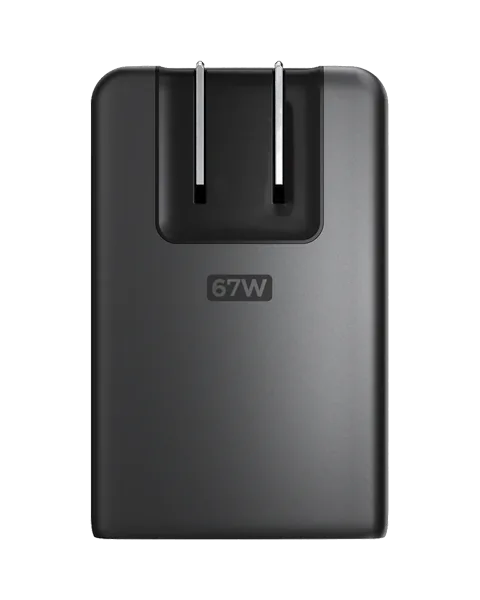
The one-charger era rewards a charger sized for your largest device. The Entropy67 offers PPS from 5 to 20 V at up to 3.35 A, adds Samsung Super Fast Charging, and gives 67 W from one port: enough for a MacBook Air and an iPhone 18 Pro from the same plug.
At 14 mm thin, it is the charger that stays in the bag.
Questions people ask
When did USB-C become the standard for phones?
The USB Type-C connector was specified in 2014 and spread through Android phones in the years after. The EU's common charger rules require USB-C on hand-held devices sold from 2024, and Apple switched the iPhone 15 series to USB-C in September 2023, completing the move for the major brands.
What was the first phone with wireless charging?
Qi 1.0 was released in 2010. Among the first phones to adopt Qi, in 2012, were Nokia's Lumia 920, the Samsung Galaxy S3 through an add-on back cover, and the Google and LG Nexus 4, according to Wikipedia's summary of the Qi standard. Apple added Qi to the iPhone 8 and iPhone X in 2017.
Why did every phone brand have a different charger?
Early USB supplied only 2.5 W to 7.5 W, so brands built their own systems to charge faster: Qualcomm's Quick Charge from 2013, Oppo's VOOC from 2014 and others. Each needed matching chargers and cables. USB Power Delivery and PPS later gave the industry a shared way to negotiate higher power.
What is the most powerful USB-C charging standard?
USB Power Delivery 3.1, announced in May 2021, introduced Extended Power Range with up to 240 W, at 48 V and 5 A. Phones do not use anywhere near that; it is aimed at laptops and larger devices. Some brands' own phone systems have also reached 240 W.
Sources
- USB hardware (Wikipedia: power history) · accessed 22 Nov 2026
- Quick Charge (Wikipedia) · accessed 22 Nov 2026
- VOOC (Wikipedia) · accessed 22 Nov 2026
- Qi (standard) (Wikipedia) · accessed 22 Nov 2026
- Lightning (connector) (Wikipedia) · accessed 22 Nov 2026
- Common external power supply (Wikipedia summary of EU rules) · accessed 22 Nov 2026
- Android Authority: Galaxy S26 Ultra 60W charging tested · accessed 22 Nov 2026
USB-C Power Delivery
One connector, a negotiated contract.
Read →Explainer · 5 min readAVS and USB PD 3.2: what is new
A phone asked a power bank for 18 V. Here is the rule that made it possible.
Read →Buying guide · 4 min readWhich charger does the Pixel 10 need?
30W, PPS, Qi2 at 15W: what the Pixel 10 asks for, and what you can skip.
Read →Buying guide · 4 min readWhich charger does the Pixel 10 Pro need?
Google sells the phone without a brick. Here is exactly which one to pair it with.
Read →Explainer · 5 min readHow to charge everything on one 65 W charger
Sixty-five watts is a budget. Spend it in the right order and it covers the whole bag.
Read →Explainer · 5 min readUSB Power Delivery explained in one page
How a charger and a phone agree on power before it flows, and how to read the label.
Read →