Journal · Explainer · 5 min read
Is it safe to charge from a car's USB port?
The port in your dashboard is usually safe and usually slow. Here is how to tell.
Most cars sold in India now have a USB port near the gear lever or on the stereo. Many drivers are wary of it: the car's electrics surge when you crank the engine, the voltage changes as the alternator works, and the roads are long and hot. Can that port harm a phone?
Short answerA factory USB port is generally safe. It supplies regulated 5 V as the USB standard requires, and the phone controls the current it takes. The usual problem is speed: many ports give about 500 mA, roughly 2.5 W. Plug in after starting, keep the phone out of sun, and use a 12 V USB-C PD charger for speed.
What a car port supplies, in volts and amps
Digital Trends, quoting an infotainment engineer at Mazda, notes that many built-in car USB ports follow the USB 1.0 and 2.0 specification of 500 mA. At 5 V, that is 2.5 W. Some cars provide more; the same article cites one model advertising 2.4 A, and explains that the Battery Charging Specification 1.2 allows dedicated charging ports up to 1.5 A.
Voltage is fixed by the standard. The ChromiumOS hardware reference gives 5.5 V as the maximum default USB voltage, and that on a USB-C connector, only USB Power Delivery may change the voltage, after the device agrees. A factory USB port does not pass the car's raw 12 V electrics through to your phone.
Separate 12 V socket chargers are built for the car's supply. In lygte-info.dk's test of one 45 W USB-C PD car charger, rated for 12 to 24 V input, its 5 V and 12 V PD outputs kept working with the input well below 12 V, while the 20 V output needed more than 11.5 V in, a sign of how such chargers handle dips.
| Source | Output | Note |
|---|---|---|
| Factory USB port, USB 1.0/2.0 | 500 mA, about 2.5 W | Common in built-in ports |
| Dedicated charging port, BC 1.2 | Up to 1.5 A | Allowed by the specification |
| One advertised car model | 2.4 A | Cited by Digital Trends |
| Default USB voltage | 5.5 V maximum | Only USB PD may change it |
Source: Digital Trends and ChromiumOS developer library, accessed Nov 2026
Current (A)
Source: Digital Trends, accessed Nov 2026
How the port protects your phone
Behind the dashboard port sits a small voltage regulator. It takes whatever the car's electrical system is doing, typically around 12 V and higher while the alternator charges, and converts it to a steady 5 V. Cranking the engine causes a brief dip; a well-designed regulator either rides through it or switches off for a moment. Either way, the phone sees 5 V or nothing.
Think of the pressure regulator on a cooking gas cylinder. The cylinder's pressure varies with how full it is and how warm the day is, but the stove always gets the same gentle flow. The car's 12 V system is the cylinder; the USB port's regulator is the valve.
Where the real risks are
Heat. Apple advises against leaving a phone in a parked car because temperatures can exceed its storage range, and says charging slows or stops when the phone gets too hot. A phone charging on a sunlit dashboard is the most common car charging problem in India.
Cheap add-on adapters. A factory port has been designed and tested with the car. A very cheap 12 V socket adapter may not regulate as well. Buy socket chargers from a known brand and an authorised seller.
Worn cables. A cable that is crushed in a seat rail or bent at the plug can short or spark. Replace any cable with exposed wires or a loose plug.
Running the battery flat. Charging with the engine off draws on the car battery. A phone is a small load, but avoid leaving devices plugged in for days in a car that is not being driven.
Aftermarket stereos and older cars
Aftermarket stereos are common in Indian cars, and their USB ports vary widely. Many are designed mainly to play music from a pen drive and supply the basic 500 mA that Digital Trends describes. If the stereo's manual does not state the port's output, assume it is the basic level. For older cars without any USB port, a well-made 12 V socket charger is the straightforward route.
Two-wheelers and USB sockets
Many scooters and motorcycles now have a USB socket under the seat or on the handlebar. The same principles apply: they are generally regulated to 5 V and often modest in output. On a two-wheeler, heat and water are the bigger concerns. Keep the phone in shade, close the socket's cover in rain, and do not leave a cable plugged into an exposed socket when parked.
What to check before you buy
Check your car's manual for the USB port's output. If it says 500 mA or 1 A, expect slow charging; if it says 2 A or more, or USB-C PD, it is more useful.
For faster charging, choose a USB-C PD charger for the 12 V socket, with an input rating that covers your vehicle, often 12 to 24 V.
Check that the charger fits the socket firmly. A loose fit loses contact on bumps and heats up.
Use a cable that is not damaged and that reaches without strain.
Myth corner
Myth: starting the engine while the phone is plugged in sends a surge that damages the battery. Fact: the port's regulator stands between the car's electrics and the phone, and USB voltage stays at 5 V or drops to zero. Plugging in after starting is a sensible habit, but a working factory port is designed for this moment.
The right one for you
For speed, the answer above is a USB-C PD charger in the 12 V socket, with an input rating that covers your vehicle.
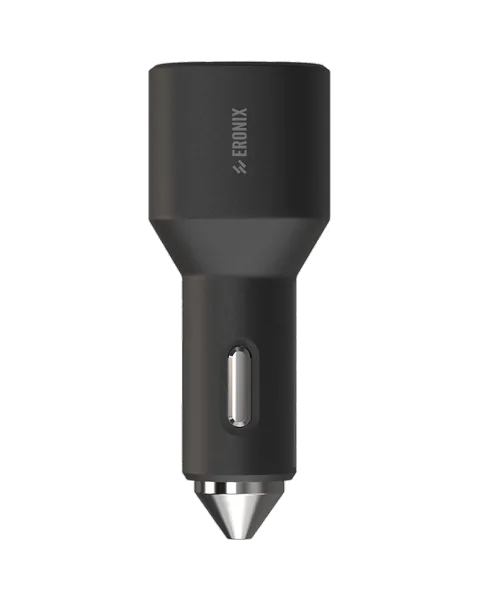
The Car Charger takes 12 or 24 V and offers two USB-C ports, 65 W and 30 W, with PD and PPS, and SUPERVOOC on the second port: a phone and a laptop charge together on a long drive. The aluminium body sits flush with the socket.
Step by step
- Start the engine before plugging in the phone.
- Check the car manual for the USB port's output.
- Use a USB-C PD charger in the 12 V socket for fast charging.
- Keep the phone out of direct sun while it charges.
- Replace any cable with damage near the plug.
Questions people ask
Can car USB charging damage my phone battery?
Not under normal conditions. A factory car USB port supplies regulated 5 V, and the phone decides how much current to draw. The bigger risk is heat: a phone charging in direct sun in a hot car can overheat, and Apple warns heat can permanently reduce battery capacity.
Why is my phone charging so slowly in the car?
Many car USB ports supply about 500 mA, roughly 2.5 W, which can fall behind a phone running maps and music. Check your car's manual for the port's output. A USB-C PD charger in the 12 V socket supplies much more and supports fast charging.
Should I unplug my phone before starting the car?
It is a reasonable habit, though a well-designed port regulates voltage and protects the phone. The engine start causes a brief voltage dip, and the port either rides through it or switches off momentarily. Plugging in once the engine is running avoids the question altogether.
Is the 12 V socket better than the car's USB port?
For speed, usually yes. A good 12 V USB-C PD charger can deliver tens of watts, while many built-in USB ports deliver about 2.5 W. For safety, both are fine if well made. Choose a 12 V charger from a known brand with an input rating that covers your vehicle.
Sources
- Why your USB car charger hardly works at all (Digital Trends) · accessed 22 Nov 2026
- Cable and Adapter Tips and Tricks (ChromiumOS developer library) · accessed 22 Nov 2026
- Test of a USB-C PD 45W car charger (lygte-info.dk) · accessed 22 Nov 2026
- If your iPhone or iPad gets too hot or too cold (Apple Support) · accessed 22 Nov 2026
USB-C Power Delivery
One connector, a negotiated contract.
Read →Explainer · 4 min readRoad-trip power planning
Maps, music, two phones and a dashcam. How to arrive with more charge than you left with.
Read →Explainer · 4 min readCharging in the car on long drives
Navigation, sunlight and fast charging all make heat. On a highway they arrive together.
Read →Explainer · 5 min readCan a 100 W charger damage your phone?
The watts on the brick are a ceiling, not a push. Heat is what your battery remembers.
Read →Explainer · 4 min readHotel room charging: making one socket work
One socket behind the bed, three devices, a 7 am meeting. Here is the plan.
Read →Explainer · 5 min readGaN chargers: what changed and what did not
A new material shrank the charger. Your phone's charging speed stayed where it was.
Read →