Journal · Explainer · 5 min read
Bass: why more is not always better
The low end fills a song. Push it too far and it starts to swallow everything else.
Walk past any earphone counter in India and the word on half the boxes is the same: bass. Extra bass, deep bass, mega bass. If a little low end makes music feel full, surely more makes it better?
Short answerNo. Bass sits roughly between 20 and 250 Hz, and a modest lift there makes music sound warm and full. Push it too far and the low end spills over voices and instruments, the sound turns muddy, and you raise the volume to hear the words. A good seal in your ear does more for bass than any boost button.
Where bass lives, in hertz and decibels
RTINGS, which measures headphones on a test rig, defines bass as the band from 20 Hz to 250 Hz: the rumble under a film score, the kick drum, the bass guitar. Above that sit the lower mids, where much of the body of a male voice and a guitar lives. The two bands touch, which is why one can mask the other.
Your ears are not equally sensitive across that range. The equal-loudness contours, first measured by Fletcher and Munson in 1933 and now standardised as ISO 226 (revised in 2003), show that below about 100 Hz perceived loudness changes very steeply with frequency, by as much as 24 dB per octave. That is why bass seems to vanish when you listen quietly and swell when you turn the volume up.
Seal matters even more than tuning. An AES E-Library paper on insert earphones reports in its abstract that a leak only 0.5 mm wide and 2.5 mm long can cut output at 50 Hz by about 15 dB. In decibel terms, that is a far bigger change than most bass boost settings make. SoundGuys shows the same effect in a fit test on its rig: with tips that did not seal, the bass fell away and the treble took over, though it did not publish a decibel figure.
Volume is the hidden cost. The World Health Organization lists 80 dB as safe for about 40 hours a week, but 90 dB for only 4 hours and 100 dB for just 20 minutes. It suggests keeping a phone at no more than 60 per cent of maximum volume.
| Item | Figure | Source |
|---|---|---|
| Bass band | 20 Hz to 250 Hz | RTINGS |
| Loudness slope below about 100 Hz | Up to 24 dB per octave | ISO 226 contours |
| Leak 0.5 mm wide, 2.5 mm long | About 15 dB less at 50 Hz | AES E-Library abstract |
| Safe phone volume | No more than 60% of maximum | WHO |
Source: RTINGS; ISO 226 summary; AES E-Library; WHO
Hours per week
Source: WHO, safe listening
How too much bass works against you
Think of bass like chilli in a curry. A measured amount lifts every other flavour. Double it and you stop tasting the cumin, the ginger and the tomato. You only taste heat. Sound behaves the same way. Loud low frequencies mask quieter sounds at nearby frequencies, so a heavy low end hides the lower mids, where the warmth of a voice sits.
Your brain then does something predictable: it asks for more of what it is missing. To hear the singer clearly over the boom, you turn the volume up. Now every band is louder, including the bass that caused the problem. On a crowded metro, where the train already adds its own low rumble, this loop happens fast.
There is also a physical limit. A small earbud driver has to move further to produce deep notes at high level. When it runs out of room, it distorts, and the bass turns from a tight thump into a loose, flabby boom. More boost on paper can mean less clean bass in your ear.
Finally, recordings already have a balance. A mastering engineer decided how loud the kick drum sits against the vocal. A strong bass lift redraws that balance for every song, whether it needs it or not. Hip-hop may survive it. A ghazal or an acoustic set usually does not.
Signs your bass is set too high
Lyrics are hard to follow even when the song is familiar.
Male voices and spoken podcasts sound thick or boxy, as if recorded in a cupboard.
You notice you keep raising the volume during a song and never lowering it.
Fast bass lines blur into a single hum instead of separate notes.
What to check before you buy
Bring one song you know well, ideally with a clear vocal and a real bass line. Listen for whether you can follow both at once. If the voice sinks behind the bass, the tuning is too heavy for everyday listening.
Try every ear tip size in the box. A size that seals properly can bring back more low end than a bass mode, as the 15 dB leak figure shows. If the earbuds sound thin, change the tip before you judge the sound.
Ask whether the companion app has an equaliser. A tuning you can adjust is safer than one that is fixed loud. You can add bass for the gym and pull it back for calls and podcasts.
Listen at a sensible level, not at full volume in a noisy shop. Bass always seems bigger when it is loud. A pair that still sounds full at about half volume will serve you better at home and on the move.
If the store is noisy, step aside or cup your hands around the earbuds. A loud room masks detail and pushes you to judge only the boom.
Myth corner
Myth: a bigger driver always means more bass. Driver size is only one part. The seal in your ear and the tuning matter as much, which is why a well-sealed small earbud can sound fuller than a loose one with a larger driver. Judge by listening, not by the number in millimetres.
The right one for you
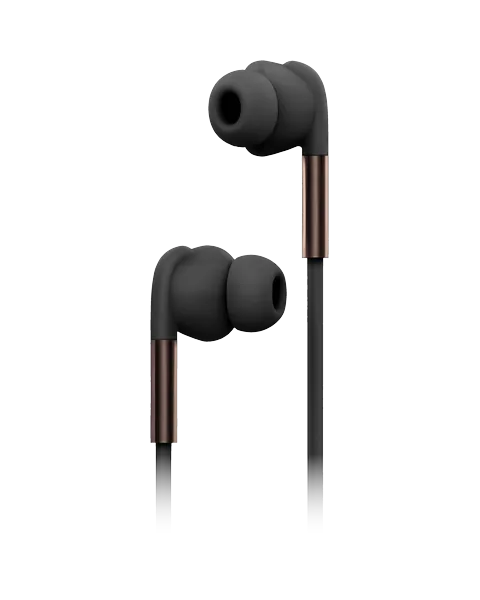
Seal does more for bass than any boost button, so start with fit. Xenon comes with ear tips in three sizes to find that seal, and dual titanium drivers in a metal housing.
It plugs into any USB-C phone, iPhone 15 and later included, through a 24-bit/96 kHz DAC in the cable, with an in-line mic and remote: no battery, nothing to charge.
Step by step
- Pick one familiar song with a clear vocal and a real bass line.
- Fit the earbuds with each ear tip size and keep the one that seals best.
- Set the volume to about half and turn any bass boost off.
- Listen for whether the voice and the bass are both easy to follow.
- Add bass in small steps in the app, stopping before the voice starts to sink.
Questions people ask
Why do my earbuds have no bass?
The most common cause is a poor seal. Research published in the AES E-Library found that a tiny leak, 0.5 mm wide, can cut output at 50 Hz by about 15 dB. Try a larger or smaller ear tip, push the earbud in gently with a slight twist, and check that the tip is not torn or loose.
Is bass boost bad for your hearing?
Bass boost itself is not the risk; loudness is. Heavy bass can mask voices, which tempts people to turn the volume up. The WHO lists 80 dB as safe for about 40 hours a week but 100 dB for only 20 minutes. Keeping the phone at no more than 60 per cent volume is its simple rule.
Why does bass sound weaker at low volume?
Human hearing is less sensitive to low frequencies at quiet levels. The equal-loudness contours in ISO 226 show the level needed for bass to sound as loud as midrange rising steeply below about 100 Hz. Turn the volume down and bass seems to fade first, even though the earbuds have not changed.
What frequency range counts as bass?
Measurement labs such as RTINGS treat bass as roughly 20 Hz to 250 Hz. The lowest part is felt as rumble, the middle as the punch of a kick drum, and the top part blends into the lower mids, where much of a male voice sits. Too much energy near 250 Hz is what makes sound muddy.
Should I use the bass boost setting in my earbuds app?
Use it for a purpose, not by default. A small lift can help in a noisy place or for bass-led genres. For calls, podcasts and acoustic music, a flatter setting keeps voices clear. If the app has a full equaliser, make small changes of a few decibels rather than one large boost.
Sources
- RTINGS: Headphone sound quality tests, bass accuracy · accessed 22 Nov 2026
- Equal-loudness contour (Wikipedia summary of Fletcher-Munson and ISO 226) · accessed 22 Nov 2026
- AES E-Library: paper on insert earphone leakage and bass response (abstract) · accessed 22 Nov 2026
- SoundGuys: How your in-ears fit matters a lot · accessed 22 Nov 2026
- WHO: Deafness and hearing loss, safe listening · accessed 22 Nov 2026
Acoustics
What a driver actually does.
Read →Explainer · 4 min readHi-Res Audio on Bluetooth: what is real
The badge on the box is real. So is the compression that makes it fit.
Read →Explainer · 4 min readCleaning earbuds safely
Most earbud damage during cleaning comes from the toothpick, not the dirt.
Read →Explainer · 5 min readWhat 'drivers' and 'mm' mean on a spec sheet
12 mm sounds bigger than 10 mm. Your ears may not agree, and here is why.
Read →Explainer · 5 min readFrequency response charts, read simply
One wiggly line can tell you whether earbuds will sound boomy, harsh or just right.
Read →Explainer · 5 min readLDAC, aptX, AAC: which codec your phone really uses
The logo on the earbud box is a promise. Your phone decides whether it is kept.
Read →