Journal · Explainer · 4 min read
Hi-Res Audio on Bluetooth: what is real
The badge on the box is real. So is the compression that makes it fit.
You pay for a lossless music plan, pick an album marked Hi-Res, and pair earbuds with a gold Hi-Res Audio Wireless badge on the box. Are you hearing the studio file, bit for bit?
Short answerNot quite. Bluetooth can carry hi-res music, but it compresses it to fit. A 24-bit, 96 kHz stereo file needs about 4.6 Mb/s; Sony's LDAC, the most common hi-res Bluetooth codec, peaks at 990 kb/s. Newer codecs can carry CD-quality audio losslessly in good conditions. For true hi-res lossless, you still need a wire.
The numbers: file sizes against Bluetooth bandwidth
Start with the music. Uncompressed stereo audio needs bit depth times sample rate times two channels. CD quality, 16-bit at 44.1 kHz, is about 1.4 Mb/s. Hi-res at 24-bit and 96 kHz is about 4.6 Mb/s. At 24-bit and 192 kHz it is about 9.2 Mb/s. Apple's 2021 announcement of Apple Music Lossless lists tiers from 16-bit/44.1 kHz up to 24-bit/48 kHz, with Hi-Res Lossless up to 24-bit/192 kHz, which Apple says needs external equipment such as a USB digital-to-analogue converter.
Now the pipe. An engineering analysis of Bluetooth audio by ValdikSS on Habr puts the realistic audio payload of Bluetooth Classic at about 1.4 to 2.1 Mb/s, depending on packet type and radio conditions.
And the codecs. What Hi-Fi?'s codec guide, updated November 2024, lists aptX HD at up to 576 kb/s for 24-bit/48 kHz, LDAC up to 990 kb/s with 96 kHz support, and aptX Lossless at about 1.1 to 1.2 Mb/s for lossless 16-bit/44.1 kHz. Its table also lists aptX Lossless at up to 24-bit/96 kHz; the lossless claim in its text applies to CD quality, so treat higher resolutions as lossy. Sony's LDAC page says its bit rate switches between 330, 660 and 990 kb/s in best-effort mode. SoundGuys found many phones default to 330 kb/s unless you change a developer setting.
| Codec | Top bit rate | Resolution |
|---|---|---|
| LC3 (LE Audio) | 345 kb/s | Up to 48 kHz |
| aptX HD | 576 kb/s | 24-bit/48 kHz |
| LDAC | 990 kb/s | Up to 96 kHz, lossy |
| aptX Lossless | 1.1 to 1.2 Mb/s | 16-bit/44.1 kHz lossless |
Source: What Hi-Fi?, Nov 2024; Sony; SoundGuys; Bluetooth SIG
kb/s
Source: What Hi-Fi?; Sony; bit-rate arithmetic in the article
How hi-res codecs fit big files into a small pipe
A hi-res codec keeps the file's sample rate and bit depth as labels, but throws away detail it judges you are least likely to hear, much as JPEG does with a photo. LDAC at 990 kb/s keeps roughly a fifth of a 24-bit/96 kHz stream's raw data.
Think of a large painting photographed for a phone screen. The colours and size are right, and most people cannot tell the difference at arm's length. Under a magnifying glass, the brush strokes have been smoothed. That is lossy hi-res over Bluetooth.
Lossless is a different trick. It shrinks the file the way a ZIP archive does, with nothing thrown away. CD-quality music compresses losslessly to roughly the 1.1 to 1.2 Mb/s that What Hi-Fi? lists for aptX Lossless, which fits Bluetooth in good conditions. Hi-res does not, yet.
What the Hi-Res Audio Wireless badge means
Sony says LDAC meets the Hi-Res Audio Wireless logo requirement only at its top transfer rate of 990 kb/s. The badge tells you the earbuds support a high-bit-rate codec capable of carrying hi-res signals. It does not promise lossless playback, and it does not promise your phone will use the top rate.
Read it as a sign of capability, then check what your own phone actually negotiates.
Where LE Audio fits
LE Audio, the newer Bluetooth audio system, uses the LC3 codec. The Bluetooth SIG lists sample rates up to 48 kHz, and SoundGuys lists bit rates up to 345 kb/s. Its strength is efficiency rather than hi-res: in the SIG's listening tests, LC3 at 160 kb/s scored better than SBC at 345 kb/s.
That makes LE Audio a better everyday codec, with longer battery life and features such as broadcast audio, rather than a route to studio files. The honest summary for 2027: CD-quality lossless is arriving on Bluetooth in good conditions; true hi-res lossless still needs a cable.
What to check before you buy
Check your phone's codecs first. What Hi-Fi? notes iPhones support AAC and SBC, and you cannot switch between them, so LDAC or aptX earbuds connect to an iPhone over AAC.
On Android, check the Bluetooth codec setting. LDAC's quality depends on whether your phone runs it at 330, 660 or 990 kb/s.
Look for aptX Lossless or LE Audio if you want CD-quality lossless, and confirm both phone and earbuds support it.
Expect the top rate only in good conditions. Bit rates step down when the phone is in a pocket or the room is crowded with 2.4 GHz traffic.
Spend on fit before format. A poor ear-tip seal costs far more audible detail, especially bass, than codec differences.
Myth corner
Myth: a Hi-Res badge means you hear the studio master over Bluetooth. Fact: even LDAC at 990 kb/s carries roughly a fifth of a 24-bit/96 kHz stream's raw data, by simple arithmetic. It can sound excellent, but it is lossy. For true hi-res lossless, use a wired connection and, as Apple notes, a suitable DAC.
The right one for you
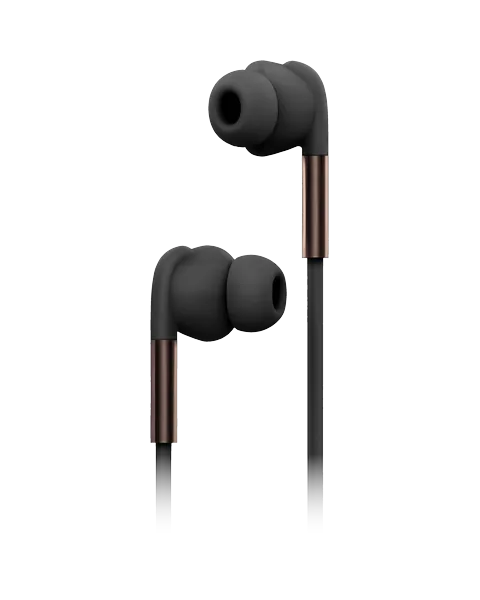
For the 24-bit, 96 kHz files that Bluetooth cannot carry whole, the Xenon takes the wire: USB-C earphones with their own 24-bit/96 kHz DAC in the cable, for iPhone 15 and later and every USB-C phone. No pairing, no battery.
Dual 14 mm titanium drivers sit in a metal housing, with ear tips in three sizes for the seal that matters more than the format.
Questions people ask
Do AirPods play Apple Music Lossless?
Over Bluetooth, iPhones send audio to AirPods using AAC, a lossy codec, so the lossless file is compressed for the wireless link. What Hi-Fi? notes iPhones support only AAC and SBC. Apple's Hi-Res Lossless tier, up to 24-bit/192 kHz, needs external equipment such as a USB DAC.
Is LDAC lossless?
No. LDAC is a lossy codec that can carry hi-res signals at up to 990 kb/s, according to Sony. It sounds very good at its top rate, but a 24-bit/96 kHz stereo file holds about 4.6 Mb/s of raw data, so LDAC must discard some of it to fit.
How do I make LDAC use 990 kb/s on Android?
Many phones choose the rate automatically, often starting at 330 kb/s, as SoundGuys found. SoundGuys points to the Best effort setting in Developer options, under the Bluetooth audio LDAC codec entry, to let the phone aim for higher rates. The phone may still drop the rate in poor radio conditions to avoid dropouts.
Can I hear the difference between AAC and LDAC?
Some listeners can on quiet, detailed recordings with well-sealed earbuds; many cannot in daily use, especially outdoors. Fit, tuning and noise around you usually matter more. Try both on your own music before paying extra for a codec.
What is aptX Lossless?
It is a Qualcomm codec designed to carry CD-quality, 16-bit/44.1 kHz audio over Bluetooth without discarding data, using about 1.1 to 1.2 Mb/s, per What Hi-Fi?. Both phone and earbuds must support it, and it scales down in poor conditions. It does not carry 24-bit hi-res losslessly.
Sources
- What are the best Bluetooth codecs? aptX, AAC, LDAC and more explained (What Hi-Fi?) · 15 Nov 2024
- LDAC (Sony) · accessed 22 Nov 2026
- Apple Music announces Spatial Audio and Lossless Audio (Apple Newsroom) · 17 May 2021
- Bluetooth codecs explained (SoundGuys) · 30 May 2025
- Audio over Bluetooth: most detailed information about profiles, codecs, and devices (ValdikSS, Habr) · 17 Jun 2019
- A Technical Overview of LC3 (Bluetooth SIG) · accessed 22 Nov 2026
Wireless Audio
Bluetooth, codecs, and the milliseconds that matter.
Read →Explainer · 5 min readLDAC, aptX, AAC: which codec your phone really uses
The logo on the earbud box is a promise. Your phone decides whether it is kept.
Read →Explainer · 5 min readWhat ANC can and cannot block
Why the bus engine fades but the conductor's voice does not, and what to check.
Read →Explainer · 4 min readTransparency mode: how earbuds let the world back in
Your earbuds can hear the platform announcement for you. Here is how, and where it stops.
Read →Explainer · 4 min readWhy earbuds sound different on iPhone and Android
Same earbuds, same song, two phones. The difference starts before the sound reaches you.
Read →Explainer · 5 min readHow Bluetooth audio actually travels
From the music file to your ear in about a sixth of a second: every step, in order.
Read →