Journal · Explainer · 4 min read
Can you use a Samsung charger on an iPhone?
Different logos, same plug, shared standard. What decides the speed is two letters: PD.
One household, one Galaxy and one iPhone, and a single charger on the bedside table. Is it safe to share, and will the iPhone fast-charge from a Samsung brick?
Short answerYes and yes, if the Samsung charger is a USB-C model that supports USB Power Delivery, which current Samsung fast chargers do. The iPhone will negotiate a standard PD voltage and fast-charge normally. Older Samsung USB-A cubes without PD will still charge an iPhone, but slowly. The cable and the standard matter, not the logo.
What each phone asks for
Apple's fast-charge page says iPhones need an 18 W or higher USB-C adapter that supports USB-PD to fast-charge. It names no brand. Its page on USB power adapters adds one caution: adapters from other makers should meet applicable safety standards.
Samsung's fast charging runs on the same family of standards. In Android Authority's 2026 test of the Galaxy S26 Ultra's 60 W mode, the charger had to support USB PD 3.1 with PPS, Programmable Power Supply, and supply 20 V at 3 A from one port. PPS is a feature inside USB Power Delivery, which is why a Samsung USB-C fast charger also speaks the standard PD voltages an iPhone uses.
Independent tests show iPhones are not fussy about brand. ChargerLAB found the iPhone 16 settling at about 23 W across Apple, third-party and power bank sources, with third-party 20 W PD chargers giving about 19 W. On the iPhone 15 Pro Max, most chargers it tried fed the phone at 9 V and 3 A, about 25 to 27 W.
Brand-specific chargers can be the exception. In the same iPhone 15 Pro Max test, ChargerLAB found one phone maker's 65 W charger delivering only 17 W, the lowest result. A charger built mainly around its own brand's fast-charging protocol may offer only modest standard PD output, so check the label.
| Phone | What it needs or draws |
|---|---|
| iPhone, to fast-charge | 18 W or higher USB-C PD |
| iPhone 16, measured | about 23 W |
| iPhone 15 Pro Max, measured | 9 V at 3 A, about 25 to 27 W |
| Galaxy S26 Ultra, 60 W mode | USB PD 3.1 with PPS, 20 V at 3 A |
| iPhone 16 Pro, wireless | 7.5 W Qi; 25 W MagSafe |
Source: Apple Support; ChargerLAB; Android Authority, 2026
Watts
Source: ChargerLAB, iPhone 16 Compatibility 100, November 2024
How one charger serves two brands
When an iPhone is connected, it and the charger exchange messages over the USB-C cable. The charger lists the voltages and currents it offers; the iPhone chooses one, usually 9 V, or 15 V where available. A Galaxy on the same charger may instead request a PPS voltage in fine steps. Each phone takes what it understands and ignores the rest.
Think of it like a restaurant menu printed in two languages. The kitchen is the same, and each diner orders from the section they can read. Nobody is served a dish they did not ask for.
That is also why a higher-watt Samsung charger is safe for an iPhone. A 45 W Samsung charger offers more, but the iPhone orders only its usual 20 to 27 W.
What to check before you buy
Look for USB-C and the letters PD on the charger or its label. That is what an iPhone needs to fast-charge.
Read the output line for 9 V. A label listing 9 V at 2.22 A or more gives at least 20 W at that voltage.
Avoid relying on old USB-A cubes. Without USB-C PD, they will not fast-charge an iPhone, as Apple's requirements make clear.
Use a USB-C to USB-C cable. The cable that came with a Galaxy works for an iPhone with a USB-C port.
For a shared charger, choose one that lists both PD and PPS. It can fast-charge both phones.
Samsung wireless pads and power banks with iPhone
Wireless works across brands too, as long as both the pad and the phone follow the Qi standard of the Wireless Power Consortium. Speed is the catch. Apple lists the iPhone 16 Pro at up to 7.5 W on ordinary Qi chargers, against up to 25 W on MagSafe with a 30 W adapter. A non-magnetic pad from any brand will charge an iPhone, but slowly, and alignment matters because there are no magnets to centre the coils. If the phone sits off-centre, it may barely charge at all.
Power banks follow the same rule as wall chargers. ChargerLAB's iPhone 16 compatibility test, published in November 2024, included a Samsung 25 W power bank, which delivered about 23.5 W, the highest of the power banks it tried; the others gave 19 to 24 W. The common thread is USB-C Power Delivery, not the name on the casing.
For a shared bedside, the simplest setup is one USB-C PD charger that also lists PPS, with one USB-C to USB-C cable. Both phones fast-charge from it, each on the protocol it prefers, and there is one less brick on the table and one less socket taken.
Myth corner
Myth: Android chargers damage iPhones. A USB-C Power Delivery charger does not, whatever the brand, because the iPhone sets the terms of every charge. ChargerLAB's tests found iPhones charging normally across many makers' PD chargers. The risk lies with unmarked chargers that do not follow the standard, not with brand logos.
The right one for you
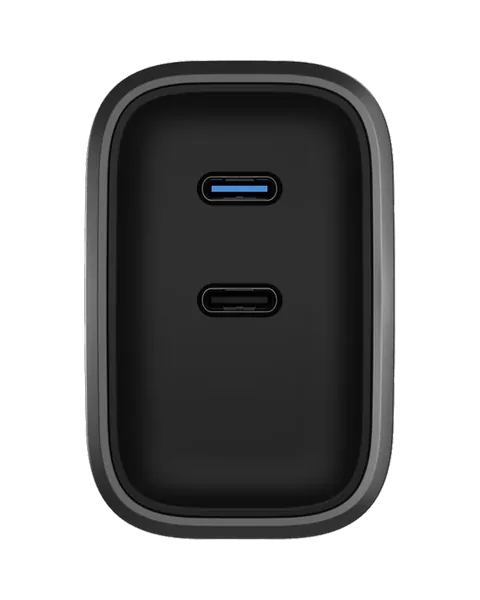
For a bedside shared by an iPhone and a Galaxy, the Fermi45 meets both checklists above. It lists PD lines of 9 V at 3 A and 15 V at 3 A for the iPhone, and PPS from 5 to 20 V with Samsung Super Fast Charging 2.0 for the Galaxy, with 45 W from one port.
Its two USB-C ports share the power as 25 W and 20 W, or 30 W and 15 W, so both phones charge overnight from one socket.
Step by step
- Check the Samsung charger has a USB-C port and the PD mark.
- Confirm the label lists 9 V output at 2.22 A or more.
- Use a USB-C to USB-C cable in good condition.
- Plug in the iPhone; it negotiates its own power level.
- For a shared charger, prefer one listing both PD and PPS.
Questions people ask
Will a Samsung 25 W charger fast-charge my iPhone?
Yes, if it is a USB-C model with Power Delivery. Apple requires an 18 W or higher USB-C PD adapter for iPhone fast charging, and a 25 W PD charger exceeds that. Expect the iPhone to draw around 20 W from it, as ChargerLAB found with other 20 to 25 W PD chargers.
Can I charge a Galaxy with an iPhone charger?
Yes. Apple's 20 W USB-C charger is a USB PD charger, so a Galaxy will charge from it. It will not reach Samsung's top Super Fast Charging speeds, which need PPS; Android Authority's S26 Ultra test needed PD 3.1 with PPS at 20 V, 3 A.
What is PPS on a charger?
Programmable Power Supply is part of USB Power Delivery. It lets a phone request voltage in fine steps instead of fixed levels. Samsung uses it for its fastest charging modes. iPhones do not need PPS but charge normally from PPS chargers through standard PD voltages.
Why does my iPhone charge slowly on my Samsung charger?
It may be an older USB-A Samsung cube without USB-C Power Delivery, or a cable that is damaged. Apple says fast charging needs an 18 W or higher USB-C PD adapter. Switch to a USB-C PD charger and a USB-C to USB-C cable.
Is it safe to use a 45 W Samsung charger with an iPhone?
Yes. Over USB-C PD, the iPhone negotiates only what it can accept, usually 20 to 27 W in ChargerLAB's tests. The extra capacity of a 45 W charger goes unused rather than being forced into the phone.
Sources
- Apple Support: Fast charge your iPhone · 22 Oct 2026
- Apple Support: About Apple USB power adapters · 11 Jul 2024
- Android Authority: Galaxy S26 Ultra 60W charging tested · accessed 22 Nov 2026
- ChargerLAB: Apple iPhone 16 charging test, Compatibility 100 · 1 Nov 2024
- ChargerLAB: Apple iPhone 15 Pro Max charging test, Compatibility 100 · 25 Sep 2023
- Apple Support: iPhone 16 Pro technical specifications · accessed 22 Nov 2026
USB-C Power Delivery
One connector, a negotiated contract.
Read →Buying guide · 4 min readWhich charger does the Galaxy S26 Ultra need?
Sixty watts on the box. Here is what it takes to get it.
Read →Explainer · 5 min readUSB Power Delivery explained in one page
How a charger and a phone agree on power before it flows, and how to read the label.
Read →Explainer · 5 min readPPS: why Samsung phones care about it
Three letters on a charger label decide whether a Galaxy charges at full speed or half.
Read →Buying guide · 5 min readWhich charger does the Galaxy S26 need?
Three phones, three speeds, one protocol called PPS. Here is what to buy and what to skip.
Read →Buying guide · 4 min readWhich charger does the Galaxy S26+ need?
Samsung promises 69 percent in about 30 minutes. One word on the label decides it.
Read →