Journal · Buying guide · 4 min read
Which charger does the iPhone 16e need?
The 16e charges like its siblings on a cable and very differently without one.
The iPhone 16e looks like its bigger siblings from the front, but turn it over and there is no MagSafe ring. So does it need a different charger, and is that stand on your desk still any use?
Short answerA 20 W USB-C Power Delivery charger meets Apple's claim of up to 50% in 30 minutes. A 30 W or higher charger lifts the peak a little, to about 23 to 26 W in lab tests. Wireless charging works on standard Qi pads at about 7.5 W, but the phone has no MagSafe magnets.
iPhone 16e charging speed in watts and minutes
Apple's technical specifications for the iPhone 16e promise up to 50% in 30 minutes with a 20 W adapter or higher and a USB-C cable. Apple notes it tested with its 20 W adapter on pre-production units. The box contains a 1 m USB-C cable and no adapter. Wireless charging is listed as working with Qi chargers.
ChargerLAB's review, published in March 2025, measured a 4,005 mAh battery. On Apple's 35 W charger, the phone peaked at about 26 W and held it for the first 17 minutes, then stepped down to about 19 W and 14 W, dropping to 5 V at about 47 minutes. It reached 50% in 24 minutes, 80% in 50 minutes and 100% in 1 hour 48 minutes.
In ChargerLAB's compatibility round, Apple chargers of 30 W and higher delivered about 23 W, and Apple's 20 W charger delivered about 18 W. Third-party chargers above 30 W gave between 23 and 25 W, and power banks fell in the same 18 to 25 W band.
Heat ran higher than on the larger phones. ChargerLAB recorded the back reaching 44.2 °C at 20 minutes and staying above 40 °C for the first half hour.
| Charger | Power at the phone | Source |
|---|---|---|
| Apple 20 W USB-C | About 18 W | ChargerLAB |
| Apple 30 W and higher | About 23 W | ChargerLAB |
| Third-party above 30 W | 23 to 25 W | ChargerLAB |
| Apple 35 W, peak | About 26 W | ChargerLAB |
| MagSafe Charger (as Qi) | About 7.5 W | ChargerLAB |
Source: ChargerLAB, Mar 2025
Minutes
Source: ChargerLAB, Mar 2025
How the iPhone 16e charges
Like other recent iPhones, the 16e uses USB Power Delivery. The charger offers fixed voltage steps and the phone picks one. In ChargerLAB's test it settled around 8.5 V and 2.75 A on a 35 W charger, which a 20 W charger can only partly supply. That is where the gap between 18 W and 23 W comes from.
Think of it like a scooter on a flyover. A bigger engine helps you climb the ramp faster, but once you reach the speed limit, more engine does nothing. The 16e's limit is in the mid-20s of watts, so a 30 W charger takes you to it and a 100 W charger takes you no further.
Wireless is where the 16e differs most. With no magnet ring, it cannot snap onto MagSafe or Qi2 chargers. MacRumors reported that the iOS 26 update raising Qi2 speeds to 25 W covers all iPhone 16 models except the 16e. ChargerLAB put the 16e on Apple's MagSafe Charger and estimated about 7.5 W reaching the phone.
20 W vs 30 W for the 16e
On a typical morning top-up, a 20 W charger will get you to about half in 30 minutes, as Apple says. A 30 W charger gets there a few minutes sooner, based on ChargerLAB's 24-minute result. If you already own a good 20 W USB-C charger, keep it.
If you are buying new, a compact 30 W charger is the better long-term choice. It has headroom for the next phone, for an iPad and for a MagSafe or Qi2 charger if you upgrade later.
What you can skip
Skip chargers above 30 W unless they will also serve a laptop or tablet. ChargerLAB found third-party chargers above 30 W topped out at about 25 W on the 16e.
Skip 5 A and 240 W cables. The 16e draws under 3 A. Skip Qi2 25 W chargers bought for this phone alone; it will use them only at basic Qi speed.
What to check before you buy
Look for USB-C PD on the charger and a 9 V output of at least 2.22 A, which is 20 W. A 30 W charger will also list 15 V, which the 16e does not use but other devices will.
Use the cable in the box, or any USB-C to USB-C cable rated 3 A. The 16e's USB-C port runs data at USB 2 speed, up to 480 Mb/s per Apple, so a pricey high-speed cable adds nothing here.
For wireless, choose a flat Qi pad or stand with a clear alignment guide. Without magnets, the phone must sit centred on the coil. Expect about 7.5 W.
If you want magnetic mounting, buy a case with a built-in magnetic ring. It will hold the phone on magnetic stands and mounts, but it does not raise wireless charging speed.
Myth corner
Myth: the iPhone 16e cannot charge on a MagSafe charger. Fact: it can, because MagSafe chargers also speak Qi. ChargerLAB measured roughly 7.5 W reaching the phone. It will not snap into place, though, and it will not charge at MagSafe speeds.
The right one for you
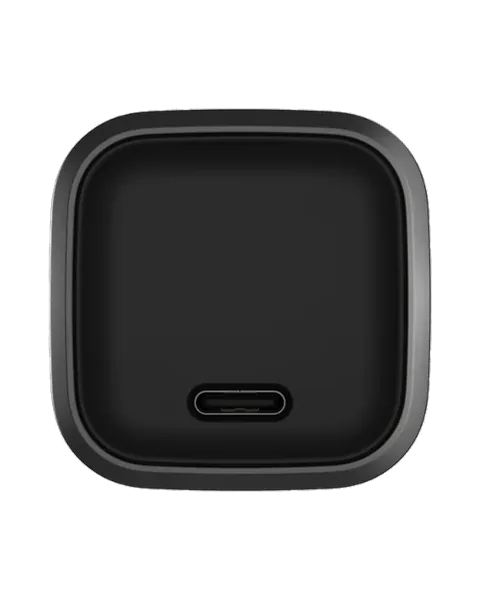
The 16e asks for USB-C Power Delivery with a 9 V step of at least 2.22 A, and gains a little from a 30 W charger. The Fermi30 lists 9 V at 3 A among its fixed rails and 30 W from one USB-C port, enough to take the 16e to its mid-20s peak with headroom for an iPad or a future phone.
It is made for the iPhone 16 family, the 16e included. At 49.6 × 32 × 32 mm and 42 g, it is as small as the 20 W cube it replaces.
Step by step
- Choose a USB-C PD charger of 20 W or more; 30 W for headroom.
- Use the 1 m USB-C cable in the box or any 3 A USB-C cable.
- For wireless, centre the phone on a Qi pad and expect about 7.5 W.
- Add a magnetic case only if you want magnetic mounting.
Questions people ask
Does the iPhone 16e support MagSafe?
No. Apple's specifications list Qi wireless charging only, and the phone has no MagSafe magnet ring. It can still charge on a MagSafe charger at around 7.5 W, as ChargerLAB found, but it will not attach magnetically or charge at MagSafe's higher speeds.
Is a 20 W charger enough for the iPhone 16e?
Yes. Apple rates the 16e at up to 50% in 30 minutes with a 20 W or higher adapter. ChargerLAB measured about 18 W from Apple's 20 W charger, against about 23 W from 30 W and higher chargers, a small difference in daily use.
How long does the iPhone 16e take to charge fully?
In ChargerLAB's test on Apple's 35 W charger, the iPhone 16e reached 50% in 24 minutes, 80% in 50 minutes and 100% in 1 hour 48 minutes. On a 20 W charger, expect the first half to take about 30 minutes, per Apple's claim.
Does the iPhone 16e support Qi2?
No. Qi2 relies on a magnetic ring, which the 16e lacks. MacRumors reported that the iOS 26 update enabling Qi2 at up to 25 W applies to iPhone 16 models except the 16e. The 16e works on Qi2 chargers using their basic Qi mode.
Will a magnetic case make the iPhone 16e charge faster wirelessly?
No. A magnetic case helps the phone stay aligned on magnetic chargers and mounts, which can stop it slipping off the coil. The phone's wireless input stays at basic Qi speed, about 7.5 W, whatever case you use.
Sources
- iPhone 16e - Technical Specifications (Apple Support) · accessed 22 Nov 2026
- 4005mAh+27W | Charging Review of iPhone 16e (ChargerLAB) · 27 Mar 2025
- iOS 26 Adds 25W Qi2 Wireless Charging Support to iPhone 16 Models (MacRumors) · 23 Aug 2025
USB-C Power Delivery
One connector, a negotiated contract.
Read →Buying guide · 4 min readWhich charger does the iPhone 16 need?
Why 30 W is the sweet spot for this iPhone, even though it rarely takes 30 W
Read →Buying guide · 4 min readWhich charger does a 3-in-1 wireless stand need?
The stand promises the watts. The plug in the wall decides whether you get them.
Read →Buying guide · 5 min readWhich charger does the iPhone 15 Pro need?
Twenty watts does the job. Here is what the lab saw, and what you can leave on the shelf.
Read →Buying guide · 5 min readWhich charger does a 15 W MagSafe puck need?
The puck is only as fast as the plug behind it. Here is the adapter that unlocks 15W.
Read →Buying guide · 4 min readWhich charger does the iPhone 16 Pro need?
Nine chargers, one phone, and a 7-minute spread between 20 W and 140 W
Read →