Journal · Explainer · 4 min read
Why does my new charger have no cable?
The box is not short of a part. The cable you need depends on what you plug in.
You pay for a new charger, lift the tray, and find an empty space where a cable should be. Did the factory skip a part, or is a ₹2,190 Apple adapter meant to come alone?
Short answerIt is deliberate. Phones now ship with a USB-C cable but no adapter, and many adapters ship without a cable, so you are not paying twice for the same part. Use the cable that came with your phone, or buy one rated for your charger: 60 W covers phones, 100 W or 240 W suits laptops.
What actually comes in the box now
Apple's support page on its USB power adapters states plainly that iPhone models no longer include a power adapter, but do include a charge cable that supports fast charging. The adapter is the part that went missing from the phone box, not the cable.
The reverse is true on the adapter side. Apple India's listing for its 20 W USB-C power adapter, at an MRP of ₹2,190, says the charging cable is sold separately and the box holds only the adapter. Many other chargers follow the same pattern, especially those with USB-C ports, because a USB-C to USB-C cable from the phone box fits them directly.
Regulation is pushing in the same direction. The European Parliament's summary of the EU common charger law says consumers must be able to buy a device with or without a charger, and the packaging must show whether one is included. Phones and most small devices sold in the EU had to adopt USB-C from 28 December 2024, and laptops from 28 April 2026. Wikipedia's account of the rules records that the stated aim was to stop people discarding working chargers every time they changed phones.
| Cable rating | Power | E-marker | Suits |
|---|---|---|---|
| 3 A at 20 V | 60 W | Not needed | Phones, small tablets |
| 5 A at 20 V | 100 W | Required | Laptops |
| 5 A at 28, 36 or 48 V | 140, 180 or 240 W | Required | Laptops above 100 W |
Source: ChargerLAB cable selection guide; USB-IF USB Power Delivery; accessed Nov 2026
How a charger and cable split the job
A charger converts mains power into low-voltage DC and negotiates with the phone over USB Power Delivery. The cable carries that power and, for higher currents, reports its own rating. ChargerLAB's cable guide explains that cables rated at 3 A or less do not need an e-marker chip, while cables above 3 A must carry one so the charger knows it is safe to send more current.
That makes the cable a separate decision. At 20 V, a 3 A cable carries 60 W and a 5 A cable carries 100 W. A phone charging at 20 W to 45 W never comes close to either limit. A laptop pulling 100 W does.
Think of the charger as a water tap and the cable as a hose. The tap fitting is standard, so the shop sells the tap on its own and lets you choose the hose: a short one for the bedside, a longer one for the sofa, a thicker one for the garden. Bundling one hose with every tap would leave most homes with a drawer full of the wrong length.
Which cable to use with your new charger
For a phone, the cable that came in the phone box is the right starting point. On a USB-C iPhone or a recent Android phone it is already USB-C at both ends and handles the phone's full fast-charging speed.
For an older iPhone with a Lightning port, you need a USB-C to Lightning cable. Apple notes that older USB-A to Lightning cables still work, but they need a USB-A port, which many new chargers no longer have.
For a laptop or tablet charged at more than 60 W, use a 5 A cable with an e-marker. USB-IF's Power Delivery page explains that 100 W uses 20 V with a 5 A cable, and that newer 28 V, 36 V and 48 V levels reach 140 W, 180 W and 240 W. A 60 W cable will still charge it, just more slowly, because the charger caps the current to what the cable reports.
ChargerLAB suggests about 1 metre for everyday use and 2 to 3 metres when the charger sits away from the bed or sofa.
What to check before you buy
Read the contents line on the box. If it says adapter only, plan for a cable now rather than discovering it at home.
Match the cable ends to your devices. A USB-C charger needs USB-C on the charger end; the other end depends on your phone, USB-C or Lightning.
Match the watt rating to the biggest device you will charge. 60 W covers phones and small tablets; 100 W or 240 W covers laptops.
Check the BIS registration number on the charger itself, printed on the body or box, and verify it on the BIS CRS portal.
Ask whether the charger is a USB-A or USB-C model. A USB-A charger needs a USB-A cable, which most new phone boxes no longer include.
Myth corner
Myth: a charger without its own matching cable will not fast-charge. Any cable that meets the USB-C specification and is rated for the needed current will carry the same power. Speed is set by the charger, the phone and the cable rating, not by whether they came in the same box.
The right one for you
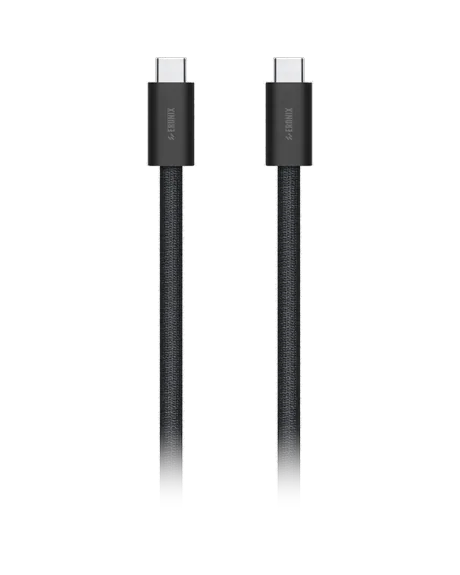
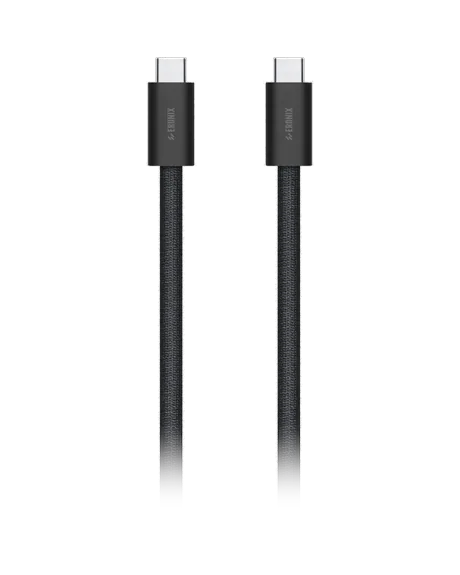
With the cable now your choice, match it to the biggest device you charge. For a phone, the Everyday Cable carries 60 W over 1 m, the everyday length ChargerLAB suggests, braided, with aluminium shells and a leather tie.
For a laptop that draws more than 60 W, the Power Cable 240 W carries the e-marker this guide calls for, and its 2 m length lets the charger sit by the wall while the laptop stays on the desk.
Step by step
- Check the box contents line to see whether a cable is included.
- Note the charger port type, USB-C or USB-A.
- Note your device port, USB-C or Lightning.
- Pick a cable rated for at least the charger's output: 60 W for phones, 100 W or 240 W for laptops.
- Choose a length that suits where you charge.
Questions people ask
Can I use my old iPhone cable with a new USB-C charger?
Only if its charger end is USB-C. A USB-C to Lightning cable plugs straight into a USB-C charger. An older USB-A to Lightning cable needs a USB-A port, which most current fast chargers do not have. Apple confirms USB-A Lightning cables still work, just with a USB-A adapter.
Does the cable affect charging speed?
Yes, at higher power. A cable rated for 3 A tops out at 60 W at 20 V. Above that, the charger needs an e-marked 5 A cable to send more current. For phones charging at 20 W to 45 W, any compliant USB-C cable is enough; for laptops above 60 W it matters.
Why do phones no longer come with chargers?
Most buyers already own a USB charger, and regulators such as the EU now require that devices be offered without one, with packaging that shows whether a charger is included. Phones still include a cable, so an existing USB-C charger can be used straight away.
What length of cable should I buy?
About 1 metre suits everyday desk or bedside use. Choose 2 to 3 metres if the socket is far from where you sit or sleep. Shorter cables are tidier for power banks and car chargers. Length matters less than the current rating and build quality.
Sources
- Apple Support: About Apple USB power adapters · accessed 22 Nov 2026
- Apple India: 20W USB-C Power Adapter · accessed 22 Nov 2026
- European Parliament Legislative Train: Common chargers for mobile phones and similar devices · accessed 22 Nov 2026
- EUR-Lex: Directive (EU) 2022/2380 · 23 Nov 2022
- Wikipedia: Common external power supply · accessed 22 Nov 2026
- ChargerLAB: Ultimate cable selection guide for everyone · accessed 22 Nov 2026
- USB-IF: USB Charger (USB Power Delivery) · accessed 22 Nov 2026
USB-C Power Delivery
One connector, a negotiated contract.
Read →Explainer · 4 min readHotel room charging: making one socket work
One socket behind the bed, three devices, a 7 am meeting. Here is the plan.
Read →Explainer · 4 min readUSB PD 3.1 EPR and 240 W, explained
Same USB-C plug, more than twice the power. The trick is voltage, not a thicker wire.
Read →Explainer · 4 min readCable management for a clean desk
A tidy desk starts by removing cables, not hiding them. Then a few rules keep it safe.
Read →Explainer · 5 min readHow to charge two laptops from one charger
In one lab test, a 65 W charger gave the second laptop 0 W. Here is how to avoid it.
Read →Explainer · 4 min readOffice desks in India: one charging setup for a whole team
Ten desks, twenty-three chargers, nobody can find a cable. There is a simpler standard.
Read →