Journal · Explainer · 5 min read
Why does a 65 W charger show only 25 W on my phone?
The number on the charger is a ceiling. The phone decides where to stop.
In one ChargerLAB test, a 140 W laptop charger gave a 45 W Galaxy only about 22 W. So when your new 65 W charger shows 25 W on your phone, did you pay for 40 W you will never get, or is something broken?
Short answerProbably nothing is broken. A charger only supplies what the phone requests, and the phone sets the speed. The usual causes are that the phone's peak is lower than 65 W, the charger lacks the exact PPS profile the phone wants, the cable is rated for 3 A, or the phone is warm or nearly full.
What the tests show
The phone's own ceiling comes first. According to 9to5Google's summary of Samsung's 2026 line-up, the Galaxy S26 charges at up to 25 W wired, the S26+ at 45 W and the S26 Ultra at 60 W. On a base S26, a 65 W charger will never show more than about 25 W, by design.
Protocol is the next filter. In ChargerLAB's compatibility test of the Galaxy S24 Ultra, a 45 W phone, a 65 W charger delivered about 44 W and a 150 W charger with high-power PPS also delivered about 44 W. A 140 W laptop charger, however, delivered only about 22 W. The charger's headline watts did not predict the result; what it offered the phone did.
The cable can cap it too. Samsung's UK support page for the S24 series says 45 W super fast charging needs a 45 W adapter and a 5 A e-marked cable, and that the cables supplied with the base S24 are limited to 25 W. The newer S26 Ultra is different: Android Authority notes its 60 W mode uses 20 V at 3 A, so the 3 A cable in the box is enough.
And the curve never stays at the peak. Android Authority measured the Galaxy S26 Ultra reaching its 60 W peak for only about 2 minutes before settling near 48 W for around 16 minutes, then tapering. A reading taken partway through a charge will usually be below the rated figure.
| Phone | Peak wired | What it needs |
|---|---|---|
| Galaxy S26 | 25 W | Any USB PD charger; never shows more than about 25 W |
| Galaxy S26+ | 45 W | PPS charger with 5 A; 5 A e-marked cable |
| Galaxy S26 Ultra | 60 W | 20 V at 3 A; the 3 A cable in the box is enough |
| Galaxy S24 Ultra | 45 W | 45 W adapter and 5 A e-marked cable |
Source: 9to5Google, Feb 2026; Samsung UK Support; Android Authority; accessed Nov 2026
Power delivered (W)
Source: ChargerLAB, Galaxy S24 Ultra 45 W compatibility test, Aug 2024
How the phone and charger agree on a speed
When you plug in, the charger and phone talk over USB Power Delivery. The charger lists the voltages and currents it can offer. The phone picks one. Many Android phones use a PD extension called Programmable Power Supply, or PPS, which lets the phone fine-tune voltage in small steps as the battery fills. If a charger offers only fixed PD voltages, or offers PPS in a current range the phone does not want, the phone falls back to a slower fixed mode, often 15 W to 25 W.
Some brands use their own protocols instead. Wikipedia's summary of VOOC and SuperVOOC, for example, shows generations at 10 V and 6.5 A, 11 V and 7.3 A, and 20 V and 12 A, and notes that the 240 W version needs a proprietary charger and cable. On a standard USB PD charger, such phones charge at their PD fallback speed, which is lower.
Think of a 65 W charger as a six-lane highway and the phone as a car with its own top speed and a driver who obeys local signs. The highway can carry far more than the car needs. The car's speed is set by its engine, the cable's speed limit and the weather, meaning heat and battery level.
Five reasons, and the fix for each
The phone's peak is lower. Check the phone's official spec page. If it says 25 W, you are already at full speed.
The charger lacks the right PPS range. Check the charger's label for PPS output, for example 3.3 to 21 V at 3 A or 5 A. Galaxy phones at 45 W need PPS with 5 A.
The cable is rated 3 A. For 45 W on Galaxy, Samsung specifies a 5 A e-marked cable. Use one, or the cable that came with a 45 W charger.
The phone is warm or above about 80%. Phones reduce power to protect the battery. Measure from a low battery level, with the case off and the screen off.
Another port is in use. Multi-port chargers split power, so a second device can cut what the phone gets. Test with only the phone connected.
What to check before you buy
Look up your phone's peak wired watts and protocol on the official spec page before choosing a charger.
Read the charger label for PPS, not just total watts. The PPS line, with its volts and amps, tells you if a Galaxy or Pixel will fast-charge.
Check which port gives full power on a multi-port charger. Often only one USB-C port delivers the top figure.
Pair it with a cable rated for the current you need: 5 A for 45 W PPS charging, 3 A for most other phones.
Keep the bill and test at home with a simple USB meter or the phone's charging message within the return window.
Myth corner
Myth: a 65 W charger forces 65 W into a 25 W phone and damages it. Under USB Power Delivery the phone requests power and the charger supplies no more than the agreed level. The extra capacity simply sits unused, ready for a laptop or tablet.
The right one for you
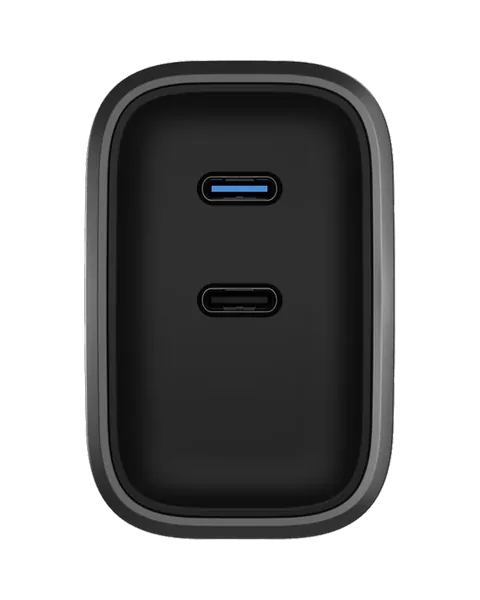
For a 45 W Galaxy such as the S26+, the two links to get right are the charger's profile and the cable. The Fermi45 delivers 45 W from one USB-C port through Samsung Super Fast Charging 2.0, at 4.5 to 4.8 A, with PPS from 5 to 20 V alongside; the same port serves an iPhone 17.
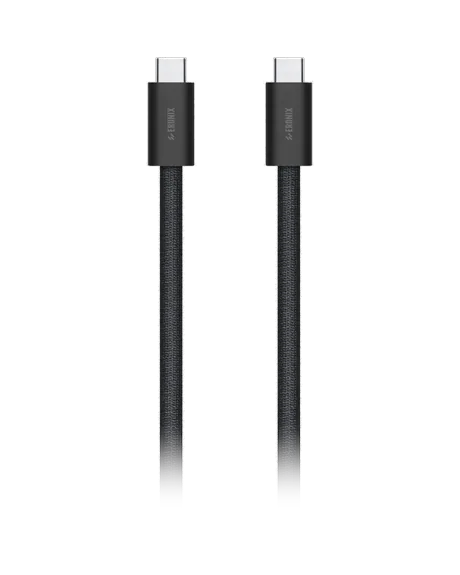
Pair it with the Power Cable 240 W, an e-marked, braided 2 m USB-C cable, so the current is never held to a 3 A limit.
Step by step
- Find your phone's peak wired watts and protocol on its spec page.
- Check the charger label for a matching PPS or PD profile.
- Use a cable rated for the current needed, 5 A for 45 W Galaxy charging.
- Unplug other devices from a multi-port charger.
- Test from a low battery level with the screen off and case removed.
Questions people ask
Is it safe to use a 65 W charger on a 25 W phone?
Yes, with a USB Power Delivery charger. The phone negotiates the voltage and current it wants, and the charger supplies no more than that. A 65 W charger on a 25 W phone charges at up to 25 W. The extra capacity is unused, not forced into the phone.
What is PPS and do I need it?
PPS, Programmable Power Supply, is part of USB Power Delivery that lets the phone adjust voltage in small steps while charging. Many Galaxy and Pixel phones need PPS to reach their top speed. Without it they fall back to a fixed mode, often around 15 W to 25 W.
Why does my Samsung say fast charging instead of super fast charging?
Samsung's support page says super fast charging needs a compatible adapter, such as 45 W with PPS, and a 5 A e-marked cable for 45 W. With a standard charger, or a 3 A cable on a 45 W model, the phone shows ordinary fast charging and draws less power.
Will a laptop charger fast-charge my phone?
Sometimes. It depends on whether the laptop charger offers the protocol your phone uses. In ChargerLAB's tests, a 140 W laptop charger gave a Galaxy S24 Ultra only about 22 W, while a 65 W charger and a 150 W charger with high-power PPS each gave about 44 W.
Why does charging speed drop after a few minutes?
Phones reduce power as the battery fills and as temperature rises. Android Authority measured a Galaxy S26 Ultra holding its 60 W peak for only about 2 minutes before settling near 48 W. A reading taken midway through a charge will usually be below the headline figure.
Sources
- 9to5Google: Samsung Galaxy S26 charging speeds and Qi2 · 25 Feb 2026
- ChargerLAB: 45W compatibility test of Samsung Galaxy S24 Ultra · 5 Aug 2024
- Samsung UK Support: How to use super fast charging on Galaxy S24 Ultra, S24+ and S24 · accessed 22 Nov 2026
- Android Authority: Galaxy S26 Ultra 60W charging tested · accessed 22 Nov 2026
- USB-IF: USB Charger (USB Power Delivery) · accessed 22 Nov 2026
- Wikipedia: VOOC · accessed 22 Nov 2026
PPS — Programmable Power Supply
Power Delivery, with a fine-adjustment dial.
Read →Explainer · 4 min readWhy is my Galaxy not showing 'Super fast charging'?
Even a 140 W laptop charger can miss it. The magic is in one hidden line on the label
Read →Explainer · 5 min readPPS: why Samsung phones care about it
Three letters on a charger label decide whether a Galaxy charges at full speed or half.
Read →Explainer · 4 min readDo original chargers matter?
The logo on the plug matters less than two words in its small print.
Read →Buying guide · 4 min readWhich charger does the Galaxy S24 Ultra need?
Two small letters on the charger, PPS, decide whether you get 45 W or half of it.
Read →Buying guide · 5 min readWhich charger does the Galaxy S25 Ultra need?
45 W is the ceiling. The three letters P, P and S decide whether you reach it.
Read →