Journal · Explainer · 4 min read
Do original chargers matter?
The logo on the plug matters less than two words in its small print.
In ChargerLAB's test of a Galaxy S24 Ultra, a third-party 150 W charger delivered 44.4 W, more than Samsung's own 45 W adapter managed on the same phone. A 140 W laptop charger from another phone maker, an original in its own right, delivered 22.35 W, about half as much. So what does original really buy you?
Short answerAn original charger is not required. What matters is that the charger speaks your phone's fast-charging standard, USB Power Delivery for iPhone and PPS for recent Samsung phones, and that it meets recognised safety standards and is sold by a seller you can trace. The one habit that matters: check the standard and the safety mark, not the logo.
What the lab numbers show
ChargerLAB measured the Galaxy S24 Ultra, which Samsung rates at up to 45 W, on a range of chargers. Samsung's 45 W GaN adapter gave 41.50 W and its 65 W adapter 44.45 W. A third-party 150 W charger with PPS gave 44.40 W. A 140 W laptop adapter from another phone maker, without the PPS mode Samsung uses for its top speed, gave 22.35 W. Third-party chargers in the test spanned about 11 to 45 W.
The spread tells you what really decides speed. Two originals from two phone makers performed very differently on the same phone, and a third-party charger matched the best original. The deciding factor was the protocol, not the badge.
Tom's Hardware tested 20 wall chargers from 15 W to 140 W in June 2026. Most measured 89 to 93% efficient, and below 67 W even the cheapest units delivered their full rated output. The article reported no unsafe failures, and noted most units included overvoltage and overcurrent protection.
| Phone or need | What to look for |
|---|---|
| iPhone 15 and later | USB-C Power Delivery |
| Samsung Super Fast Charging | PPS on the label or box |
| Speed | Rated at or above the phone's top wired speed |
| Indian homes | Input 100 to 240 V, 50 or 60 Hz |
| Sold in India | BIS Standard Mark with an R-number |
Source: Apple Support; Samsung UK Support; BIS CARE
Watts
Source: ChargerLAB 45 W compatibility test
How a phone and charger agree on power
A modern USB-C phone does not simply take whatever the charger offers. The two talk first. Under USB Power Delivery, the charger announces the voltage steps it can supply, and the phone picks one. Samsung's Super Fast Charging uses PPS, a part of USB PD that lets the phone ask for fine voltage changes during the charge. If the charger lacks PPS, the phone falls back to a slower step.
Google's ChromiumOS hardware notes add a rule that protects you: under the USB Type-C specification, chargers may not use proprietary methods to change the voltage, and the default limit before negotiation is 5.5 V. Any compliant charger starts safe and only raises voltage when the phone agrees.
It works like ordering at a restaurant. The menu, the charger's list of voltages, can come from any good kitchen. What matters is that the kitchen offers the dish you want and follows food-safety rules. Whose name is on the door is secondary.
Where original chargers still have an edge
An original makes sure the protocol fits, which saves you reading labels. It is also covered by the phone maker's own warranty and service network. Samsung India, for example, lists 6 months of warranty for chargers bought separately, with a valid invoice.
The real danger is not third-party chargers; it is chargers that do not meet any safety standard. Apple's support page is blunt about non-compliant adapters, saying that charging with them could pose a risk of death or injury. Apple also says third-party adapters are fine if they comply with applicable regulations and international safety standards, naming IEC 62368-1.
How to read a charger's label in ten seconds
Turn the charger over and find the output line. A USB-C PD charger lists several steps, such as 5 V, 9 V, 15 V and 20 V, each with a current. Multiply volts by amps for the watts at each step. A PPS charger adds a range, for example a span of voltages rather than a single figure.
Then find the input line. Chargers sold for Indian homes should accept 100 to 240 V at 50 or 60 Hz, which Apple lists for its own adapters. A charger with only a single output line and no voltage steps is a basic 5 V unit, safe but slow for a modern phone.
What to check before you buy
Match the standard. For iPhone 15 and later, look for USB-C PD. For Samsung Super Fast Charging, look for PPS on the label or box.
Match the wattage. The charger should be rated at or above your phone's top wired speed. Bigger is safe; the phone only draws what it negotiates.
In India, look for the BIS Standard Mark with an R-number on the charger, and check it on the BIS CARE app or the BIS registration portal.
Buy from a seller who gives a proper tax invoice, so warranty claims are possible.
Reject any charger that is unusually light, has no output label, or gets too hot to hold in normal use.
Myth corner
Myth: only the charger from your phone's brand charges at full speed. Fact: in ChargerLAB's Galaxy S24 Ultra test, a third-party PPS charger reached 44.4 W while another maker's original laptop charger, without PPS, reached 22.35 W. The protocol decided the result, not the brand.
The right one for you
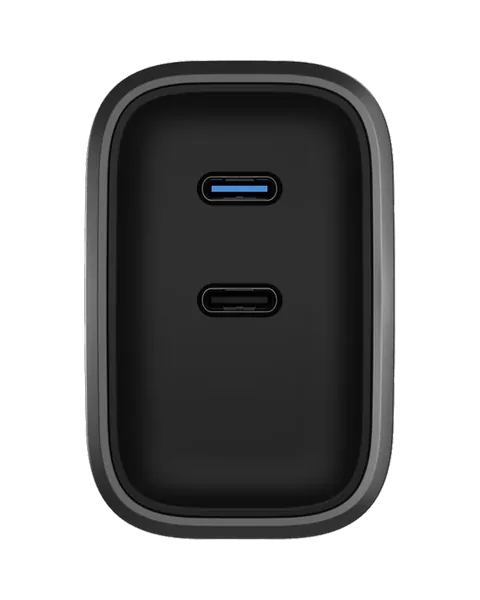
This test rewards the protocol, and Fermi45 states its protocols on the sleeve: USB Power Delivery steps from 5 V to 20 V for iPhone, and PPS with Samsung Super Fast Charging 2.0, which delivers 45 W from one port at 4.5 to 4.8 A for the Galaxy phones that take 45 W.
Its input reads 100–240 V, 50–60 Hz, and it lists over-voltage, over-current, over-temperature and short-circuit protection. It is matched to the iPhone 17 series and the 45 W Galaxy S phones.
Step by step
- Find your phone's fast-charging standard: USB PD for iPhone, PPS for Samsung.
- Choose a charger rated at or above your phone's top wired speed.
- Check for a BIS Standard Mark and R-number, and verify it on BIS CARE.
- Buy with a proper tax invoice for warranty.
- Stop using any charger that gets too hot to hold.
Questions people ask
Can a non-original charger damage my phone?
A compliant one should not. USB-C chargers start at a safe 5 V and raise voltage only after the phone agrees, under the USB Type-C rules. The risk comes from chargers that ignore safety standards. Apple warns that non-compliant adapters could pose a risk of death or injury.
Why does my Samsung charge slowly on an iPhone charger?
Samsung's fastest charging uses PPS, a mode many Apple adapters do not offer. In ChargerLAB's test, a 140 W laptop adapter without PPS gave a Galaxy S24 Ultra only 22.35 W, while chargers with PPS gave around 44 W. Use a charger that lists PPS for Samsung Super Fast Charging.
Is it safe to use a laptop charger for a phone?
Yes, if it is a USB-C PD charger. The phone negotiates only the voltage and current it needs, so a 65 W or 140 W laptop charger will not force extra power into it. Speed depends on whether the charger supports the phone's preferred mode, such as PPS on Samsung.
Does using a third-party charger void my warranty?
Apple says third-party adapters that meet safety standards can be used. Samsung India's warranty, however, excludes defects caused by accessories not made, supplied or authorised by Samsung, including non-Samsung chargers. A compliant charger should cause no damage, but if one does, that repair may not be covered.
Sources
- ChargerLAB: 45W compatibility test of Samsung Galaxy S24 Ultra · 5 Aug 2024
- Tom's Hardware: We tested 20 wall chargers from 15 W to 140 W · 11 Jun 2026
- Apple Support: About Apple USB power adapters · accessed 22 Nov 2026
- ChromiumOS: Cable and adapter tips and tricks · accessed 22 Nov 2026
- Samsung UK Support: How to use super fast charging on Galaxy S24 series · accessed 22 Nov 2026
- Samsung India: Warranty information · accessed 22 Nov 2026
- BIS CARE app (Google Play) · accessed 22 Nov 2026
USB-C Power Delivery
One connector, a negotiated contract.
Read →Buying guide · 4 min readWhich charger does the Galaxy S26 Ultra need?
Sixty watts on the box. Here is what it takes to get it.
Read →Explainer · 5 min readPPS: why Samsung phones care about it
Three letters on a charger label decide whether a Galaxy charges at full speed or half.
Read →Buying guide · 5 min readWhich charger does the Galaxy S26 need?
Three phones, three speeds, one protocol called PPS. Here is what to buy and what to skip.
Read →Buying guide · 4 min readWhich charger does the Galaxy S26+ need?
Samsung promises 69 percent in about 30 minutes. One word on the label decides it.
Read →Buying guide · 4 min readWhich charger does the Galaxy Z Fold8 need?
Samsung's foldables now charge at 45 W. Here is the charger that gets you there.
Read →