Journal · Buying guide · 4 min read
Which charger for two phones at once?
Two phones, one socket, both fast. The answer is in the shared-port line of the label.
One bedside socket, two phones, and both need to be ready by morning, or by the end of a 30-minute coffee before you leave. A dual-port charger is the obvious answer. But will both phones still fast charge when they share it?
Short answerChoose a dual USB-C charger whose shared-port rating gives each phone its own fast-charging wattage at the same time. For most current iPhones and Galaxy phones, that is about 25 to 30 W per port, so 60 to 65 W in total. For Samsung phones, both ports must keep PPS. Overnight, a smaller 35 W charger is enough.
What two phones need, and what dual chargers give
Each phone's need comes first. ChargerLAB measured the iPhone 17 peaking at about 27 to 28 W, as MacRumors reported, and the iPhone 16 Pro Max holding 28 to 31 W. The iPhone 16e drew about 23 W. Among Galaxy phones, 9to5Google lists 25 W wired for the Galaxy S26, 45 W for the S26+ and 60 W for the S26 Ultra.
Now the split. Apple's support page for its 35 W Dual USB-C Port adapter says power is shared evenly for most pairs of devices, which means up to 17.5 W each for two phones. That is still fast charging, but below what current iPhones can take alone.
A bigger shared charger holds up better. In ChargerLAB's distribution test of a 65 W charger with two USB-C ports, two Galaxy phones charging together drew about 23.3 W and 20.9 W; ChargerLAB does not state the protocol for that pair. The same charger's second USB-C port is rated to about 25 W at most, so the split was set partly by the port, not only by the total.
| Phone | Wired peak |
|---|---|
| iPhone 16e | About 23 W |
| iPhone 17 | 27 to 28 W |
| iPhone 16 Pro Max | 28 to 31 W |
| Galaxy S26 | 25 W |
| Galaxy S26+ | 45 W |
| Galaxy S26 Ultra | 60 W |
Source: ChargerLAB; MacRumors; 9to5Google
How a dual charger decides who gets what
A dual charger has one power budget and a controller that divides it. Each USB-C port then agrees a voltage and current with its phone. When a second phone joins, the controller redraws the split and the first port often agrees a new level; ChargerLAB recorded the first port dropping to zero briefly and recovering on one charger.
Think of two people sharing an auto-rickshaw fare. If the fare is large enough, both reach home without stopping. If it is just enough for one, each gets only part of the way before someone has to wait. The charger's total wattage is the fare; the shared-port table tells you how it is split.
Three common pairs
Two iPhones. Each draws about 20 to 30 W. A 35 W dual charger gives each up to 17.5 W, fine overnight. For a quick top-up of both, a 60 to 65 W dual USB-C charger lets each phone run near its own limit.
An iPhone and a 25 W Galaxy. About 30 W plus 25 W. A 60 to 65 W charger with PPS on the Galaxy's port covers both.
Two 45 W Galaxy phones. Each wants 45 W over PPS at close to 5 A, with a 5 A cable; ChargerLAB measured a Galaxy S24 Ultra pulling about 4.5 to 4.8 A at around 9 V. That needs about 90 W shared with 45 W PPS available on both ports at once, which few chargers offer. Otherwise, expect one or both to drop to about 25 W.
Overnight or quick top-up: decide first
Overnight, speed hardly matters. Two phones on a 35 W dual charger at 17.5 W each will still be full well before morning, and slower charging means a little less heat. Most phones also hold the last stretch to 100% until shortly before you usually wake.
A quick top-up is different. If both phones must gain as much as possible in half an hour, each needs its own full wattage at the same time. That is where a 60 to 65 W dual USB-C charger earns its extra size and cost. Decide which of the two you need, and the right charger follows.
What to check before you buy
Find the line for two USB-C ports used together. That figure, not the headline total, decides whether both phones fast charge.
Check PPS on both ports if either phone is a Samsung. Galaxy super fast charging depends on it.
Check that both ports are USB-C. USB-A ports usually get the smallest share; in ChargerLAB's test a USB-A port gave a Galaxy about 9 W.
Check cables. Two 3 A USB-C cables cover iPhones and 25 W Galaxy phones; 45 W Galaxy phones need 5 A e-marked cables.
Plug both phones in at the start. Adding the second phone later can briefly pause the first.
Myth corner
Myth: a 40 W dual charger gives 40 W to each phone. Fact: the rating is shared. Apple's own 35 W dual adapter gives two phones up to 17.5 W each. Read the shared-port line, then compare it with what each phone actually draws.
The right one for you
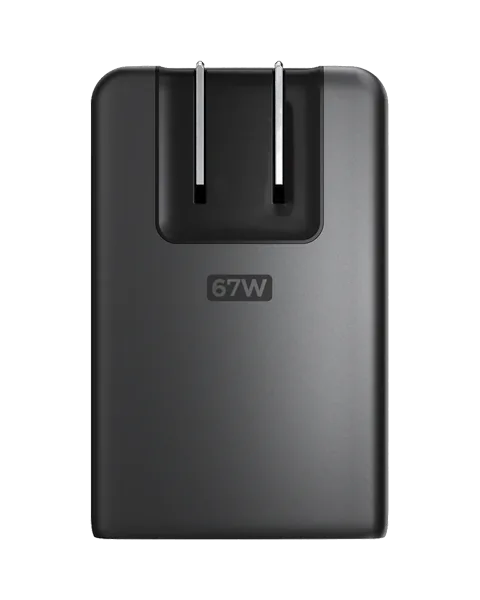
For two phones topping up quickly together, the Entropy67 splits its power 35 + 30 W across two USB-C ports, which covers the 25 to 30 W per port that current iPhones and 25 W Galaxy phones draw. PPS and Samsung Super Fast Charging 2.0 are listed, and the whole charger is 14 mm thin.
On one port alone it gives 67 W, so the same plug also charges a MacBook Air when the phones are done.
Step by step
- Find each phone's charging wattage and whether it needs PPS.
- Choose a dual USB-C charger whose shared-port rating covers both.
- Use a 3 A cable for each phone, or 5 A for 45 W Galaxy phones.
- Plug both phones in together to avoid a mid-charge pause.
Questions people ask
Is Apple's 35 W dual adapter good for two iPhones?
For overnight charging, yes. Apple says power is shared evenly for most pairs, so each iPhone gets up to 17.5 W. That is fast charging but below the 25 to 30 W current iPhones can take alone. For quick top-ups of two phones, a larger dual charger helps.
Can one charger fast charge an iPhone and a Samsung together?
Yes, if both ports are USB-C PD and the Samsung's port supports PPS. An iPhone takes about 25 to 30 W; a 25 W Galaxy needs PPS at 25 W. A 60 to 65 W dual charger whose shared-port line covers both will charge them near full speed.
Why did my first phone stop charging when I plugged in the second?
The charger was reallocating power. Each port renegotiates with its phone when the split changes, and some chargers cut the first port briefly. ChargerLAB recorded this on a 65 W charger. Charging resumes within moments; plugging both phones in together avoids it.
Is a dual charger with USB-A and USB-C fine for two phones?
One phone will be slower. USB-A ports usually offer only basic or older fast-charging protocols and take the smaller share. In ChargerLAB's test, a USB-A port gave a Galaxy about 9 W. For two modern phones, two USB-C ports are the better choice.
Is it safe to charge two phones from one charger overnight?
Yes, with a well-made USB PD charger. Each port supplies only what its phone asks for, and each phone stops drawing current when full. Place the charger where air can circulate, keep it off soft bedding, and replace it if it gets very hot.
Sources
- How to use the 35W Dual USB-C Port Power Adapter (Apple Support) · accessed 22 Nov 2026
- Power Distribution Review of Samsung 65W 2C1A Charger EP-T6530 (ChargerLAB) · 14 Jul 2022
- Regular iPhone 17's USB-C Charging Speeds Tested With Apple Chargers (MacRumors) · 26 Sep 2025
- Improved Charging Power | Charging Review of iPhone 16 Pro Max (ChargerLAB) · 27 Sep 2024
- 4005mAh+27W | Charging Review of iPhone 16e (ChargerLAB) · 27 Mar 2025
- Samsung Galaxy S26 charging speeds and Qi2 (9to5Google) · 25 Feb 2026
- 45W Compatibility Test of Samsung Galaxy S24 Ultra (ChargerLAB) · 5 Aug 2024
USB-C Power Delivery
One connector, a negotiated contract.
Read →Buying guide · 1 min readChoosing a USB-C charger: a short, honest checklist
Five checks that outlast any marketing cycle.
Read →Buying guide · 4 min readWhich charger does the Galaxy S26 Ultra need?
Sixty watts on the box. Here is what it takes to get it.
Read →Comparison · 4 min readSingle-port vs multi-port chargers
The big number on the box is shared. The table on the back says what each device gets.
Read →Buying guide · 4 min readOne charger for phone, tablet and laptop: how many watts?
Add up what each device takes, then decide how patient you are. That is the calculation.
Read →Buying guide · 5 min readWhich charger does the Galaxy S26 need?
Three phones, three speeds, one protocol called PPS. Here is what to buy and what to skip.
Read →