Journal · Explainer · 4 min read
Latency: why video and games can lag on earbuds
A fifth of a second sounds like nothing, until the gunshot arrives after the muzzle flash.
You tap a key on your phone and the click reaches your earbuds a beat late. In a game, the footstep you hear belongs to a moment that has already passed. One developer timed the first AirPods at about 274 milliseconds, more than a quarter of a second. Where does that time go?
Short answerBluetooth earbuds in one developer's tests delayed sound by about 140 to 280 milliseconds, because audio must be compressed, sent over radio, buffered against dropouts, shared between two earbuds and decoded. Video apps can often hide the delay by keeping picture and sound in step; games, typing and calls cannot, because the sound depends on what you just did.
How many milliseconds earbuds really lag
Stephen Coyle, a software developer, measured the time between triggering a sound on an iPhone and hearing it, using the iOS keyboard and his own rhythm game. MacRumors reported his results: about 274 ms for first-generation AirPods, 178 ms for the second generation and 144 ms for the first AirPods Pro. Over-ear headphones he tried were in the 225 to 250 ms range.
Codecs set part of the floor. SoundGuys lists aptX Low Latency at under 40 ms and the LHDC low-latency mode at as little as 30 ms end to end, but these need support on both phone and earbuds. For the common AAC and SBC codecs, SoundGuys gives no single latency figure, because it varies so much by device.
The Bluetooth SIG says its newer LC3 codec, used in LE Audio, works in frames of 10 or 7.5 milliseconds, and lists lower latency among the goals LE Audio was designed for. It publishes no single end-to-end figure, because the radio and buffer add their own time.
| Earbuds or codec | Delay | Source |
|---|---|---|
| AirPods (1st generation) | About 274 ms | Coyle test |
| AirPods (2nd generation) | About 178 ms | Coyle test |
| AirPods Pro (1st generation) | About 144 ms | Coyle test |
| Over-ear headphones tested | 225 to 250 ms | Coyle test |
| aptX Low Latency | Under 40 ms | SoundGuys |
| LHDC low-latency mode | As little as 30 ms | SoundGuys |
Source: Stephen Coyle via MacRumors; SoundGuys
Milliseconds
Source: Stephen Coyle's measurements, reported by MacRumors
Where the delay comes from
Each step adds a little. The phone collects audio into frames and compresses it with a codec. The radio sends it in the crowded 2.4 GHz band, which Qualcomm notes Bluetooth shares with Wi-Fi, hopping across 80 channels to dodge interference. The earbud stores a few frames in a buffer so a dropped packet does not become a click. Then it decodes and plays.
True wireless earbuds add one more task: two earbuds must play in sync. Qualcomm's white paper describes designs where one earbud relays audio to the other, which it says can use double the Bluetooth bandwidth, and newer designs where the second earbud listens in directly. Either way, timing between the two ears has to be managed.
Think of a live cricket broadcast on the radio. The commentator's words reach you a little after the ball is bowled, and you never notice, because you cannot see the ground. Put a television next to the radio and the gap is suddenly obvious. Earbud latency is that radio delay; a game is the television that exposes it.
Why films often look fine but games do not
A film is predictable. The player knows what sound comes next, so the system can delay the picture slightly to match the earbuds. That is why many viewers never notice latency on a streaming app.
A game, a keyboard click or a voice call is not predictable. The MacRumors report on Coyle's test makes this point: user-triggered sounds are the hardest for platforms to hide, because they cannot be prepared in advance. In a fast shooter or rhythm game, a 150 to 250 ms delay is long enough to feel.
What to choose for games, video and calls
For video, most current earbuds are fine on major apps. For casual games, choose earbuds with a stated low-latency or game mode. For competitive mobile games, look for a codec both your phone and earbuds share that is built for low delay; SoundGuys suggests AAC on iPhone and aptX or aptX Low Latency on Android where available.
For the lowest delay of all, a wired connection or a dedicated 2.4 GHz dongle removes much of the Bluetooth chain, which is why gaming headsets often use them.
For calls, latency matters less than you might think. A short delay feels like a slightly slow line, not a broken one, and call quality depends far more on the microphones and the signal.
What to check before you buy
Ask for a latency figure in milliseconds and how it was measured. A number without a method is hard to compare.
Check codec support on both sides. aptX Low Latency, for example, only works if the phone supports it too; many phones do not.
Look for a game or low-latency mode in the earbuds' app, and check whether it reduces sound quality or connection range.
Test it at the counter: open the phone's keyboard with sounds on, tap quickly, and listen for the gap.
Myth corner
Myth: newer Bluetooth versions remove latency. Fact: Coyle's measurements show delay changing a lot between earbud generations on the same phone, from about 274 to 144 ms, which comes down to codec, buffering and chip design, not just the version number on the box.
The right one for you
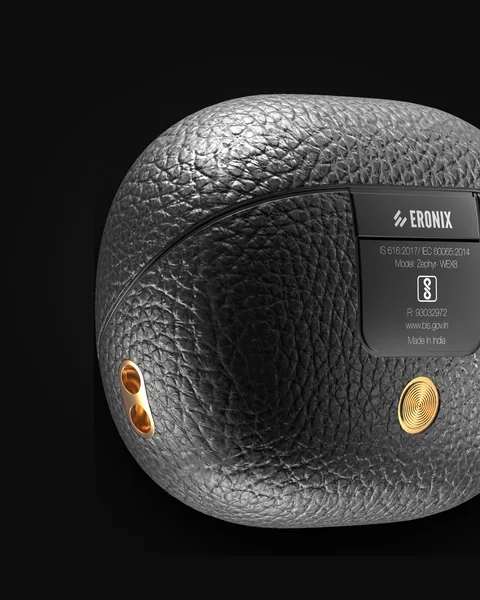
For games and typing, the number to ask for is the delay in milliseconds, and Zephyr lists latency under 40 ms. It connects over Bluetooth 5.4, with AAC for iPhone and aptX HD for Android phones that support it.
Its four microphones, with ENC up to 35 dB, keep your voice clear of the street on calls. It suits iPhone, Galaxy A and S FE, and OnePlus owners, and it comes in a NeoLeatherette case.
Step by step
- Turn on keyboard sounds and tap quickly to hear the delay.
- Check which codecs both your phone and the earbuds support.
- Turn on the earbuds' game or low-latency mode if they have one.
- For competitive gaming, consider wired audio or a 2.4 GHz dongle.
Questions people ask
What latency is good for gaming earbuds?
Lower is better; there is no single agreed threshold. SoundGuys lists aptX Low Latency at under 40 ms and LHDC low-latency at about 30 ms. Ordinary Bluetooth earbuds measured by Stephen Coyle ranged from about 144 to 274 ms on an iPhone.
Why is there a delay on YouTube with Bluetooth earbuds?
Usually the video app or phone is not fully compensating for the earbuds' delay. Many apps delay the picture to match Bluetooth audio, but some browsers, older apps or casting setups do not. Restarting the app, reconnecting the earbuds or updating them often helps.
Do wired earphones have latency?
Practically none for listening. A wired connection skips compression, radio transmission and the buffer that Bluetooth needs, so sound arrives almost instantly. That is why many musicians and competitive gamers still prefer wired audio or a dedicated low-latency dongle.
Does LE Audio reduce latency?
It is designed to help. The Bluetooth SIG lists lower latency among LE Audio's goals, and its LC3 codec works in 10 or 7.5 ms frames. Real-world delay still depends on the earbuds, the phone and the buffer settings, and no single figure is published.
Sources
- MacRumors: AirPods Pro offer close to seamless audio experience thanks to improved Bluetooth latency · 23 Dec 2019
- SoundGuys: Bluetooth codecs explained · accessed 22 Nov 2026
- Bluetooth SIG: A technical overview of LC3 · accessed 22 Nov 2026
- Qualcomm: The evolution of true wireless technology (white paper) · 2020
Wireless Audio
Bluetooth, codecs, and the milliseconds that matter.
Read →Explainer · 5 min readLDAC, aptX, AAC: which codec your phone really uses
The logo on the earbud box is a promise. Your phone decides whether it is kept.
Read →Explainer · 4 min readWhy earbuds sound different on iPhone and Android
Same earbuds, same song, two phones. The difference starts before the sound reaches you.
Read →Explainer · 5 min readHow Bluetooth audio actually travels
From the music file to your ear in about a sixth of a second: every step, in order.
Read →Explainer · 5 min readWhat ANC can and cannot block
Why the bus engine fades but the conductor's voice does not, and what to check.
Read →Explainer · 4 min readTransparency mode: how earbuds let the world back in
Your earbuds can hear the platform announcement for you. Here is how, and where it stops.
Read →