Journal · Explainer · 4 min read
Full-grain, top-grain, PU: leather terms explained
Six words on a price tag, and what each one tells you about the case in your hand
Two leather cases sit side by side at the counter, one labelled full-grain, the other genuine leather, and a third tag nearby says PU leather. They look almost the same under shop lights. Are they?
Short answerNo. Full-grain leather keeps the hide's entire natural surface. Corrected grain, often sold as top-grain, has that surface buffed and refinished. Split leather is a lower layer of the hide. Bonded leather fibre is ground leather reformed with a binder. PU is a plastic coating on fabric and, by the industry's own definitions, not leather.
What the standards actually say
The Leather Working Group's list of definitions, which draws on ISO, UNECE and CEN wording, defines leather as a hide or skin with its fibrous structure largely intact, tanned so that it does not rot. Any surface coating must be no thicker than 0.15 mm. Material broken down into fibres and reformed into sheets, it notes, is not leather.
Full grain means leather that has kept its entire grain, with none of the surface removed by corrective treatment. Corrected grain means the grain has been partly removed by buffing or a similar mechanical process and then given a finish. Split leather is a layer taken from the flesh side or the middle of a hide once it has been sliced, then tanned so it will not rot.
Two more terms carry hard numbers. Coated leather has a surface coating thicker than 0.15 mm but no more than one third of the product's total thickness. Leather fibre board, which the list also names bonded or recycled leather fibre, must contain at least 50 per cent dry leather fibre by weight, and it is not counted as leather.
Leather Naturally, an industry education body, calls the phrase vegan leather a misleading marketing term for synthetic material made to look like leather.
| Term | What it is | Counted as leather |
|---|---|---|
| Full grain | Entire natural grain kept | Yes |
| Corrected grain (often sold as top-grain) | Grain buffed, then finished | Yes |
| Split | Lower layer of the hide | Yes |
| Coated leather | Coating over 0.15 mm, up to a third of thickness | Yes, as coated leather |
| Bonded leather fibre | At least 50% leather fibre with a binder | No |
| PU | Polyurethane coating on fabric | No |
Source: Leather Working Group, List of Definitions v1.1
How the layers of a hide work
A hide has a dense, tight outer layer, the grain, over a looser, more open layer of fibres underneath. The grain is where strength, water resistance and the natural pattern of pores live. Every step that removes it trades some of those qualities for a more uniform look.
Think of it like wood. Full-grain is a solid plank showing its real grain. Corrected grain is the same plank sanded and painted to hide knots. Split is a thinner board cut from further inside the log. Bonded fibre is particle board made from sawdust and glue. PU is a printed laminate with no wood in it at all.
That is why full-grain leather develops a patina and corrected grain usually does not. The natural surface can absorb oils and age; a pigmented, sealed finish mostly stays the same until it wears through.
Where top-grain and genuine leather fit
Top-grain is a common retail term rather than a defined standard term in the sources above. Sellers use it for leather from the upper layer whose surface has been sanded and refinished, which matches the standard description of corrected grain.
Genuine leather, Leather Naturally notes, is used to stress that a product is real leather rather than synthetic. It tells you nothing about which layer or grade was used. A case can be genuine leather and still be a heavily coated split.
Finish matters as much as grade
Grade tells you which layer of the hide you are holding. Finish tells you how much has been put on top. The Leather Working Group's definitions note that aniline leather, the most natural-looking finish, usually carries a non-pigmented surface layer of 0.01 mm or less, against the 0.15 mm ceiling for anything sold simply as leather.
A thin finish shows the grain, feels warm and marks easily, then softens into patina. A thicker pigmented finish hides marks and resists stains, but it can look flat and will eventually wear through at corners. Neither is wrong; they suit different owners.
What to check before you buy
Look at the surface closely. Full-grain shows fine, irregular pores and small natural marks. A perfectly even, repeating pattern usually means an embossed coating.
Check the cut edge. Real leather shows a fibrous edge, even when painted. PU shows a fabric backing and a thin plastic skin.
Ask for the exact term in writing. Full-grain, corrected grain, split, coated or bonded leather fibre are specific. Genuine leather and premium leather are not.
Press a fingernail lightly on the surface. Full-grain leather wrinkles softly and recovers; heavily coated surfaces resist and may crease sharply.
Think about how you live. If you want a case that ages, choose full-grain. If you want a uniform look that wipes clean, a corrected or coated leather can make sense.
Myth corner
Myth: PU leather is a type of leather. It is not. Leather, by the ISO-based definitions the Leather Working Group uses, is an animal hide with its fibre structure largely intact. PU is a polyurethane coating on a fabric base, and even bonded leather fibre must contain at least 50 per cent real leather fibre to use that name.
The right one for you
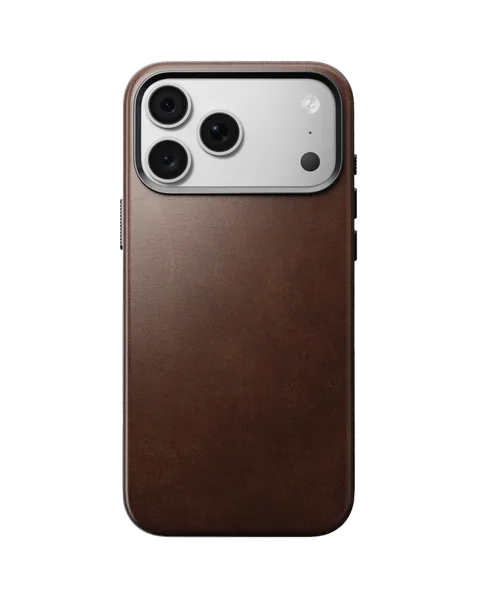
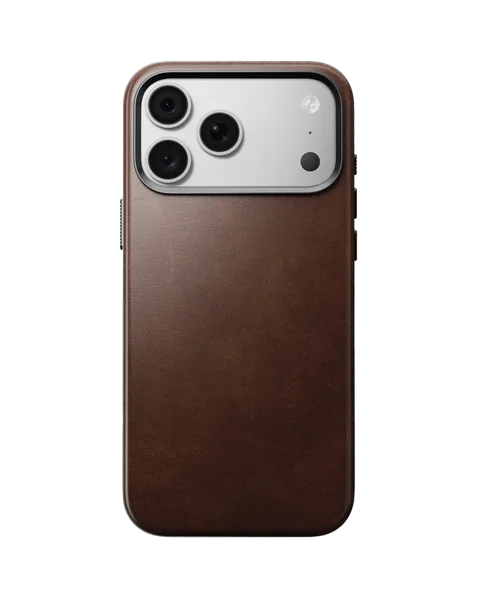
If the counter test points you to full-grain, the Leather Case for iPhone 18 Pro, and its twin for the 18 Pro Max, say so plainly: full-grain leather over a microfibre lining, with aluminium buttons and a raised lip round the camera.
The grain is left to age, so it deepens where your hand rests. Black or Tan.
Step by step
- Ask which exact leather term applies: full-grain, corrected grain, split, coated or bonded fibre.
- Inspect the surface for irregular natural pores.
- Check the cut edge for fibres or a fabric backing.
- Press gently to see how the surface creases and recovers.
- Choose full-grain if you want patina; corrected grain for a uniform finish.
Questions people ask
Is full-grain or top-grain leather better for a phone case?
Full-grain keeps the whole natural surface, so it is generally stronger at the surface and ages into a patina. Top-grain, usually a corrected grain that has been buffed and refinished, looks more uniform and resists marks at first. Which is better depends on whether you want character or a consistent finish.
Does PU leather last as long as real leather?
It depends on quality, but PU is a plastic coating on a fabric base. Over time, coatings can crack or peel, particularly at edges and folds. Real leather does not peel because there is no separate skin; it wears and scuffs instead.
What does genuine leather mean on a label?
It means the product is made of real leather rather than synthetic material. Leather Naturally notes that genuine and real are used to stress this. It does not tell you the grade, so ask whether it is full-grain, corrected grain or split.
What is bonded leather?
It is ground leather fibre reformed into sheets with a binder. Under the CEN definition in the Leather Working Group's list, where it is called leather fibre board or bonded leather fibre, it must contain at least 50 per cent dry leather fibre by weight. It is not classed as leather itself.
How can I tell real leather from PU at the shop?
Look at the cut edge and the surface. Real leather shows a fibrous edge and irregular pores. PU usually shows a woven or knitted fabric backing under a thin plastic layer, and a regular, repeating texture on top.
Sources
- Leather Working Group: List of Definitions v1.1 (ISO, UNECE and CEN terms) · accessed 22 Nov 2026
- Leather Naturally: Leather terminology · accessed 22 Nov 2026
Magnetic Alignment
Position, made physical.
Read →Explainer · 5 min readLeather that ages well: caring for a leather case
Less care than you think, and the three things that actually damage leather
Read →Compatibility · 1 min readMagnetic power banks and cases: what fits what
The ring, the case, and the physics between them.
Read →Explainer · 1 min readWhat is Qi2, and why did wireless charging need magnets?
The standard that made wireless charging predictable.
Read →Buying guide · 6 min readWhich charger does your 25 W magnetic (Qi2.2) puck need?
The puck can only give what the adapter feeds it, and heat takes its share first.
Read →Comparison · 5 min read20 W vs 30 W for an iPhone: is the difference worth it?
Four minutes on one iPhone, eight on another: the number that decides it is your phone's.
Read →