Journal · Comparison · 1 min read
GaN vs conventional chargers: what actually changed
Less mythology, more physics.
Published 20 August 2026 · Reviewed by 20 February 2027
Chargers shrank dramatically in the last few years, and the two-syllable explanation on every box is “GaN”. The real explanation is slightly longer and more interesting: gallium nitride transistors switch faster and waste less energy than silicon, and switching speed is the lever that shrinks everything else.
A charger’s bulky components — transformer, inductors, capacitors — are sized by how much energy they must hold between switching cycles. Switch faster and each cycle carries less energy, so the components shrink. GaN switches comfortably at frequencies where silicon struggles, and the whole power stage scales down with it.
The honest comparison
Same output power: the GaN design is meaningfully smaller and typically runs cooler. Same size: the GaN design delivers more power. Efficiency gains are real but incremental — the headline change is power density, watts per cubic centimetre.
What GaN does not change: protection engineering, negotiation honesty, thermal design, build quality. Those remain the difference between a good charger and a hazard, and no semiconductor buys them for you.
On the ERONIX range
Every ERONIX adapter from Fermi30 to Entropy67 is built on a GaN3 power stage, a third-generation gallium-nitride design. What that buys is stated on each product page as a figure: the output, the two-port split, the thickness, and a standby draw under 0.05 W. What it does not buy is the rest of the list above, which is why those pages also state the protection and the cable each adapter needs.
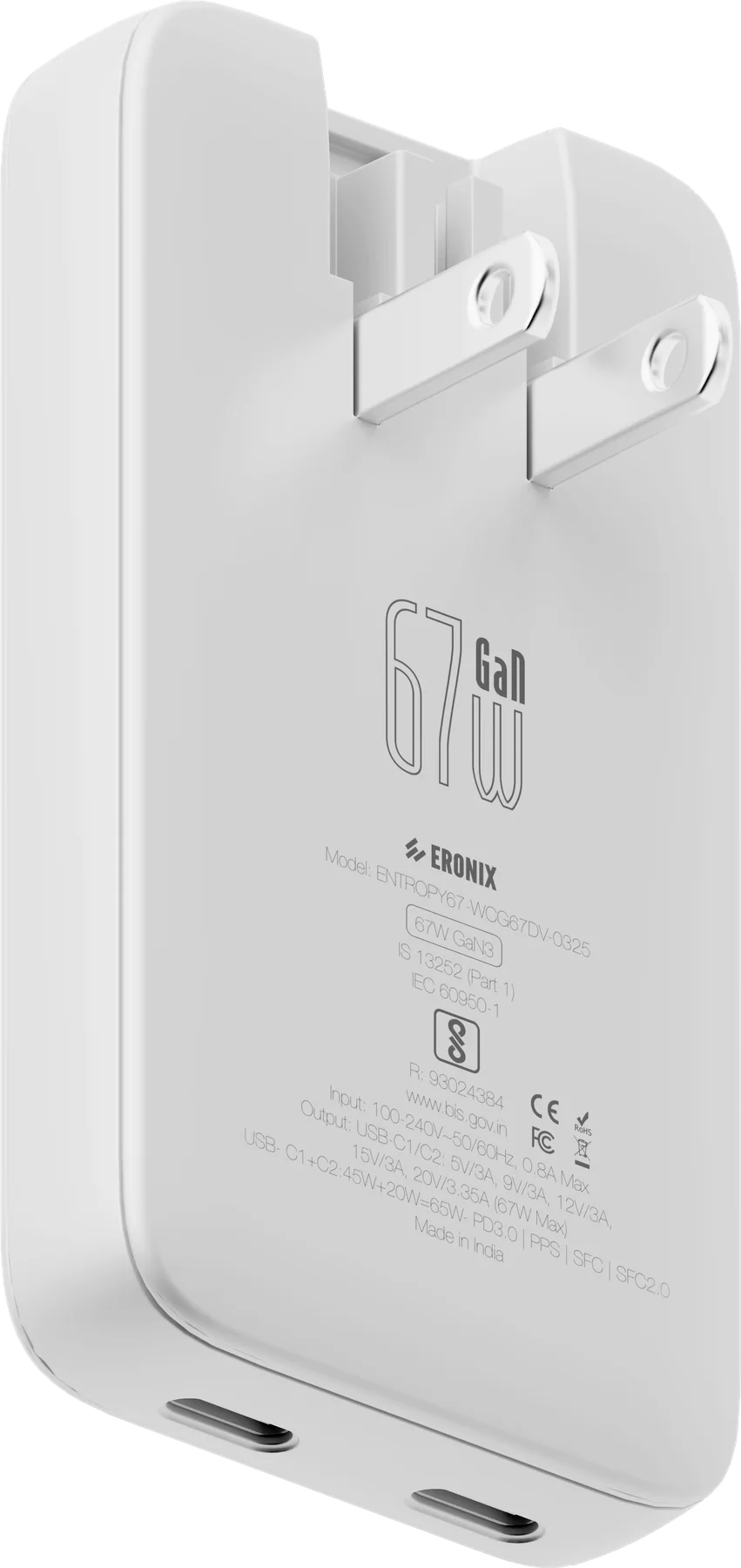

GaN — Gallium Nitride
The semiconductor that let chargers shrink.
Read →PowerThermal Management
The quiet discipline inside every serious power product.
Read →Buying guide · 1 min readHow much power does your laptop actually need?
Reading watts like a spec sheet, not a horoscope.
Read →Buying guide · 1 min readChoosing a USB-C charger: a short, honest checklist
Five checks that outlast any marketing cycle.
Read →