Journal · Comparison · 4 min read
GaN vs silicon chargers in daily use
Side by side on a desk, in a bag and on the electricity bill. One number decides it.
Two 60 W chargers sit on a desk, one GaN, one ordinary silicon. Both charge the same laptop at the same speed. Over a year, what is actually different between them?
Short answerSize more than anything. In the IEA's side-by-side tests, GaN chargers offered up to twice the power density, so the same watts can fit in as little as half the space. At 60 W they were about 2 per cent more efficient, saving about 1.4 W of heat; at 30 W the two were level. Speed is unchanged.
The side-by-side numbers
The most careful comparison comes from the International Energy Agency's 4E Power Electronic Conversion Technology Annex, published in January 2024. It tested GaN and silicon USB-C chargers at several loads. At 30 W, both types ran at around 90 per cent efficiency, with a difference of about 1 per cent that fell within measurement error. At 60 W, GaN chargers averaged 92 per cent and silicon 90 per cent. One GaN unit lost about 1.4 W less than its silicon rival at 60 W.
Power density is the larger gap, though it varies. The report found GaN chargers offered up to twice the power density of silicon ones on average, by volume and weight. In its detailed comparison, one GaN design reached about 0.98 kW per cubic decimetre, nearly double the 0.39 of both silicon designs, while the other reached about 0.48, only a quarter higher. It also notes that both GaN units still used silicon parts for rectifiers and secondary switching.
In everyday heat terms, Tom's Hardware's June 2026 test of 20 USB-C chargers found most ran at 89 to 93 per cent efficiency. After 30 minutes at load, 45 to 68 W models measured roughly 55 to over 70 °C at their hottest point, and all three 140 W models throttled. Chargers without displays drew about 0.3 W at idle.
| Measure | GaN | Silicon |
|---|---|---|
| Efficiency at 30 W | about 90% | about 90% |
| Efficiency at 60 W | 92% average | 90% average |
| Power density, IEA detailed units | 0.98 and 0.48 kW/dm³ | 0.39 kW/dm³ |
| iPhone 16 Pro charging speed | Unchanged | Unchanged |
Source: IEA 4E PECTA, January 2024; ChargerLAB
kW per dm³
Source: IEA 4E PECTA, January 2024
How the difference shows up day to day
In the bag: half the volume for the same watts is the change you notice every day. A 65 W GaN charger can replace a laptop brick and a phone cube in one small block.
On the electricity bill: by our arithmetic on the IEA figure, saving 1.4 W while charging a laptop for two hours a day adds up to about 1 kWh a year. It is real, but small.
On the desk: higher efficiency means a little less heat. Smaller size means less surface to shed it. In practice, a compact GaN charger at full load can feel as warm as a larger silicon one.
Think of it like two water heaters of the same capacity. The newer one is half the size and wastes a little less energy, but your bath fills in the same time from either.
The one number that decides it
If you remember one figure, make it power density: up to twice as many watts per cubic centimetre for GaN, in the IEA's measurements, depending on the design. Efficiency, heat and price all move a little; size moves a lot. Ask yourself whether a much smaller charger changes your day. For a travel bag or a crowded socket strip, it usually does. For a charger that never leaves the bedside, it may not.
Speed does not enter the decision. ChargerLAB's tests of an iPhone 16 Pro on Apple chargers from 30 W to 140 W found full-charge times between 1 hour 59 minutes and 2 hours 4 minutes, because the phone, not the charger or its material, sets the pace.
Where each one makes sense
Phone only, at home: around 20 to 30 W, the IEA found little efficiency difference. A silicon charger is perfectly sensible; GaN buys a smaller plug.
Laptop and phone, or travel: at 60 W and above, GaN's size and efficiency gains are clearest. This is where it earns its place.
Desk station charging several devices for hours: look past the material to sustained output and heat. Tom's Hardware's results show that even good high-watt chargers throttle when small and hot.
What to check before you buy
Read the USB-C PD output table and per-port split first. That decides what your devices get.
Compare the size against the wattage. A GaN 65 W charger should be noticeably smaller than a silicon one of the same rating.
Check the idle draw if the maker lists it, especially for chargers with displays, which Tom's Hardware measured at about 1 W.
Give high-watt chargers air. Do not bury a charger running a laptop under a pillow or bag.
Look for clear safety markings and a 100-240 V input rating, whatever the material.
Myth corner
Myth: GaN chargers stay cool. They waste a little less energy, but they are also smaller, so their surface can still get hot. Tom's Hardware measured 140 W units at about 67 to 76 °C after sustained load. Efficiency and temperature are not the same thing.
The right one for you
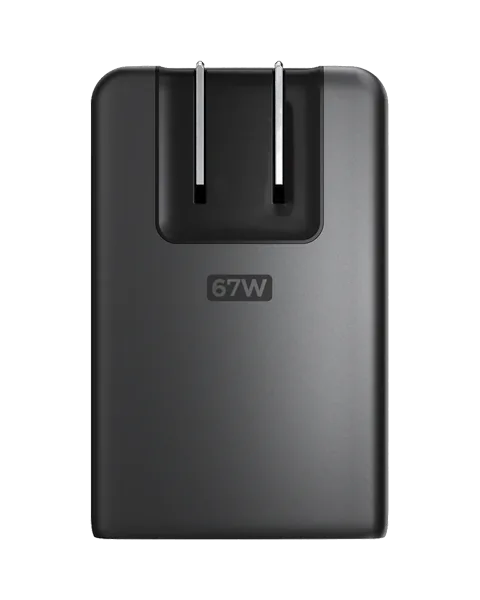
The case for GaN is clearest at laptop wattage, and the Entropy67 shows it. It puts 67 W GaN into a body 84 by 44 by 14 mm, with two USB-C ports for a laptop and a phone.
Its idle draw is under 0.05 W, and it carries over-voltage, over-current, over-temperature and short-circuit protection.
Step by step
- Decide the highest wattage you charge at, phone or laptop.
- Below about 30 W, choose on size and price.
- At 60 W and above, prefer GaN for size and efficiency.
- Check the output table and per-port split.
- Use the charger in open air when running a laptop.
Questions people ask
Is a GaN charger worth it for a phone only?
Mainly for size. The IEA's 2024 measurements found GaN and silicon chargers at roughly equal efficiency, about 90 per cent, at 30 W. If a smaller plug matters to you, GaN is worth it; if not, a well-made silicon charger is fine.
Does a GaN charger save electricity?
A little, at higher power. The IEA measured GaN chargers at 92 per cent against 90 per cent for silicon at 60 W, with one GaN unit losing about 1.4 W less. For one laptop charged two hours a day, that is around 1 kWh a year by our arithmetic.
Why does my GaN charger get hot?
Because it packs a lot of power into a small space. Even at over 90 per cent efficiency, a 65 W charger at full load turns several watts into heat, and a small case has less surface to shed it. Tom's Hardware measured some 45 to 68 W chargers at over 70 °C.
Do GaN chargers last longer than silicon chargers?
There is no widely published long-term comparison. Lower losses mean slightly less heat, which helps components, but small size works against cooling. Build quality and how hot the charger runs in your use matter more than the material.
Are silicon chargers being phased out?
Not entirely. The IEA report notes GaN chargers themselves combine GaN switches with silicon parts. GaN has become common above about 30 W, where its size and efficiency gains are largest, while silicon remains common in low-watt chargers.
Sources
- IEA 4E PECTA: Energy efficiency measurement of wide bandgap-based power supplies · Jan 2024
- Tom's Hardware: We tested 20 wall chargers from 15 W to 140 W · 11 Jun 2026
- IEEE Spectrum: Gallium nitride and silicon carbide fight for green tech domination · 26 Mar 2023
- ChargerLAB: Comparative test of iPhone 16 Pro with Apple chargers at different power · 11 Dec 2024
GaN — Gallium Nitride
The semiconductor that let chargers shrink.
Read →Comparison · 1 min readGaN vs conventional chargers: what actually changed
Less mythology, more physics.
Read →Explainer · 5 min readGaN chargers: what changed and what did not
A new material shrank the charger. Your phone's charging speed stayed where it was.
Read →Explainer · 4 min readHotel room charging: making one socket work
One socket behind the bed, three devices, a 7 am meeting. Here is the plan.
Read →Explainer · 5 min readSilicon carbide and GaN: the next step in chargers
A new label is reaching charger boxes. What silicon carbide does, and does not, change.
Read →Comparison · 5 min read65 W vs 100 W for a laptop: which one do you need?
A 100 W charger has 54 percent more power. Whether you feel it depends on one number.
Read →