Journal · Explainer · 5 min read
Silicon carbide and GaN: the next step in chargers
A new label is reaching charger boxes. What silicon carbide does, and does not, change.
First the boxes said GaN. Now a few say SiC, and one 140 W desktop charger torn down by ChargerLAB in November 2025 runs on a silicon carbide transistor rated for 800 V. Is SiC the new GaN, and should you wait for it?
Short answerNo need to wait. Silicon carbide and gallium nitride are both wide-bandgap materials that switch power more efficiently than silicon. GaN leads in phone and laptop chargers; SiC leads at very high voltages, such as 800 V electric car systems. A SiC charger can be excellent, but its design, protections and output table matter more than the material.
SiC vs GaN vs silicon: the numbers
IEEE Spectrum, in a March 2023 analysis by Umesh Mishra, a University of California, Santa Barbara professor who is also chief technical officer of a GaN company, lists the bandgap of silicon at 1.12 eV, common silicon carbide at 3.26 eV and gallium nitride at 3.40 eV. A wider bandgap lets a transistor block higher voltages in a smaller chip. Keep the author's GaN interest in mind when reading his forecasts, though the material figures are standard.
The same article puts electron mobility, a measure of how quickly charge moves, at about 1,450 for silicon, about 950 for SiC and about 2,000 for GaN, in cm²/V·s. GaN power converters, it says, run at hundreds of kilohertz, while silicon and SiC designs typically sit around 100 kHz. That speed is why GaN dominates compact chargers.
The voltage map follows. IEEE Spectrum says GaN dominates high-voltage power transistors below about 400 V, SiC has the edge at 800 V and above, and the 400 to 1,000 V band is contested. It names GaN the incumbent in phone, tablet and laptop chargers from 25 to 500 W since about 2019, and SiC the leader in electric car inverters, where 400 V and 800 V systems are common.
SiC has one safety trait worth knowing. The article notes that SiC MOSFETs are fail-open devices: if the control circuit fails, they stop conducting, which lowers the risk of a short circuit. GaN lacks such a reliable insulator, so designers use particular device types, or pair it with a silicon transistor, to make it fail safely. Both can be made safe; they get there differently.
| Material | Bandgap | Electron mobility, cm²/V·s | Typical switching |
|---|---|---|---|
| Silicon | 1.12 eV | About 1,450 | About 100 kHz |
| Silicon carbide | 3.26 eV | About 950 | About 100 kHz |
| Gallium nitride | 3.40 eV | About 2,000 | Hundreds of kHz |
Source: IEEE Spectrum, Mar 2023
eV
Source: IEEE Spectrum, Mar 2023
How wide-bandgap materials help a charger
A charger's main transistor switches mains-derived DC on and off thousands of times a second. Every switch wastes a little energy, and every bit of resistance while the switch is on wastes a little more. Wide-bandgap materials do both jobs with less waste than silicon, so the charger runs cooler or can be made smaller.
Think of it like Indian Railways' electric locomotives. A freight engine built for heavy loads and high voltage and a fast suburban train built for quick starts and stops are both electric, both efficient, and suited to different routes. SiC is the freight engine; GaN is the suburban train. A phone charger runs a suburban route.
That is why a SiC phone charger is possible, but not automatically better. ChargerLAB's teardown of one 140 W SiC desktop charger with a small display found an 800 V SiC MOSFET as the primary switch. The charger measured about 67 by 74 by 38 mm and weighed about 294 g, heavy for its class, and its main port delivered about 136 W when charging a large power bank in testing.
Chargers already mix materials
The International Energy Agency's 4E report on wide-bandgap chargers, published in January 2024, makes a point that applies to both: a GaN charger is not built only from GaN parts. It combines GaN switches with silicon controllers, rectifiers and protection parts. The same is true of SiC designs.
What the report did measure was the effect. GaN chargers averaged 92 per cent efficiency against 90 per cent for silicon at 60 W, and offered up to twice the power density, though one GaN design in its comparison was only about a quarter denser than silicon. The gain comes from the whole design, not one part.
What to check before you buy
Read the USB-C PD output table first. Material does not matter if the voltages your devices need are missing.
Compare size and weight for the wattage. A heavy 140 W charger is not a bad sign; more mass often means more room to shed heat under long laptop loads.
Check the per-port split. Multi-port chargers share power, whatever their material.
Look for the maker's safety markings and an input rating of 100-240 V on the body.
Treat GaN or SiC as a design detail, not a reason on its own to pay more.
Cost is shifting too. IEEE Spectrum reported that SiC substrates and fabrication cost more than GaN's, though at 5 kW and above the final device prices were roughly level, and it expected high-voltage GaN to challenge SiC on price. For a buyer at the counter, that simply means both labels will keep appearing, and neither one guarantees the better charger.
Myth corner
Myth: SiC chargers will make phones charge faster than GaN ones. They will not. The phone requests its power through USB-C PD or PPS, and both materials can supply it. IEEE Spectrum's own map shows SiC's advantage lies at 800 V and above, far beyond a phone charger's job.
The right one for you
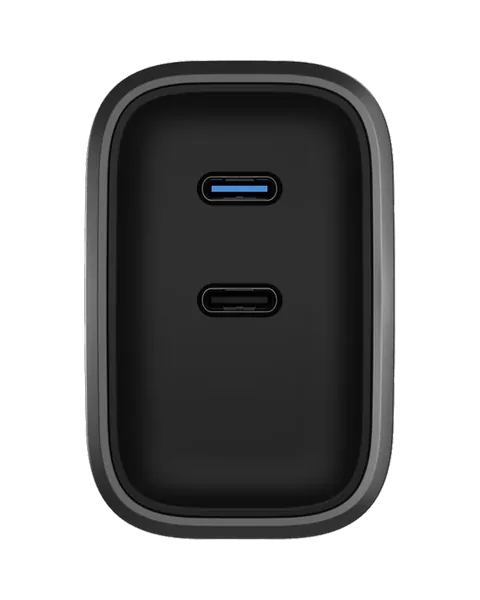
Judged the way this guide suggests, by what it delivers rather than what it is made of, Fermi45 sets everything out: rails from 5 V at 3 A to 20 V at 2.25 A, PPS from 5 to 20 V, a stated split of 25 + 20 W or 30 + 15 W across its two USB-C ports, and an input of 100–240 V.
It is a GaN charger for the iPhone 17 series and the Galaxy phones that take 45 W, with Samsung Super Fast Charging 2.0 delivering 45 W from one port.
Step by step
- Note the voltages and watts your devices need.
- Check the charger's USB-C PD output table covers them.
- Compare per-port power for multi-device use.
- Look for safety markings and the input rating on the body.
- Choose on output, size and protections, not on GaN or SiC alone.
Questions people ask
What does SiC mean on a charger?
SiC stands for silicon carbide, a wide-bandgap semiconductor. In a charger, it usually means the main power switch uses a SiC transistor instead of silicon or GaN. ChargerLAB's teardown of one 140 W SiC charger found an 800 V SiC MOSFET as the primary switch.
Is a SiC charger safe for my phone?
Yes, if it is a well-made USB-C Power Delivery charger with proper protections. The phone still negotiates the voltage and current it accepts. The semiconductor material inside does not change how the phone is charged.
Is GaN or SiC more efficient?
At charger power levels, GaN usually has the edge because it switches faster, which IEEE Spectrum puts at hundreds of kilohertz against about 100 kHz for silicon and SiC. SiC is preferred at 800 V and above, as in electric car inverters.
Will SiC replace GaN in phone chargers?
Not on current evidence. IEEE Spectrum describes GaN as the incumbent for 25 to 500 W chargers and SiC as dominant at much higher voltages. Some SiC chargers exist, but both materials are likely to keep sharing the market.
Why is SiC used in electric cars?
Electric car systems often run at 400 V or 800 V, and SiC handles high voltages efficiently. IEEE Spectrum notes that a mass-market electric car adopted SiC for its inverter in 2017, and other car makers followed.
Sources
GaN — Gallium Nitride
The semiconductor that let chargers shrink.
Read →Comparison · 1 min readGaN vs conventional chargers: what actually changed
Less mythology, more physics.
Read →Explainer · 4 min readDoes fast charging kill the battery?
The watts on the charger matter less than the temperature of the phone
Read →Explainer · 4 min readHotel room charging: making one socket work
One socket behind the bed, three devices, a 7 am meeting. Here is the plan.
Read →Explainer · 5 min readGaN chargers: what changed and what did not
A new material shrank the charger. Your phone's charging speed stayed where it was.
Read →Buying guide · 6 min readWhich charger does your 25 W magnetic (Qi2.2) puck need?
The puck can only give what the adapter feeds it, and heat takes its share first.
Read →