Journal · Explainer · 5 min read
How ANC chips think: a look inside
Two tiny microphones, a fast chip and a trick of physics that is nearly a century old.
You put in noise-cancelling earbuds on a Metro coach and the rumble of the wheels simply falls away, yet the announcement and the person next to you still come through. Nothing has been plugged into your ear canal more tightly. So what exactly is the chip inside doing, and why does it pick and choose?
Short answerAn ANC earbud listens to incoming noise with tiny microphones, and its chip plays back an inverted copy of that sound through the speaker so the two cancel in your ear. The physics favours steady, low-pitched noise such as engines and fans. Higher, sudden sounds like voices are left mostly to the ear tip's seal.
How much noise ANC removes, in numbers
The idea is old. Wikipedia's history of active noise control records a 1936 patent by Paul Lueg for silencing sound with sound, and a 1957 headset by Willard Meeker that cancelled noise across roughly 50 to 500 Hz, with a best reduction of about 20 dB.
Modern figures sit in a similar range. Wikipedia's headphones article puts active cancellation at 20 dB or more, working mainly on constant, low-frequency sound and far less on sharp sounds and voices. For comparison, it lists passive isolation of about 10 to 15 dB for in-ear designs and about 8 to 12 dB for closed-back headphones.
Manufacturers now quote gains between their own generations. Apple says AirPods Pro 3 remove up to twice as much noise as AirPods Pro 2, and four times as much as the original model, measured to the IEC 60268-24 test method. That is a relative claim, not an absolute dB figure, and Apple notes results depend on settings and environment.
| Method | Reduction | Works best on |
|---|---|---|
| Active noise cancelling, today | 20 dB or more | Constant, low-frequency sound |
| Passive isolation, in-ear | About 10 to 15 dB | Higher frequencies, voices |
| Passive isolation, closed-back headphones | About 8 to 12 dB | Higher frequencies, voices |
| Meeker's headset, 1957 | About 20 dB at best | Roughly 50 to 500 Hz |
Source: Wikipedia: Headphones; Wikipedia: Active noise control; accessed Nov 2026
How the chip builds anti-noise
Sound is a pressure wave. If you add a second wave of the same size but flipped, so its peaks line up with the first wave's troughs, the two sum to nearly nothing. Engineers call this destructive interference. The earbud's job is to make that flipped wave fast and accurately enough, at the eardrum, not somewhere near it.
Picture two children on a see-saw. If one pushes down at the exact moment the other pushes up, the plank barely moves. Push a fraction late and the plank rocks anyway. ANC is that timing game, played thousands of times a second.
Most ANC earbuds use two kinds of microphone. An outward-facing microphone hears noise before it reaches the ear, which gives the chip a head start. This is called feedforward. An inward-facing microphone sits between the speaker and the eardrum and hears what is actually left, including any noise that slipped past the tip. This is called feedback. Using both is called hybrid ANC. Apple's AirPods Pro specification, for example, lists dual beamforming microphones and an inward-facing microphone on each bud.
The chip, usually a digital signal processor built into the earbud's Bluetooth system-on-chip, runs a filter that shapes the anti-noise to match how sound travels through that bud and that ear. Qualcomm's true wireless white paper, for example, lists integrated ANC as a feature of its earbud chips, so the same chip that runs Bluetooth also runs the cancellation.
Why voices slip through
Timing gets harder as pitch rises. Sound moves at about 343 m/s. Wikipedia's active noise control article notes that a 1,600 Hz tone has a full wavelength of about 21.5 cm, roughly the distance between your ears. At those short wavelengths a small timing or position error turns cancellation into reinforcement, and above about 1,000 Hz sound in a real space adds and cancels unpredictably.
Speech carries much of its detail above that range, and it starts and stops without warning, so the chip cannot predict it. Low engine drone repeats itself and has long wavelengths, which is why it vanishes first. This is also why the ear tip matters so much: passive sealing does most of the work on higher frequencies, and ANC does most of the work below.
What to check before you buy
Check the microphone list. A product page that mentions both outer and inner microphones, or says hybrid ANC, is using the feedback loop that corrects for fit. Feedforward-only designs depend more on a perfect seal.
Try more than one tip size. ANC and passive sealing stack together. A loose tip leaks low frequencies and the chip has to work harder, which costs both quiet and battery.
Test with steady noise and with voices. At the counter, stand near an air conditioner or fan and toggle ANC on and off. The fan should drop sharply. Voices dropping only a little is normal physics, not a fault.
Listen for pressure or hiss. Some people feel a mild pressure sensation with strong ANC, and some designs add faint hiss in a quiet room. Spend a minute with ANC on and no music before you decide.
Read battery figures with ANC on. Brands usually quote hours with ANC enabled and separately with it off. Compare like with like.
Myth corner
Myth: ANC makes earbuds louder so they drown out noise. It does the opposite. The anti-noise subtracts sound energy at the eardrum, which is why many people listen at lower volume with ANC on, a point SoundGuys also makes about hearing safety.
The right one for you
For the engine drone and fan hum this guide describes, the check that matters most is hybrid ANC: the feedforward and feedback microphones working together, so the chip corrects for fit as well as noise.
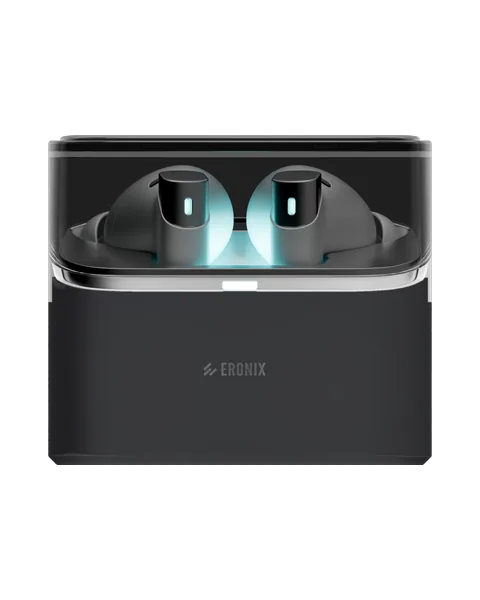
The Euphoria uses ANC rated at 45 dB and works with iPhone and Galaxy S. On Android phones that support aptX HD, it keeps more of the detail once the cabin goes quiet. It plays 5.5 hours on a charge and is rated IPX6.
Step by step
- Fit the largest ear tip that is still comfortable and check for a seal.
- Stand near a steady noise source such as a fan or air conditioner.
- Toggle ANC on and off and listen for how much the low hum drops.
- Spend a minute with ANC on and no music to check for hiss or pressure.
- Compare battery figures quoted with ANC on, not off.
Questions people ask
What is hybrid ANC?
Hybrid ANC uses two microphones per earbud. An outward-facing feedforward microphone hears noise before it arrives, and an inward-facing feedback microphone hears what remains inside the ear. The chip combines both to create anti-noise, which helps correct for imperfect fit and gives more consistent cancellation than one microphone alone.
Why can I still hear people talking with ANC on?
Voices carry much of their energy at higher frequencies and change constantly. At short wavelengths small timing errors turn cancellation into reinforcement, so ANC works best on low frequencies, and above about 1,000 Hz cancellation becomes unpredictable. The ear tip's passive seal handles higher sounds, which is why voices are reduced but rarely silenced.
Is ANC safe for my ears?
ANC itself does not add volume. By removing low-frequency background noise it lets many people listen at a lower level, which reduces hearing risk. Some users feel a mild pressure sensation with strong ANC. If it is uncomfortable, a lighter mode or transparency mode is a reasonable alternative.
How many decibels does ANC remove?
Wikipedia's summary puts active cancellation at 20 dB or more on steady low-frequency noise, on top of about 10 to 15 dB of passive isolation from an in-ear seal. Brands rarely publish absolute figures; Apple, for example, gives a relative claim measured to IEC 60268-24.
Sources
- Wikipedia: Active noise control · accessed 22 Nov 2026
- Wikipedia: Headphones (active noise cancelling, passive isolation) · accessed 22 Nov 2026
- Apple Newsroom: Introducing AirPods Pro 3 · 9 Sep 2025
- Apple: AirPods Pro technical specifications · accessed 22 Nov 2026
- Qualcomm: The Evolution of True Wireless Technology (white paper) · 2020
- SoundGuys: How noise cancelling headphones work · accessed 22 Nov 2026
Active Noise Cancellation
Silence, computed in real time.
Read →Explainer · 5 min readWhat ANC can and cannot block
Why the bus engine fades but the conductor's voice does not, and what to check.
Read →Explainer · 4 min readWired vs wireless audio today
Bluetooth has closed most of the gap. Here is exactly where wired is still ahead
Read →Explainer · 4 min readNoise cancelling headphones for Indian commutes
Metro rumble, auto engines, horns. What noise cancelling removes, and what it should not.
Read →Explainer · 4 min readTransparency mode: how earbuds let the world back in
Your earbuds can hear the platform announcement for you. Here is how, and where it stops.
Read →Explainer · 4 min readCall quality: how earbud microphones handle noise
Your mouth is a hand's width from the mic. Everything else makes up for that.
Read →