Journal · Comparison · 4 min read
Laptop USB-C vs barrel chargers
The round plug did one job for one laptop. USB-C does most jobs, up to a ceiling.
Your old laptop came with a heavy brick and a round barrel plug. Your new one charges over USB-C, and so does your phone. Is USB-C just as good for a laptop, or is the barrel plug still better for serious work?
Short answerFor most laptops, USB-C is as good and more flexible. USB Power Delivery reached 100 W at 20 V and 5 A, and Revision 3.1 raised the ceiling to 240 W at 48 V. One USB-C charger can serve laptop, phone and tablet. Barrel chargers remain for laptops that need more power or lack USB PD.
Side by side: how much power each can carry
The USB-IF's own summary of USB Power Delivery sets out the numbers. Before Revision 3.1, USB PD was limited to 100 W, using 20 V with USB-C cables rated at 5 A. Revision 3.1 added fixed voltages of 28 V, 36 V and 48 V, enabling 140 W, 180 W and 240 W, plus an adjustable voltage mode where a device can request intermediate voltages from 15 V upward.
Plugable's explainer on this Extended Power Range adds detail on the adjustable mode: sinks can choose a voltage between 15 V and 48 V in 100 mV steps. It also notes that EPR cables must be visibly marked as supporting 240 W.
The cable is part of the limit. ChargerLAB's cable guide divides USB-C charging cables into 3 A types, good for 60 W, and 5 A types, good for 100 W. A 100 W laptop on a 3 A cable is capped at 60 W.
A barrel charger has no shared standard. Each maker sets the voltage, current, plug size and polarity for its own laptops. That is why one brand's barrel charger rarely fits another's laptop, and why a barrel charger cannot charge your phone.
| MacBook | Adapter for fast charging | Note |
|---|---|---|
| MacBook Pro 16-inch | 140 W | USB-C to MagSafe 3, or 240 W USB-C cable on late-2023 models |
| MacBook Pro 14-inch | 96 W or 140 W | USB-C adapter |
| MacBook Air | 70 W or more | 67 W on the 13.6-inch model |
Source: Apple Support, Fast charge your MacBook Air or MacBook Pro, accessed Nov 2026
Maximum power (W)
Source: USB-IF, USB Charger (USB Power Delivery), accessed Nov 2026
A real laptop example
Apple's support page on fast charging its MacBooks shows how USB-C covers even large laptops. The 16-inch MacBook Pro fast charges with Apple's 140 W USB-C power adapter, either through a USB-C to MagSafe 3 cable or, on models from late 2023, Apple's 240 W USB-C charge cable. The 14-inch MacBook Pro fast charges with a 96 W or 140 W adapter, and the MacBook Air with 70 W or more, or 67 W on the 13.6-inch model. Apple states fast charging reaches up to 50% in around 30 minutes on eligible models. MagSafe 3 here is a magnetic connector, but the adapter is still USB-C.
How USB-C decides the power
A barrel charger is always on at one voltage; plug it in and the laptop takes what it needs. USB-C starts at a safe 5 V and stays there until the charger and laptop agree on more. Through USB PD, the laptop asks for 20 V, or 28 V and above on EPR, and the charger confirms it can deliver. Plugable notes that an EPR contract can only begin after an initial standard power contract.
Think of a barrel charger as a dedicated water line to a single washing machine, built for that machine only. USB-C is a municipal connection with a meter: every appliance in the house can use it, and each gets the pressure it asks for, up to the main's capacity.
When a barrel charger still makes sense
If a laptop's maximum draw is above 240 W, USB-C cannot carry it. If a laptop's USB-C port does not support charging, or supports it only at a low rating, the barrel charger is needed for full performance. And if you are replacing a charger for an older barrel laptop, an exact-match replacement from the maker is the safe route; a mismatch in voltage or polarity can damage it.
Travelling with one charger
For travel, USB-C's biggest advantage is consolidation. One multi-port USB PD charger, sized to the laptop, can replace the laptop brick, the phone charger and the tablet charger. Size it so the laptop's port gets its full wattage even with the phone connected, or accept that the laptop charges more slowly while sharing.
What to check before you buy
Find your laptop's charging wattage in its manual or on the original charger's label. Match or exceed it with a USB-C PD charger.
Check that the laptop's USB-C port supports charging. Many show a charging symbol beside the port, or say so in the specifications.
Match the cable. For more than 60 W, use a 5 A cable; for more than 100 W, use a cable marked for 240 W.
On a multi-port charger, check the output of the specific port when other devices are connected. Shared chargers often split power.
Expect a smaller USB-C charger to run warm under full laptop load, and give it open air.
Myth corner
Myth: a USB-C charger with lower wattage than the laptop's original will damage it. Fact: USB PD negotiates power, so a lower-rated charger simply supplies less. The laptop may charge slowly or, under heavy load, drain slowly while plugged in, but it is not harmed. The risk with mismatches belongs to barrel chargers, which have no negotiation at all.
The right one for you
A 16-inch MacBook Pro fast charges from a 140 W USB-C adapter, and above 100 W the cable must be one rated for 240 W.
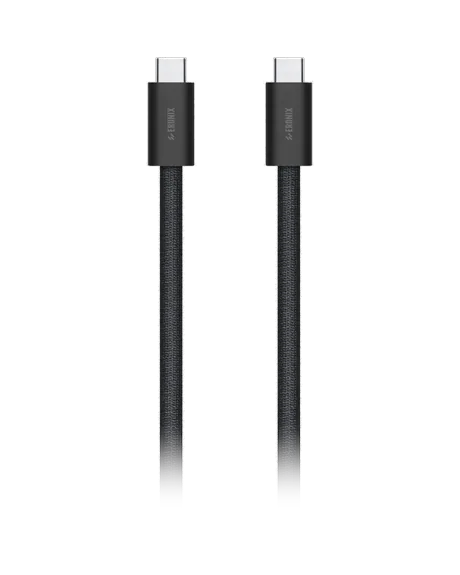
The Entropy140 delivers 140 W over USB PD 3.1 EPR, with a second USB-C port and a USB-A port for the phone and the watch, in an aluminium-clad finish. Pair it with the Power Cable 240 W, an EPR cable with an e-marker, braided and 2 m long, so the charger reaches the far side of the desk.
Step by step
- Read your laptop's rated charging wattage.
- Confirm its USB-C port supports charging.
- Choose a USB-C PD charger at or above that wattage.
- Use a 5 A cable above 60 W, or a 240 W cable above 100 W.
- Check the per-port output on multi-port chargers.
Questions people ask
Can I charge any laptop with a USB-C charger?
Only laptops whose USB-C port supports USB Power Delivery charging. Check the specifications or look for a charging symbol by the port. If it does, a USB-C PD charger at or above the laptop's rated wattage will charge it fully; a lower-rated one will charge more slowly but safely.
What is the maximum power over USB-C?
USB PD Revision 3.1 allows up to 240 W, using 48 V at 5 A, according to the USB-IF. Earlier USB PD was limited to 100 W at 20 V and 5 A. Reaching more than 100 W needs a charger, cable and laptop that all support the Extended Power Range.
Why is my laptop charging slowly on USB-C?
The usual causes are a charger rated below the laptop's draw, a 3 A cable limiting power to 60 W, or a multi-port charger splitting power with another device. Heavy use, like gaming or video export, can also exceed the charger's output. Check each link in the chain against the laptop's rating.
Is a 100 W USB-C cable enough for a laptop?
For laptops up to 100 W, yes. A 5 A cable carries 100 W at 20 V. For larger laptops that charge above 100 W through USB-C, such as Apple's 16-inch MacBook Pro on USB-C, use a cable marked for 240 W, which Extended Power Range requires.
Sources
- USB Charger (USB Power Delivery) (USB-IF) · accessed 22 Nov 2026
- What is 240W USB Extended Power Range (EPR)? (Plugable) · accessed 22 Nov 2026
- What's the difference between 5A cable and 3A cable (ChargerLAB) · accessed 22 Nov 2026
- Fast charge your MacBook Air or MacBook Pro (Apple Support) · accessed 22 Nov 2026
USB-C Power Delivery
One connector, a negotiated contract.
Read →Buying guide · 5 min readWhich charger does the iPhone 18 Pro need?
Half a battery in 15 minutes, but only if your charger speaks one new word: AVS.
Read →Buying guide · 4 min readWhich charger does your MacBook Pro 16-inch (M5 Pro or M5 Max) need?
The one MacBook where a 100 W charger works but never fast-charges.
Read →Explainer · 4 min readUSB PD 3.1 EPR and 240 W, explained
Same USB-C plug, more than twice the power. The trick is voltage, not a thicker wire.
Read →Comparison · 5 min read20 W vs 30 W for an iPhone: is the difference worth it?
Four minutes on one iPhone, eight on another: the number that decides it is your phone's.
Read →Comparison · 5 min readFast charging on iPhone vs Galaxy
Two phones, two dialects of USB-C. The charger that speaks both is the one to own.
Read →