Journal · Explainer · 4 min read
Portable speakers: what watts mean
A 40 W speaker is not twice as loud as a 20 W one. Here is what the number does tell you.
Two portable speakers sit side by side on the shelf. One says 20 W, the other 40 W, and the second costs more. Will it really sound twice as loud at your next house party?
Short answerNo. Watts describe how much electrical power the amplifier can deliver, not how loud the speaker sounds. Doubling the power adds only about 3 dB, a small step. Roughly ten times the power is needed to sound twice as loud. Sensitivity, size and tuning matter as much as watts, and ratings like PMPO follow no standard at all.
The numbers behind speaker watts
The acoustics are well established. Wikipedia's article on audio power, summarising audio engineering practice, says a 3 dB change corresponds to doubling or halving acoustic power. Perceived loudness roughly doubles with about a 10 dB increase, which needs about ten times the power. So a 40 W speaker, if everything else were equal, would be only about 3 dB louder than a 20 W one: noticeable, not dramatic.
Sensitivity can outweigh watts entirely. Speakers are rated for how loud they play with 1 W of input. The same article gives a striking example: a speaker with 84 dB sensitivity needs a 400 W amplifier to match a 90 dB speaker on 100 W, or a 100 dB speaker on just 10 W. Many good home speakers fall between about 84 and 94 dB.
Distance matters too. In open space, Wikipedia's inverse-square law article says sound level falls by about 6 dB each time you double your distance from the source. Moving from 1 metre to 4 metres away costs about 12 dB, far more than any doubling of watts can give back.
| Change | Effect on level |
|---|---|
| Double the power | About +3 dB |
| About ten times the power | About +10 dB, roughly twice as loud |
| Double the distance | About −6 dB |
| Move from 1 m to 4 m | About −12 dB |
Source: Audio power and Inverse-square law, Wikipedia
W
Source: Audio power, Wikipedia
How a speaker turns watts into sound
Inside a portable speaker, a battery feeds an amplifier, the amplifier drives one or more drivers, and each driver pushes air with a cone or dome. Most of the electrical power becomes heat in the driver's coil; only a small share becomes sound. How much depends on the driver's size, magnet, enclosure and tuning, which is what sensitivity captures.
Bass is the hungry part. The equal-loudness research summarised on Wikipedia shows the ear is most sensitive between 2 and 5 kHz, and loudness sensitivity falls steeply below about 100 Hz. A small speaker needs far more power and cone movement to make deep bass sound as loud as the midrange, which is why small speakers often reduce bass at high volume.
Think of it like the engine power of a car. A big engine in a heavy SUV and a small engine in a light hatchback can reach the same speed on the same road. What matters is how efficiently the power is turned into motion. Watts are the engine; sensitivity is how light and efficient the car is.
RMS, peak and PMPO
Not all watt figures mean the same thing. The Wikipedia article explains that continuous, or average, power is the meaningful figure, sometimes labelled RMS. Peak power is always higher, and for a pure tone it is twice the average.
PMPO, short for peak music power output, is the one to ignore. The same source notes that PMPO has never been defined in any standard, and makers' definitions vary so much that it cannot be converted to anything else. In the US, the FTC's Amplifier Rule has required continuous power ratings for amplifiers since 1974, and was extended in 1998 to self-powered speakers.
Distortion matters as well. Amplifiers are often rated at 1 percent total harmonic distortion, sometimes at 10 percent. A figure taken at 10 percent may be higher, but it is measured while the sound is already audibly distorted.
Why a speaker distorts when you push it
When an amplifier is asked for more than it can give, it clips: the tops of the waveform are flattened. Wikipedia's article on clipping explains this creates strong high-frequency harmonics, which sound harsh and can overheat a tweeter. A modest speaker played below its limit will sound cleaner than a bigger one pushed into clipping.
What to check before you buy
Look for continuous or RMS watts, and ignore PMPO figures entirely.
Look for a maximum sound level in dB, if the maker gives one, and the distance it was measured at. That says more about loudness than watts.
Listen at the volume you will use. Play a track you know, at party level and at background level, and listen for harshness or bass that thins out.
Check driver count and size. Larger drivers and a passive radiator usually help bass more than extra watts.
Check battery life at high volume, not only at moderate volume. Louder playback drains the battery faster.
Myth corner
Myth: a 40 W speaker is twice as loud as a 20 W one. Doubling power adds only about 3 dB, according to standard acoustics, while sounding twice as loud needs roughly ten times the power. Sensitivity, size and where you place the speaker matter at least as much.
The right one for you
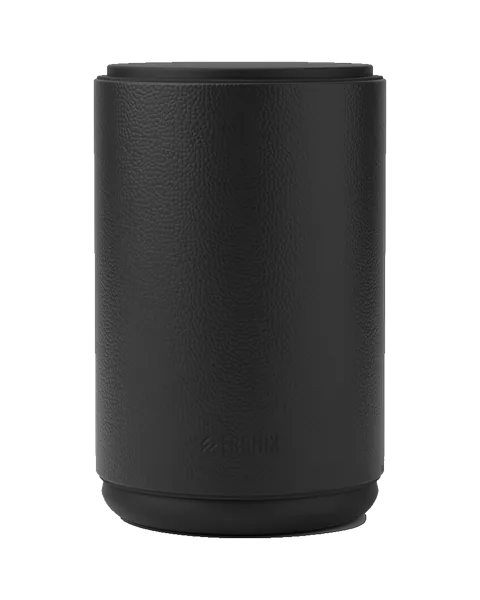
Watts are one line on the sheet, so read the rest. The Crescendo lists 2 × 15 W in stereo with dual passive radiators, the part this guide says helps bass more than extra watts, and a second unit pairs for real left and right.
It plays for 24 hours, is IP67 for the terrace and the garden, and wears aluminium end caps with a fabric wrap.
Step by step
- Ignore PMPO and look for continuous or RMS watts.
- Look for a maximum sound level in dB and the distance it was measured at.
- Listen at your normal and party volumes for harshness.
- Compare driver size and the presence of passive radiators.
- Check battery life at high volume.
Questions people ask
Is a 10 W Bluetooth speaker loud enough for a room?
Often, yes, for a small or medium room. Loudness depends on sensitivity, driver size and distance as much as watts. A 10 W speaker with good sensitivity, placed close by, can fill a bedroom comfortably. For outdoor use, expect to need more, because sound falls about 6 dB per doubling of distance.
What is PMPO in speakers?
PMPO stands for peak music power output. According to Wikipedia's article on audio power, it has never been defined in any standard, and makers' definitions vary too much to compare. Use continuous or RMS power figures instead, and ideally a maximum sound level in dB.
Does a higher watt speaker have better bass?
Not by itself. Bass depends on driver size, enclosure design and passive radiators. The ear is far less sensitive below about 100 Hz, so small speakers need a lot of power and cone movement for bass. Extra watts help only if the drivers can use them without distorting.
Why does my speaker sound harsh at full volume?
It is probably clipping or the drivers are at their limit. Clipping flattens the waveform's peaks and adds high-frequency harmonics that sound harsh and can stress tweeters, as Wikipedia's article on clipping explains. Turning down slightly or moving closer usually sounds better than maximum volume.
Sources
- Audio power, Wikipedia · accessed 22 Nov 2026
- Inverse-square law, Wikipedia · accessed 22 Nov 2026
- Equal-loudness contour, Wikipedia · accessed 22 Nov 2026
- Clipping (audio), Wikipedia · accessed 22 Nov 2026
Acoustics
What a driver actually does.
Read →Explainer · 5 min readLDAC, aptX, AAC: which codec your phone really uses
The logo on the earbud box is a promise. Your phone decides whether it is kept.
Read →Explainer · 5 min readWhat ANC can and cannot block
Why the bus engine fades but the conductor's voice does not, and what to check.
Read →Explainer · 4 min readTransparency mode: how earbuds let the world back in
Your earbuds can hear the platform announcement for you. Here is how, and where it stops.
Read →Explainer · 4 min readWhy earbuds sound different on iPhone and Android
Same earbuds, same song, two phones. The difference starts before the sound reaches you.
Read →Explainer · 5 min readHow Bluetooth audio actually travels
From the music file to your ear in about a sixth of a second: every step, in order.
Read →