Journal · Explainer · 5 min read
Solid-state batteries: what they could change
The battery everyone keeps promising. What is real today, and what is still a lab result.
Every year a headline promises a battery that charges in minutes, lasts twice as long and cannot catch fire. The name attached is almost always solid-state. So should you wait for one before buying your next phone, power bank or laptop?
Short answerNot yet. A solid-state battery replaces the flammable liquid electrolyte inside a lithium-ion cell with a solid one, which could allow lithium-metal anodes, more energy per kilogram and better safety. Today they are used in small niche devices; for phones and power banks, cost, cycle life, cold performance and manufacturing are still unsolved.
The numbers: what solid-state promises
The Wikipedia article on solid-state batteries, which summarises the research literature, says conventional lithium-ion cells are generally below 300 Wh/kg, while solid-state cells can exceed 350 Wh/kg, with a wide spread depending on design. Battery University describes the promise as roughly twice the energy of regular lithium-ion. Most of that gain comes from using pure lithium metal as the anode instead of graphite, because lithium metal stores far more charge for its weight.
The limits are just as specific. Battery University notes that prototypes it reviewed reached only about 100 cycles, with poor conductivity at cool temperatures and high internal resistance. A typical phone battery is expected to survive hundreds of full cycles. Wikipedia notes that ceramic electrolytes need firm, continuous pressure to stay in contact with the electrodes, around 1 to 7 MPa for lithium-metal designs, which is hard to engineer into a thin phone.
The two sources do not agree on everything. Battery University's page sounds more cautious and quotes a specialist who doubts solid-state can match lithium-ion on cost, life and safety. Wikipedia lists newer prototypes, such as a Panasonic cell announced in September 2023 that charged from 10 to 80 percent in about 3 minutes. Both are worth reading as signals, not as product specs.
| Measure | Lithium-ion today | Solid-state |
|---|---|---|
| Energy density | Generally below 300 Wh/kg | Can exceed 350 Wh/kg |
| Electrolyte | Liquid, flammable | Solid, meant to block dendrites |
| Anode | Graphite | Lithium metal in many designs |
| Cycle life | Hundreds of full cycles expected in a phone | About 100 in prototypes Battery University reviewed |
| Stack pressure | Not needed | About 1 to 7 MPa for lithium-metal ceramic designs |
Source: Solid-state battery (Wikipedia); Battery University BU-212, accessed 22 Nov 2026
How a solid-state battery differs
Every lithium battery moves lithium ions between two electrodes. When you charge, ions travel to the anode and are stored there; when you use the phone, they travel back to the cathode, and electrons flow through the circuit to power it. Between the electrodes sits the electrolyte, which lets ions pass but blocks electrons.
In today's cells, that electrolyte is a liquid soaked into a thin separator. It works well, but it is flammable, and it limits which anode materials are safe. Lithium metal, the most energy-dense option, tends to grow needle-like deposits called dendrites when charged. In a liquid cell those needles can pierce the separator and short the battery. A solid electrolyte is meant to block them.
Think of the electrolyte as the road between two cities. A liquid electrolyte is a smooth, well-paved road, but it is lined with fuel tanks. A solid electrolyte is a fireproof road, but it is harder to build, it gets bumpy in the cold, and the two cities must stay tightly bolted to it or the traffic stops.
What still holds it back
Interfaces. Wikipedia describes high resistance where the solid electrolyte meets each electrode, and side reactions that build a layer ions struggle to cross. A liquid simply flows into every gap; a solid does not.
Volume change. Lithium metal swells and shrinks as it plates and strips, about 5 micrometres per 1 mAh per square centimetre, according to the same summary. That movement opens voids that reduce capacity over time.
Cost and scale. Wikipedia notes that many companies that announced production targets had not commercialised products as of January 2026, and a large Japanese car maker said in June 2023 it would not use them commercially until at least 2027. Solid-state cells are already used in pacemakers, RFID tags and some wearables, where cells are tiny and cost matters less.
What it could change for phones and accessories
If the problems are solved, the biggest wins would be energy and safety. More energy per kilogram would mean longer phone life at the same size, or thinner power banks at the same capacity. A non-flammable electrolyte would reduce fire risk, which matters for devices that go into pockets, bags and aircraft cabins.
Fast charging would not change automatically. Charging speed depends on how quickly ions can move and how much heat the cell can shed. Some prototypes charge quickly, but Battery University warns that low loading capability is a known weakness of the chemistry. The charger and cable rules you use today, USB Power Delivery and its voltage steps, would still apply.
What to check before you buy
Read the chemistry line on the label. A battery or power bank marketed as solid-state should say so on its specifications. Some products use the term loosely; ask whether the electrolyte is fully solid or semi-solid.
Look at capacity in Wh as well as mAh. Energy in watt-hours is what airlines and real use care about, and it lets you compare chemistries fairly.
Check the rated cycle life. If a maker claims a new chemistry, it should state how many cycles the cell keeps most of its capacity for.
Do not wait for it to replace a failing battery. Today's lithium-ion cells, kept cool and away from 100 percent for long stretches, already last years.
Myth corner
Myth: solid-state batteries cannot fail. A solid electrolyte removes the flammable liquid, but Wikipedia notes that lithium dendrites can still penetrate some solid electrolytes and cause shorts and overheating. Safer does not mean without risk, and real products will still need protection circuits.
The right one for you
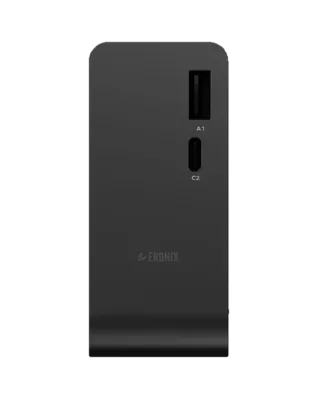
Solid-state is worth following, not waiting for. This guide's checks ask for energy in Wh as well as mAh, and the Battery Pack for MacBook 140W states both: 20,000 mAh and 74 Wh, under the cabin limit.
It charges a MacBook Air or Pro, an iPad or a phone, with 140 W of output and a display on the pack. It is made for the long-haul flight, with the batteries of today.
Questions people ask
Are solid-state batteries available in phones?
Not in mainstream smartphones as of late 2026, based on the sources reviewed. Wikipedia notes solid-state cells are used in pacemakers, RFID tags and some wearables, and that many companies with production targets had not commercialised products by January 2026. Phones still use lithium-ion or lithium-polymer cells.
Is a solid-state battery safer than lithium-ion?
It aims to be, because it replaces the flammable liquid electrolyte with a solid. That reduces fire risk. It does not remove all risk: Wikipedia notes that lithium dendrites can still pierce some solid electrolytes and cause shorts. Protection circuits remain necessary.
How much more energy can a solid-state battery hold?
Wikipedia says lithium-ion cells are generally below 300 Wh/kg, while solid-state cells can exceed 350 Wh/kg. Battery University describes a potential of about twice regular lithium-ion. The gain mainly comes from using a lithium-metal anode instead of graphite.
Why do solid-state batteries struggle in the cold?
Ions move more slowly through a solid than a liquid, and that slows further as temperature drops. Battery University notes poor conductivity at cool temperatures and high internal resistance in solid-state designs, which reduces the power the cell can deliver.
Sources
- Solid-state battery, Wikipedia · accessed 22 Nov 2026
- BU-212: Future batteries (Battery University) · accessed 22 Nov 2026
Battery Management
Capacity is chemistry; longevity is software.
Read →Explainer · 4 min readDoes fast charging kill the battery?
The watts on the charger matter less than the temperature of the phone
Read →Explainer · 4 min readLithium-ion vs lithium-polymer cells
Two names on power bank boxes, one chemistry inside. The real difference is the packaging.
Read →Explainer · 4 min readHow to store a power bank you rarely use
The emergency power bank is only useful if it still works on the day of the emergency.
Read →Explainer · 5 min readCan a 100 W charger damage your phone?
The watts on the brick are a ceiling, not a push. Heat is what your battery remembers.
Read →Explainer · 4 min readIs it safe to charge your phone overnight?
Your phone does not overcharge. It sits full for hours, and that is what to fix.
Read →