Journal · Comparison · 5 min read
Stem vs bean earbuds: fit and calls
The little stick is not just styling. It changes how your voice reaches the other side.
Six decibels. That is how much louder your voice reaches a microphone each time it sits half as far from your mouth, and it is why the short stem on some earbuds is more than styling. Beans sit flush in the bowl of the ear; stems hang towards the jaw. On a call from a busy road, that difference can decide whether you are heard or asked to repeat yourself.
Short answerStem earbuds put a microphone closer to your mouth, which usually helps calls in noise, because sound loses about 6 dB each time its distance doubles. Bean earbuds sit flush, suiting side sleepers, helmets and some smaller ears, but rely more on software to pick out your voice. For calls, the stem has physics on its side.
The number that decides calls: distance to the mouth
Wikipedia's article on the inverse-square law gives the rule that matters: for a point source, sound level falls by about 6 dB, 6.02 dB to be exact, every time the distance doubles. A microphone half as far from your mouth hears your voice about 6 dB louder, while the traffic around you, coming from far away, stays roughly the same at both positions.
Wikipedia's entry on noise-cancelling microphones explains why closeness is so valuable. Close-talking microphones are tuned for a source typically 1 to 3 cm from the mic, and their noise rejection depends on the voice being much closer than the background. Dual-microphone systems work by comparing a mic near the mouth with one that hears mainly the surroundings, then subtracting the difference.
An earbud can never sit 1 to 3 cm from the mouth. But a stem moves its lower microphone meaningfully closer than a bean's microphones, which sit at the ear. Every centimetre helps the voice stand out from the noise before any software starts work.
| Measure | Stem | Bean |
|---|---|---|
| Microphone distance to mouth | Closer | At the ear |
| Calls in noise | Physics helps | Relies more on software |
| Side sleeping, helmets | Stem can catch | Flush, nothing sticks out |
| Controls | Squeeze or swipe on the stem | Taps on the outer shell |
| Insert and remove | Easier to grip | Smaller to hold |
Source: Noise-canceling microphone (Wikipedia); SoundGuys, accessed 22 Nov 2026
How it works: hardware first, software second
Most modern earbuds use two or more microphones on each side and process them together to focus on your voice and suppress the rest. Bean designs depend on this processing more heavily, because their microphones start further from the mouth and closer to the wind.
Think of it like trying to hear a friend at a crowded railway platform. If they lean in close, you hear them easily. If they stand a metre away, you have to concentrate hard and still miss words. Software is the concentration. Distance is leaning in. Leaning in works every time, in every noise.
Wind is the hardest case for both. A gust across a microphone port is loud, close and random, and it defeats the comparison trick. Stems with ports facing down and away from the wind, and beans with mesh-covered ports, both try to manage it; test outdoors if you call while walking.
Fit: where each shape tends to work
Stem earbuds are easier to grip, insert and remove, and their stems often carry squeeze or swipe controls. The stem's weight hangs below the ear, which some people find stable and others feel pulls the bud loose during exercise.
Bean earbuds keep their weight inside the ear bowl. They suit side sleepers, people who wear helmets or tight caps, and some people with smaller ears, because nothing sticks out to catch on a pillow or strap.
Both shapes depend on the ear tip for seal. SoundGuys' fit testing found that a better fit gives more isolation and a more even frequency response, and that a poor seal makes bass drop significantly. A bean in the wrong tip size sounds no better than a stem in the wrong one.
The other half of a call: the radio link
A clear voice still has to reach the phone. Qualcomm's white paper on true wireless technology describes how later earbud designs can swap roles between the left and right buds during a call when one has a better Bluetooth link or better microphone conditions, without dropping the call or needing a button press.
The same paper notes that when the link is poor, for example with the phone in a pocket, the primary earbud can resend lost data to the other bud to keep the call stable. This works the same in stems and beans; shape affects where the microphones sit, while link handling depends on the chip and software inside.
For a buyer, that means two tests, not one. A call from a quiet room shows the link. A call from a noisy road shows the microphones. Good earbuds pass both.
What to check before you buy
Check calls in a noisy place. Ask to make a short call from the shop door or a busy corridor and have the other person describe how you sound; a pair with several microphones per side and call noise reduction usually does best.
Check controls. Stems often use squeezes; beans often use taps on the outer shell, which push the bud into the ear. Decide which feels better for you.
Check side-lying comfort if you listen in bed. Lie your head on your hand for a minute with the bud in.
Check tip sizes. More sizes in the box mean a better chance of a proper seal, whatever the shape.
Myth corner
Myth: stem earbuds are a fashion choice copied from one brand. The stem places a microphone closer to the mouth, and sound physics gives about 6 dB more voice for each halving of distance. That is a real engineering reason, not only a styling one, even if many good bean designs now close the gap with processing.
The right one for you
For calls on the move, the microphones and their processing do the work the shape alone cannot. The Zephyr uses four microphones with ENC rated up to 35 dB to hold your voice clear of the street, over Bluetooth 5.4 with HFP 1.7 for calls.
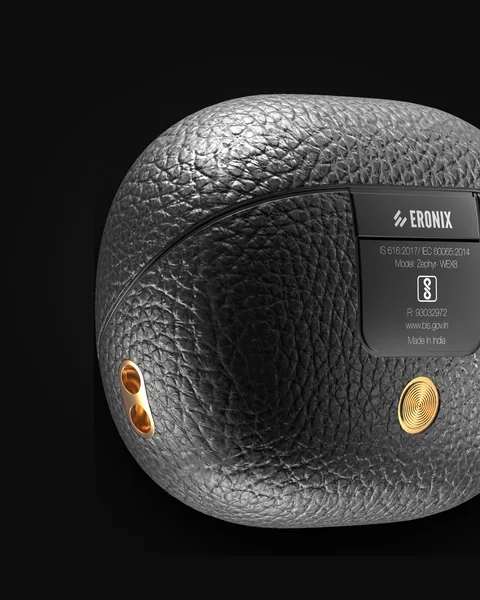
It pairs with iPhone, Galaxy A and S FE, and OnePlus phones, and travels in a NeoLeatherette case.
Step by step
- Try both shapes with every tip size in the box.
- Make a short test call in a noisy place for each.
- Ask the other person how clear your voice sounds.
- Lie your head on your hand to test side comfort.
- Shake your head and look down to check the fit holds.
Questions people ask
Are stem earbuds better for phone calls?
Usually, in noisy places. The stem brings a microphone closer to the mouth, and sound level rises about 6 dB each time the distance halves, while distant background noise stays similar. Good processing narrows the gap for bean designs, so test calls in a noisy spot before deciding.
Which earbud shape is best for sleeping on your side?
Compact bean-style earbuds that sit flush inside the ear bowl, with nothing protruding, are usually more comfortable on a pillow. Stems can press against the pillow and lever the bud out. Try lying on your hand with the bud in at the shop to see how it feels.
Why does my voice sound bad on earbud calls outdoors?
Wind and distance. Earbud microphones sit far from the mouth compared with a phone held to your face, so background noise competes with your voice. Wind hitting the microphone ports is the hardest noise to remove. Turning your back to the wind or holding the phone closer often helps.
Do bean earbuds fall out less than stem earbuds?
It depends on your ear. Beans keep their weight inside the ear and can feel more secure for some people; stems can feel stable for others because they rest against the ear notch. In both, the right tip size matters most. Shake your head at the counter to test.
Sources
- Inverse-square law: sound (Wikipedia) · accessed 22 Nov 2026
- Noise-canceling microphone (Wikipedia) · accessed 22 Nov 2026
- How your in-ears fit matters a lot (SoundGuys) · accessed 22 Nov 2026
- The Evolution of True Wireless Technology (Qualcomm white paper) · 2020, accessed 22 Nov 2026
Acoustics
What a driver actually does.
Read →Explainer · 5 min readLDAC, aptX, AAC: which codec your phone really uses
The logo on the earbud box is a promise. Your phone decides whether it is kept.
Read →Explainer · 4 min readWhy earbuds sound different on iPhone and Android
Same earbuds, same song, two phones. The difference starts before the sound reaches you.
Read →Explainer · 5 min readHow Bluetooth audio actually travels
From the music file to your ear in about a sixth of a second: every step, in order.
Read →Explainer · 4 min readCall quality: how earbud microphones handle noise
Your mouth is a hand's width from the mic. Everything else makes up for that.
Read →Comparison · 4 min readEarbuds vs neckbands vs over-ear
Five grams or nearly four hundred. Weight says a lot about what each style does best.
Read →