Journal · Buying guide · 4 min read
What does a 20,000 mAh power bank actually deliver?
Seventy-two watt-hours in the box. Here is where each of them ends up.
Twenty thousand milliamp-hours sounds like a lot, and it is: in energy terms, it is about 72 watt-hours. That is roughly what four big phone batteries hold. But some of it never leaves the power bank, and some is lost inside your phone. So what will a 20,000 mAh bank really do for you on a long day or a weekend away?
Short answerA 20,000 mAh bank stores about 72 Wh, and roughly 50 to 55 Wh of that reaches your devices after conversion losses. That is about three full charges of a 5,000 mAh phone, three and a half of a 4,000 mAh phone, many earbud top-ups, or part of a laptop charge if the bank has a strong USB-C PD port.
From mAh to what reaches your phone
Android Authority's example converts 20,000 mAh at 3.6 V into 72 Wh. It puts good end-to-end setups at about 85 to 90% efficiency and suggests planning on about 75% of rated capacity, which gives about 54 Wh delivered.
Lab tests back the range. ChargerLAB measured a 38.5 Wh bank delivering 86 to 89% of its energy at the port, before the phone's own losses. CHOICE's rule of thumb from testing 31 banks is 60 to 70% of the label reaching the phone in practice, which for 72 Wh means about 43 to 50 Wh.
So the honest working figure for a well-made 20,000 mAh bank is about 50 to 55 Wh into your devices, and less for a poor one.
| Device | Battery energy | Charges from about 54 Wh |
|---|---|---|
| 5,000 mAh phone | About 19 Wh | Just under 3 |
| 4,000 mAh phone | About 15 Wh | About 3.5 |
| True wireless earbud | Under 0.2 Wh | Many top-ups |
Source: Android Authority; GSMArena; Qualcomm, accessed Nov 2026
Wh
Source: Android Authority; CHOICE, accessed Nov 2026
What that buys, device by device
A 5,000 mAh phone, such as the Galaxy S24 Ultra, holds about 19 Wh at around 3.85 V. Divide 54 by 19 and you get just under three full charges.
A 4,000 mAh phone, such as the base Galaxy S25, holds about 15 Wh. That works out to roughly three and a half charges.
Earbuds barely register. Qualcomm's true-wireless white paper describes earbuds getting up to 9 hours of play from a 45 mAh battery, which at about 3.7 V is under 0.2 Wh each. Even counting the charging case, a 20,000 mAh bank can refill earbuds many times over.
Laptops are where the limits show. Android Authority notes laptop batteries sit at 11 to 16 V, and USB-C PD laptops usually ask for the 20 V step, so the bank must boost its cells a long way. The energy is enough for a meaningful top-up of many thin laptops, but only if the bank's USB-C port supplies the wattage the laptop needs.
Mixing devices is where a 20,000 mAh bank shines. On a two-day trip, it can bring a phone back from low twice, keep a second phone going, and still refill earbuds every evening, which a 10,000 mAh bank cannot.
How the energy is spent
Inside the bank, cells at about 3.6 V are boosted to 5, 9, 15 or 20 V for the cable. Inside the phone, that voltage is stepped down again to charge the battery. Each conversion loses a few percent as heat, and Android Authority notes that batteries charge less efficiently past about 80% full.
Think of a big water tank on the roof. The tank holds a fixed amount, but some is lost in the pipes and some splashes as you fill each bucket. You never carry the whole tank's worth into the house, yet a full tank still fills many buckets. The bank is the tank; your devices are the buckets.
Speed, refill time and flying
Output speed depends on the bank's protocols. ChargerLAB's Galaxy S24 Ultra test found power banks delivering anywhere from about 8 W to 47 W to the same phone. A bank with USB PD, and PPS for Samsung, makes those 54 Wh arrive much faster.
Refilling takes time. ChargerLAB recorded 4 hours 23 minutes to fully recharge a 10,000 mAh bank from a built-in plug. A 20,000 mAh bank holds about twice the energy, so fast USB-C input matters.
For flights, 72 Wh is under IATA's 100 Wh cabin limit for spare batteries. Power banks must go in cabin baggage only, and India's DGCA has banned using them to charge devices in flight, as Business Today reported.
What to check before you buy
Find the Wh figure on the label; it should be around 72 to 77 Wh for a 20,000 mAh bank.
Check the USB-C output wattage and protocols: USB PD for iPhone and laptops, PPS for Samsung phones.
Check the input wattage for refill time. Higher USB-C input means fewer hours on the wall.
If you plan to charge a laptop, confirm the bank's port wattage matches what the laptop's own adapter supplies, or expect slow charging.
Myth corner
Myth: a 20,000 mAh bank charges a 5,000 mAh phone four times. Fact: conversion losses take about a quarter. Android Authority's 75% planning figure gives about 54 Wh delivered, just under three charges of a 19 Wh phone battery.
The right one for you
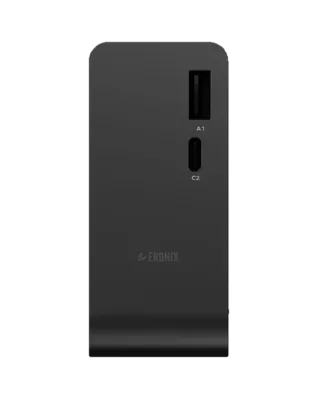
If the bank is for a laptop as well as a phone, the port matters as much as the capacity. The Battery Pack for MacBook 140W holds 20,000 mAh and states 74 Wh, under the 100 Wh cabin limit.
Its 140 W output charges a MacBook Pro at full speed, and the same pack serves a MacBook Air, an iPad or a phone.
Step by step
- Find the bank's Wh rating, about 72 Wh for 20,000 mAh.
- Multiply by 0.75 for the energy that reaches your devices.
- Divide by each device's battery Wh for the number of charges.
- Check the USB-C output wattage and protocol for each device.
- Recharge the bank with a fast USB-C charger the night before travel.
Questions people ask
How many times can a 20,000 mAh power bank charge an iPhone?
It depends on the model's battery size. A 20,000 mAh bank delivers about 54 Wh at 75% efficiency. Apple's spec pages list battery life in hours rather than capacity, so find your model's battery energy in Wh from its regulatory label or a teardown and divide 54 by it.
Can a 20,000 mAh power bank charge a laptop?
Partly, if it has a USB-C PD port with enough wattage. Laptop batteries run at 11 to 16 V, according to Android Authority, and USB-C laptops usually charge on the PD 20 V step. A bank whose PD port matches the wattage of the laptop's own adapter can top it up well; a phone-oriented port may be too slow.
How long does a 20,000 mAh power bank last on standby?
Months, though not forever. Lithium-ion cells self-discharge slowly, and some banks draw a small standby current for their circuits. Top up a stored bank every few months and charge it fully the night before travel.
Is a 20,000 mAh power bank allowed in hand luggage in India?
Yes, under IATA guidance, because at about 72 Wh it is under the 100 Wh limit. It must travel in cabin baggage, not checked bags. India's DGCA has banned using power banks to charge devices during flights, so keep it switched off on board.
Sources
- Android Authority: Why your power bank feels smaller than it should · accessed 22 Nov 2026
- ChargerLAB: Review of a 4-in-1 10000mAh power bank with built-in cables · accessed 22 Nov 2026
- CHOICE: Power banks that don't live up to claimed capacity · 21 Feb 2023
- ChargerLAB: 45W compatibility test of Samsung Galaxy S24 Ultra · 5 Aug 2024
- Qualcomm: The evolution of true wireless technology (white paper) · 2020
- GSMArena: Samsung Galaxy S25 specifications · accessed 22 Nov 2026
- IATA: Passenger lithium battery guidance · accessed 22 Nov 2026
- Business Today: Airlines told to tighten fire safety as DGCA bans inflight charging · 4 Jan 2026
Battery Management
Capacity is chemistry; longevity is software.
Read →Buying guide · 5 min readWhat size power bank do you need for a full phone charge?
Why a 10,000 mAh power bank never gives two full charges, and how to size one honestly
Read →Buying guide · 4 min readCan a power bank charge a MacBook? What to check
Two numbers decide it: output watts for speed, watt-hours for how much you get
Read →Buying guide · 4 min readWhich charger does the iPhone 18 Pro Max need?
The biggest iPhone battery yet, filled to half in the time it takes to drink a chai.
Read →Buying guide · 5 min readWhich charger does the iPhone 15 Pro Max need?
A 140 W laptop brick and a 30 W charger fill it in almost the same time. Here is why.
Read →Comparison · 4 min read10,000 vs 20,000 mAh power banks: which should you carry?
Double the mAh gives about double the charges, and double the weight in your bag.
Read →