Journal · Buying guide · 5 min read
Which charger does the iPhone Air need?
The thinnest iPhone asks for the smallest charger in the line-up. Here is why.
Apple sells a 40 W adapter for the iPhone 17 family, so most buyers assume the iPhone Air wants the same. Apple's own fast-charging table says half of that is enough. If you are buying one charger for the thinnest iPhone, how big does it really need to be?
Short answerA 20 W or higher USB-C Power Delivery charger gives the iPhone Air its fastest wired charging, which Apple rates at up to 50% in about 30 minutes. A bigger charger does not improve Apple's claim. For wireless, MagSafe and Qi2 charging reach up to 20 W, and that needs a 30 W or higher adapter behind the pad.
iPhone Air charging speed in watts and minutes
Apple's iPhone Air technical specifications list fast charging of up to 50% in 30 minutes with a 20 W adapter or higher and a USB-C cable. Apple notes it measured this with its 20 W adapter on pre-production units in January 2025. The same page rates MagSafe and Qi2 wireless charging at up to 20 W, with a 30 W or higher adapter required to reach it.
Apple's support page on fast charging confirms the split across the range. The iPhone 17, 17 Pro and 17 Pro Max are listed with 40 W or higher adapters and about 20 minutes to 50%. The iPhone Air is listed with 20 W or higher and about 30 minutes. The thin body leaves less room for battery and heat, and Apple sets a gentler target.
For battery life, Apple lists up to 27 hours of video playback, or up to 40 hours with the iPhone Air MagSafe Battery, which is sold separately. Streamed video is rated at up to 22 hours, or 35 hours with the battery.
We did not find an independent lab measurement of the Air's wired peak in watts that we could open and confirm, so we do not quote one. Apple's own minutes-to-50% figure is the number to work from.
| Model | Wired adapter | Time to 50% | MagSafe peak |
|---|---|---|---|
| iPhone Air | 20 W or higher | About 30 min | 20 W |
| iPhone 17 | 40 W or higher | About 20 min | 25 W |
| iPhone 17 Pro | 40 W or higher | About 20 min | 25 W |
| iPhone 17 Pro Max | 40 W or higher | About 20 min | 25 W |
Source: Apple Support: Fast charge your iPhone; How to use your MagSafe Charger
Minutes
Source: Apple iPhone Air specifications; Macworld, Oct 2026
How the Air uses a bigger charger
Like every USB-C iPhone, the Air uses USB Power Delivery. It tells the charger what it wants, and the charger supplies it. A 65 W laptop charger will not push 65 W into the phone. The phone takes its own amount and the rest of the charger's ability simply sits unused.
That makes the Air easy to charge from a laptop adapter, a car charger or a multi-port desk charger, as long as the port offers USB-C PD at 20 W or more. Charging is fastest early, when the battery is low, and slows as it fills.
Think of a narrow doorway. A bigger crowd waiting outside does not get more people through per minute; the doorway sets the pace. The Air's charging system is the doorway, and a 20 W charger already fills it, by Apple's own measure.
Wireless and MagSafe on the iPhone Air
Apple's MagSafe Charger support page lists the iPhone Air peaking at 20 W on the 25 W-tier MagSafe Charger, while the iPhone 17 and 17 Pro models reach 25 W. To get that, Apple asks for a 30 W or greater adapter rated at 15 V and 2 A or more. With a 20 W adapter, MagSafe charging works but at a lower speed.
Apple also notes that connecting a wired accessory such as USB-C headphones while on MagSafe caps the iPhone 17 and Air at 16 W. Wired power always takes priority over MagSafe.
Here the sources differ. Apple's spec page claims the same 50% in 30 minutes on a MagSafe Charger with a 30 W adapter. Macworld's guide lists around 40 minutes to 50% for the Air on a Qi2 charger. Treat Apple's figure as the best case and Macworld's as a realistic one; on a bedside, either rarely matters.
What you can skip
Skip buying a 40 W charger for the Air alone. Apple's claim is the same 50% in about 30 minutes from 20 W upward. Buy a bigger charger only if it will also serve a laptop, tablet or a second phone.
Skip 5 A and 240 W cables for the phone. A good 3 A USB-C cable carries up to 60 W, far above what the Air draws. Skip high-speed data cables too: Apple lists the Air's USB-C port at USB 2 speed, up to 480 Mb/s.
Skip MagSafe Compatible chargers if you want speed. Macworld notes such chargers are typically limited to 7.5 W.
What to check before you buy
For wired charging, choose a USB-C PD charger rated 20 W or more. Check that the label lists 9 V; that step is what most 20 W phone charging uses.
For MagSafe or Qi2 at 20 W, pair the pad with an adapter of 30 W or more that lists 15 V at 2 A or higher, as Apple specifies.
If you already own a 20 W USB-C adapter, keep it. It meets Apple's stated requirement for the Air's fastest wired charging.
Charge in a cool place. Apple's fast-charging page warns that fast charging might not work when conditions are too hot or too cold, which matters more in a thin phone on an Indian summer dashboard.
Myth corner
Myth: the newest iPhone always needs the newest, biggest charger. Fact: Apple's own table lists the iPhone Air at 20 W or higher for its fastest wired claim, half the 40 W it lists for the iPhone 17 Pro. Size the charger to the device, not the launch year.
The right one for you
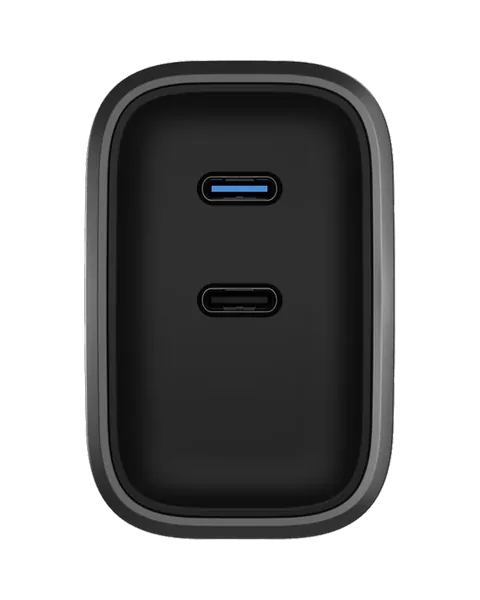
The iPhone Air asks for 20 W by cable, and for a 30 W adapter at 15 V and 2 A behind a magnetic charger. Fermi45 is the charger matched to it. It covers both from one USB-C port: a 9 V 3 A step for wired charging and a 15 V 3 A step for MagSafe or Qi2.
Its GaN power stage keeps it to 62.5 × 42 × 36 mm. A second USB-C port charges earbuds or a watch from the same socket.
Step by step
- Pick a USB-C PD charger rated 20 W or more for wired fast charging.
- Use a 3 A USB-C to USB-C cable.
- For MagSafe or Qi2 at 20 W, use an adapter of 30 W or more that lists 15 V at 2 A.
- Charge in a cool place, away from direct sun.
Questions people ask
Does the iPhone Air support 40 W charging?
Apple does not claim faster charging for the iPhone Air above 20 W. Its support table lists the Air with a 20 W or higher adapter for about 50% in 30 minutes, while the iPhone 17 and 17 Pro models are listed with 40 W adapters. A 40 W charger works safely, but Apple's stated speed is the same.
How fast does the iPhone Air charge on MagSafe?
Apple rates MagSafe and Qi2 charging on the iPhone Air at up to 20 W, using a 30 W or higher adapter rated at 15 V and 2 A or more. Apple's MagSafe page lists the Air peaking at 20 W, below the 25 W of the iPhone 17 and 17 Pro models.
Can I charge the iPhone Air with a MacBook charger?
Yes. Apple MacBook USB-C adapters use USB Power Delivery, and the iPhone Air will draw only what it needs from them. Apple lists Mac USB-C power adapters among the options for charging iPhone, and any USB-C PD charger of 20 W or more meets the Air's fast-charging requirement.
How long does the iPhone Air battery last?
Apple lists up to 27 hours of video playback and up to 22 hours of streamed video. With the iPhone Air MagSafe Battery, sold separately, Apple lists up to 40 hours of video playback and 35 hours streamed. Real results vary with network, brightness and use.
Sources
- Apple: iPhone Air technical specifications · accessed 22 Nov 2026
- Apple Support: Fast charge your iPhone · accessed 22 Nov 2026
- Apple Support: How to use your MagSafe Charger · accessed 22 Nov 2026
- Apple Support: About Apple USB power adapters · accessed 22 Nov 2026
- Macworld: Qi2 vs MagSafe, which wireless charger is best for your iPhone · 21 Oct 2026
- ChargerLAB: Ultimate cable selection guide for everyone · accessed 22 Nov 2026
USB-C Power Delivery
One connector, a negotiated contract.
Read →Buying guide · 4 min readWhich charger does the iPhone 16 Pro need?
Nine chargers, one phone, and a 7-minute spread between 20 W and 140 W
Read →Buying guide · 5 min readWhich charger does the iPhone 16 Pro Max need?
Apple says 20 W. The lab says 30 W. Here is what the extra 10 W buys you.
Read →Buying guide · 4 min readWhich charger does the iPhone 17 need?
The new 20-minute claim is real, but the last watts cost more than they give.
Read →Buying guide · 5 min readWhich charger does a 15 W MagSafe puck need?
The puck is only as fast as the plug behind it. Here is the adapter that unlocks 15W.
Read →Buying guide · 4 min readWhich charger does the iPhone 16 need?
Why 30 W is the sweet spot for this iPhone, even though it rarely takes 30 W
Read →