Journal · Explainer · 5 min read
The 60/60 rule for listening
A rule of thumb you can follow without a meter, and the WHO numbers that stand behind it.
The World Health Organization says more than 1 billion young adults are at risk of permanent, avoidable hearing loss from unsafe listening. Most of them are not at rock concerts. They are on buses, metros and sofas, earbuds in, volume nudged up one more step to cover the traffic.
Short answerThe 60/60 rule means listening at no more than 60% of your device's maximum volume for about 60 minutes at a time, then resting your ears. The WHO's guidance backs the volume half directly, advising no more than 60% of maximum, and lists an average of 80 dB as safe for up to 40 hours a week.
What the WHO actually says about safe listening time
The WHO's safe listening guidance includes a table of weekly limits. At 80 dB, the safe limit is 40 hours a week. At 85 dB it falls to 12 hours 30 minutes. At 90 dB, 4 hours. At 95 dB, 1 hour 15 minutes. At 100 dB, only 20 minutes a week. Sounds at 60 dB and below are listed as unlimited.
The pattern matters more than any single row. Every few decibels up cuts the safe time sharply, because the decibel scale is logarithmic. Going from 80 dB to 90 dB does not add an eighth; it cuts safe weekly time from 40 hours to 4.
The same guidance advises setting devices to no more than 60% of maximum, keeping the average below 80 dB if you use a sound-level app, and using well-fitted noise-cancelling headphones so you do not need to turn up the volume in noisy places. For loud venues and games, it suggests resting your ears for 10 minutes every hour.
| Average level | Safe time per week |
|---|---|
| 60 dB and below | Unlimited |
| 80 dB | 40 h |
| 85 dB | 12 h 30 min |
| 90 dB | 4 h |
| 95 dB | 1 h 15 min |
| 100 dB | 20 min |
Source: World Health Organization, Safe listening, accessed 22 Nov 2026
Hours per week
Source: World Health Organization, Safe listening, accessed 22 Nov 2026
Where the second 60 comes from
The WHO page does not use the phrase 60/60. The 60-minute half is a popular shorthand that matches the WHO's advice to take regular breaks. It is a habit, not a medical limit. At a genuinely low volume, the WHO table shows you can listen far longer; at a high volume, even 60 minutes can be too much across a week.
So read the rule as two separate reminders. Keep the volume modest. Take breaks. Neither replaces the other.
How it works: why loud sound tires the ear
Inside the inner ear, rows of tiny hair cells turn vibration into nerve signals. Loud sound over time overworks and damages them, which is why the WHO describes the hearing loss from unsafe listening as permanent. The ringing or dull feeling after a loud evening is a warning that the ear has been strained.
Think of it like walking on a lawn. One walk across leaves no mark. The same path walked every day for months wears a bare strip that takes a long time to recover, and past a point never does. Volume is how hard you step. Time is how often you walk the path.
Noise around you makes this worse in a sneaky way. A study in Canadian Acoustics measured 80 to 85 dB(A) of continuous noise inside commercial aircraft cabins during flight. To hear music clearly over that, people push volume well above 80 dB. That is why the WHO links safe listening to well-fitted, noise-cancelling earbuds and headphones: they let you hear more at a lower setting.
A typical Indian listening day, worked out
Take a common weekday. Forty-five minutes of music on the morning commute, an hour of calls and videos at work, forty-five minutes on the way home, and a film on the phone at night. That is roughly four hours of listening, or 20 hours across a five-day week.
At an average of 80 dB, that week sits comfortably inside the WHO's 40-hour limit. Push the commute volume up to cover traffic, and if the average climbs to 85 dB, the same 20 hours is well past the 12 and a half hours the WHO lists for that level. Nothing about the day changed except a few volume steps.
The fix is rarely to listen less. It is to listen lower in the loud parts of the day: better tips or noise cancellation on the bus, and a quieter setting at home where the room is already quiet.
What to check before you buy
Check the fit first. A good seal blocks outside noise and keeps bass full, so you naturally listen quieter. Try every tip size in the box.
Check whether the earbuds or headphones have active noise cancellation, and test it near a noisy road or fan. Effective cancelling is the most practical safe-listening feature you can buy. A cancelling depth quoted in decibels gives you a figure to compare.
Check your phone's hearing tools. Many phones can show headphone audio levels or warn after loud listening across a week. Turn them on when you set up new earbuds.
Check volume behaviour on your own phone. Play a familiar song at 60% in the shop. If it already sounds loud in a quiet room, you have room to listen even lower at home.
Myth corner
Myth: hearing damage only happens at concerts. The WHO table shows that 85 dB, far below concert level, is safe for only around 12 and a half hours a week. Turn the volume up to beat traffic every day and the hours add up quietly, without a single painful moment.
The right one for you
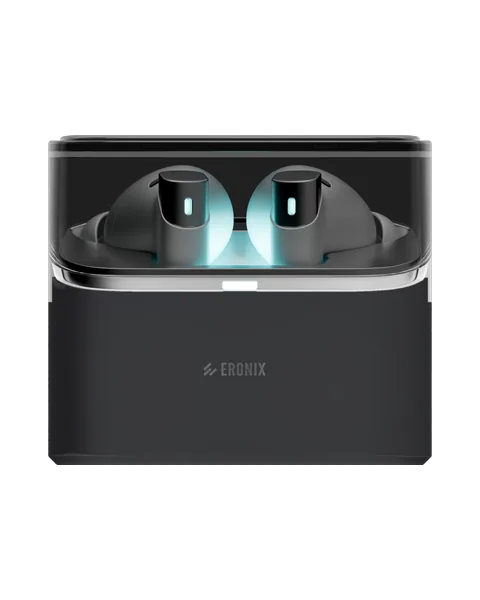
The WHO's advice is to cancel the noise rather than out-shout it. The Euphoria earbuds list noise cancelling up to 45 dB, so the bus and the metro fall back and the volume can stay low.
They are made for iPhone and Galaxy S, play 5.5 hours on a charge and carry an IPX6 rating for the walk home.
Step by step
- Set your phone's volume to 60% or less while listening in a quiet room.
- Choose ear tips that seal well so you do not need to turn up the volume.
- Use noise cancellation in noisy places instead of raising the volume.
- Take a break of about 10 minutes every hour.
- Turn on your phone's headphone level or hearing warning features.
Questions people ask
Is 60% volume safe on all earbuds?
Not exactly. Sixty percent produces different loudness on different phones and earbuds, so it is a rule of thumb, not a measurement. The WHO advises staying at or below 60% of maximum and keeping average levels below 80 dB. If a song sounds loud in a quiet room at 60%, go lower.
How many hours a day is it safe to use earbuds?
It depends on volume. The WHO lists 80 dB as safe for 40 hours a week, about 5 to 6 hours a day, but 85 dB for only 12 and a half hours a week, and 90 dB for 4 hours. Lower volume buys far more safe time than shorter sessions do.
Does noise cancellation protect hearing?
It can help indirectly. The WHO recommends well-fitted, noise-cancelling headphones so you do not need to raise the volume in noisy places. ANC itself does not lower the music, but by removing steady background noise it lets you enjoy the same song at a lower, safer level.
What are the signs I am listening too loud?
Ringing in the ears, a muffled or blocked feeling after taking earbuds out, or needing to shout to someone next to you while listening are all signs. If these happen often, lower the volume and take breaks. The WHO advises an annual hearing check for people often exposed to loud sound.
Is the 60/60 rule a WHO guideline?
Only half of it. The WHO advises keeping volume at no more than 60% of maximum and taking regular breaks, such as 10 minutes every hour in loud settings. The 60-minute part is a popular shorthand that matches the break advice rather than a formal WHO limit.
Sources
- Deafness and hearing loss: Safe listening (World Health Organization) · accessed 22 Nov 2026
- Deafness and hearing loss fact sheet (World Health Organization) · accessed 22 Nov 2026
- In-cabin noise levels during commercial aircraft flights (Canadian Acoustics) · accessed 22 Nov 2026
Active Noise Cancellation
Silence, computed in real time.
Read →Explainer · 4 min readSafe listening: how loud is too loud?
Hearing damage is a dose: loudness times time. Five decibels changes it a lot.
Read →Explainer · 5 min readWhat ANC can and cannot block
Why the bus engine fades but the conductor's voice does not, and what to check.
Read →Explainer · 4 min readEarbuds for flights: what actually matters
The engine hum is the easy part. Fit, battery and volume decide how you land.
Read →Explainer · 4 min readTransparency mode: how earbuds let the world back in
Your earbuds can hear the platform announcement for you. Here is how, and where it stops.
Read →Explainer · 4 min readEar tips: the cheapest upgrade in audio
Before you blame the earbuds, check the little silicone sleeve holding them in your ear.
Read →