Journal · Explainer · 4 min read
Safe listening: how loud is too loud?
Hearing damage is a dose: loudness times time. Five decibels changes it a lot.
On a crowded local train, you turn the earphones up to hear the podcast over the noise, then up again when another train passes. By the time you get off, the volume bar is nearly full. How loud is that, and how long can your ears take it?
Short answerThe World Health Organization treats sound as a weekly dose. Sound at 80 dB is safe for about 40 hours a week; at 90 dB, about 4 hours; at 100 dB, only about 20 minutes. WHO advises keeping volume at no more than 60% of maximum, taking breaks, and using well-fitted or noise-cancelling headphones.
The WHO numbers
WHO's safe listening guidance includes a table of how long a week a person can listen at a given level without undue risk. Up to 60 dB, about the level of normal conversation, listening time is effectively unlimited. At 80 dB, the safe weekly time is 40 hours. At 85 dB, 12 hours 30 minutes. At 90 dB, 4 hours. At 95 dB, 1 hour 15 minutes. At 100 dB, 20 minutes. At 105 dB, 8 minutes. At 110 dB, two and a half minutes.
The scale is the surprising part. Each step of 5 dB cuts the safe time to roughly a third. A small turn of the volume wheel near the top of the range uses up a week's allowance in an afternoon.
The stakes are large. WHO's fact sheet on deafness and hearing loss says over 1 billion young adults are at risk of permanent, avoidable hearing loss from unsafe listening practices. About 430 million people already need rehabilitation for disabling hearing loss, and WHO projects that nearly 2.5 billion people will have some degree of hearing loss by 2050.
| Sound level | Safe time per week |
|---|---|
| 80 dB | 40 hours |
| 85 dB | 12 hours 30 minutes |
| 90 dB | 4 hours |
| 95 dB | 1 hour 15 minutes |
| 100 dB | 20 minutes |
| 105 dB | 8 minutes |
| 110 dB | 2.5 minutes |
Source: World Health Organization, Safe listening Q&A, accessed Nov 2026
Minutes per week
Source: World Health Organization, Safe listening Q&A, accessed Nov 2026
How loudness damages hearing
Inside the inner ear are tiny sensory hair cells that turn sound vibrations into nerve signals. Loud sound over time fatigues and damages them, and damaged hair cells do not grow back. Early signs include ringing in the ears after listening, sounds seeming muffled, and difficulty following conversation in noisy places.
Decibels are logarithmic, which is why small numbers matter. A rise of 10 dB is a tenfold increase in sound intensity, so 90 dB carries ten times the sound energy of 80 dB, and WHO's table cuts the safe weekly time tenfold, from 40 hours to 4.
Think of sunburn. Ten minutes of midday Rajasthan sun is fine; two hours is not. And standing in brighter sun burns you far faster. Hearing works the same way: both the intensity and the time count, and the intensity counts much more.
Why noise around you raises the risk
People do not set volume by number; they set it to be heard over the background. On a train, a bus or a busy road, that pushes volume up. This is why WHO recommends well-fitted and noise-cancelling headphones. If less outside noise reaches your ear, you can listen at a lower level and still hear clearly. A good seal on earbuds does part of this work on its own.
Habits that keep you inside the safe dose
Keep the volume at or below 60% of maximum, as WHO advises.
Use your phone's hearing or headphone safety features to monitor exposure; WHO suggests keeping the average below 80 dB.
Take breaks. WHO recommends resting the ears for 10 minutes every hour in loud settings.
Turn it down rather than up when the background gets loud, or pause until it passes.
Get a hearing check if you notice persistent ringing or difficulty with high-pitched sounds or conversations. WHO suggests yearly checks for people in noisy jobs and for heavy gamers.
Everyday sounds for scale
WHO's guidance gives reference points. A whisper is about 30 dB and normal conversation about 60 dB, and sounds below 80 dB are unlikely to cause damage. Traffic on a busy road, a loud train platform or a crowded market can push the background well above conversation level, which is exactly when people raise their earphone volume to compensate.
What to check before you buy
Check the fit. Earbuds with several tip sizes, or over-ears with cushions that fully surround the ear, block more outside noise so you can listen quieter.
Check for active noise cancellation if you commute by train, bus or metro. It reduces the background you would otherwise talk over with volume.
Check the companion app for volume limits or hearing protection settings.
For children, choose headphones with a volume limit, and use speakers for long online classes where possible, as WHO suggests.
Myth corner
Myth: if it does not hurt, it is not damaging. Fact: hearing damage from loud music builds gradually and painlessly. WHO's table shows 90 dB, loud but not painful for most people, is safe for only about 4 hours a week. Pain comes at levels far higher than those that cause lasting harm.
The right one for you
On a train, the volume that protects your hearing is the one you never have to raise.
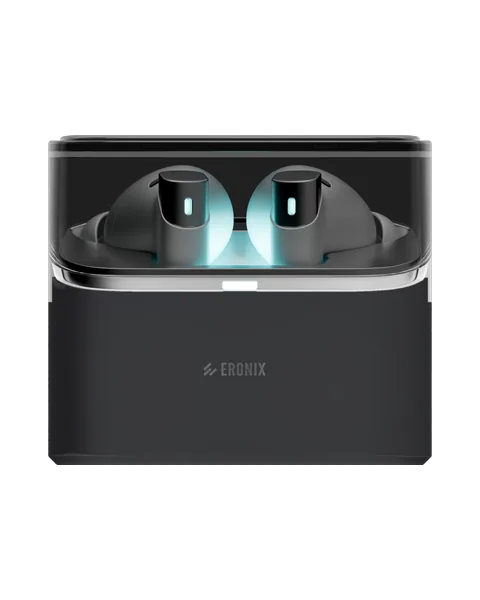
Euphoria's noise cancelling, rated at 45 dB, takes down the background you would otherwise talk over with the volume wheel, the use WHO describes for noise-cancelling headphones. It works with iPhone and Galaxy S and plays 5.5 hours on a charge; keep it at 60% or below and the WHO table stays on your side.
Step by step
- Set your volume to no more than 60% of maximum.
- Turn on your phone's headphone audio monitoring if available.
- Take a 10-minute break every hour in loud places.
- Use well-fitted or noise-cancelling headphones on commutes.
- Get a hearing check if ringing or muffled hearing persists.
Questions people ask
What is the 60 60 rule for headphones?
It is a simple habit: keep volume at no more than 60% of maximum and limit continuous listening, often given as about 60 minutes before a break. WHO's own guidance supports the volume part, advising no more than 60% of maximum, and recommends 10-minute breaks every hour in loud settings.
How many decibels are earphones at full volume?
It varies by device and earphones, and is not published consistently, so measure rather than guess. Many phones include headphone audio level tools that estimate exposure. WHO's table shows why it matters: at 100 dB, the safe weekly time is about 20 minutes, and at 110 dB about two and a half minutes.
Is 85 dB safe for headphones?
For a limited time. WHO's table puts the safe weekly listening time at 85 dB at about 12 hours 30 minutes. Spread over a week, that is under two hours a day. Listening at 80 dB extends the safe time to 40 hours a week.
Do noise-cancelling headphones protect hearing?
They help indirectly. By reducing background noise, they let you listen at lower volume in trains, buses and planes. WHO recommends well-fitted, noise-cancelling headphones for this reason. They do not make loud volume safe; the dose still depends on the level you choose and how long you listen.
Sources
- Deafness and hearing loss: Safe listening (World Health Organization Q&A) · accessed 22 Nov 2026
- Deafness and hearing loss fact sheet (World Health Organization) · accessed 22 Nov 2026
Active Noise Cancellation
Silence, computed in real time.
Read →Explainer · 5 min readWhat ANC can and cannot block
Why the bus engine fades but the conductor's voice does not, and what to check.
Read →Explainer · 4 min readEarbuds for flights: what actually matters
The engine hum is the easy part. Fit, battery and volume decide how you land.
Read →Explainer · 4 min readTransparency mode: how earbuds let the world back in
Your earbuds can hear the platform announcement for you. Here is how, and where it stops.
Read →Explainer · 4 min readEar tips: the cheapest upgrade in audio
Before you blame the earbuds, check the little silicone sleeve holding them in your ear.
Read →Explainer · 4 min readHow to get a proper seal with earbuds
Three seconds of technique: lift, twist, settle. Then one simple test to prove it worked.
Read →