Journal · Explainer · 5 min read
Over-voltage, over-current, over-temperature: charger safety
Three silent guards and one physical gap stand between a wall socket and your phone
Inside every mains charger, a few millimetres separate 230 V from the metal of your phone's port. In engineer Ken Shirriff's teardown of a counterfeit laptop charger, that gap was under 1 mm, against a safety target of at least 4 mm. What else guards that line, and how do you know your charger has it?
Short answerA well-made charger has four layers. Isolation keeps mains voltage physically apart from the output. Over-voltage protection stops the output rising above what was agreed. Over-current and short-circuit protection cut power if too much current flows. Over-temperature protection reduces or stops power when the charger gets too hot. Your phone adds its own guards on top.
The safety numbers that matter
Isolation. Shirriff's 2016 teardown found the counterfeit's isolation gap under 1 mm where traces crossed it, and described a target gap of at least 4 mm. The counterfeit also lacked the genuine unit's extensive insulating tape, put its full output of about 14.75 V on the connector at all times, and sparked when he shorted its pins.
Low voltage until it is safe. Shirriff noted the genuine charger held its output at only 3 to 6 V until it detected a laptop. USB-C does something similar by design. Google's ChromeOS hardware guide calls it VBUS Cold: with nothing attached the power line must sit at 0 V, and 5 V is applied only once a device is detected. Under USB Power Delivery, anything above 5 V is then requested by the device.
What a charger converts. Wikipedia's summary of switched-mode power supplies explains that 230 V AC is rectified to about 325 V DC inside the charger before being switched at tens to hundreds of kilohertz through a small transformer. It notes that touchable equipment is generally limited to 60 V DC, and that a switching supply's failure rate roughly doubles for every 10 to 15 °C above 25 °C, which is why heat protection matters.
The battery's own limit. Battery University says a standard lithium-ion cell charges to 4.20 V, with a tolerance of about 50 mV, and that prolonged charging above 4.30 V on a cell designed for 4.20 V plates metallic lithium on the anode. The phone's charging chip and battery protection circuit, not the wall charger, enforce that final limit.
| Measure | Value |
|---|---|
| Isolation gap, safety target | At least 4 mm |
| Isolation gap, counterfeit teardown | Under 1 mm |
| USB-C power line, nothing attached | 0 V |
| Mains after rectification | About 325 V DC |
| Touchable equipment limit | 60 V DC |
| Lithium-ion full charge | 4.20 V, about ±50 mV |
| Lithium plating risk | Prolonged charging above 4.30 V |
Source: Ken Shirriff teardown, 2016; ChromiumOS developer library; Wikipedia, switched-mode power supply; Battery University BU-409
How each protection works
Think of a building's water system. The mains pipe is high pressure. A pressure-reducing valve brings it down for the taps; a relief valve opens if pressure climbs; a flow limiter shuts off a burst pipe; and a thermostat stops the geyser overheating. A charger has electrical versions of each.
Over-voltage protection is the relief valve. A feedback circuit, often through an opto-coupler, constantly compares the output with a reference. If the output rises past a set point, for example because a component fails, the controller shuts down instead of passing the excess to your phone.
Over-current and short-circuit protection are the flow limiter. If the cable is crushed or a coin bridges the contacts, current shoots up. The controller senses it and cuts or limits output within moments. A fuse on the mains side is the last resort if something inside fails short.
Over-temperature protection is the thermostat. A sensor near the hottest parts tells the controller to reduce power, which is why chargers in tests often throttle after several minutes of full load, and to stop entirely if the temperature keeps climbing.
Isolation is the wall between the pipes. The transformer and the opto-coupler carry energy and signals across the gap without a direct electrical path, so a fault on the mains side cannot reach the USB port.
Signs a protection has done its job
Throttling is the most common one. In Tom's Hardware's test of 20 chargers, several high-power units cut their output as they heated, one 140 W model falling to 88 W. That is over-temperature protection working.
A charger that stops and restarts when the cable is wiggled, or that refuses to power a damaged cable, is often its current protection responding. Your phone adds its own: iPhones show Charging On Hold when too hot or too cold. Treat these as warnings to check the setup, not faults to bypass.
What to check before you buy
Check the BIS Standard Mark and R-number, and look it up on crsbis.in. Registration is mandatory for the chargers the scheme covers, and the number lets you confirm the brand and product type.
Look for protections named in the specification, such as over-voltage, over-current, short-circuit and over-temperature protection. Reputable makers list them.
Prefer USB-C with USB Power Delivery. Its negotiate-first design keeps higher voltages off the port until the phone agrees.
Be wary of very cheap, very light units with poor print. Shirriff's counterfeit looked convincing outside; the danger was inside.
Inspect the plug and body. Loose pins, a rattling case or a body that flexes when pressed are signs of poor build.
Myth corner
Myth: if a charger works, it is safe. A charger can deliver power for months while missing the isolation or protection that matters only when something goes wrong. Shirriff's counterfeit charged a laptop, yet had an isolation gap under 1 mm and full voltage on its pins at all times. Safety is about what happens in a fault.
The right one for you
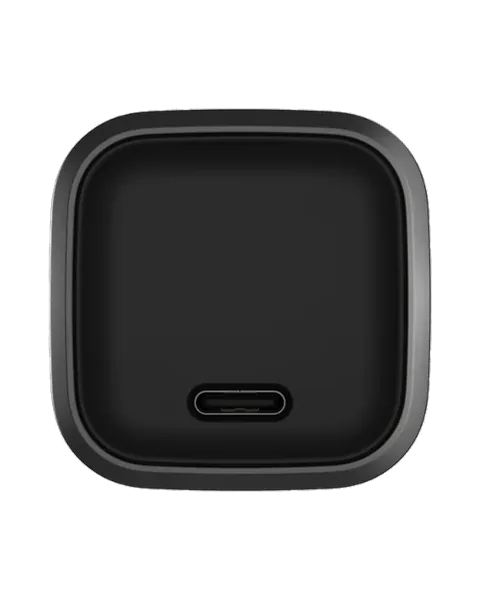
The protections in this guide should be named, not implied. The Fermi30 lists over-voltage, over-current, over-temperature and short-circuit protection on its specification, accepts 100–240 V input, and offers USB-C rails from 5 V 3 A to 20 V 1.5 A, with PPS from 3.3 to 11 V.
It is matched to the iPhone 16 family, in a GaN3 body 49.6 × 32 × 32 mm.
Step by step
- Find the BIS Standard Mark and R-number and verify it on crsbis.in.
- Check the product listing for over-voltage, over-current, short-circuit and over-temperature protection.
- Prefer USB-C chargers with USB Power Delivery.
- Inspect the plug and body for loose pins, rattles or flexing.
- Stop using any charger that sparks, smells or shows scorch marks.
Questions people ask
What do OVP, OCP and OTP mean on a charger?
They are short for over-voltage protection, over-current protection and over-temperature protection. OVP stops the output rising above the agreed voltage, OCP cuts power if too much current flows, for example in a short circuit, and OTP reduces or stops output when the charger gets too hot.
Can a fast charger damage my phone's battery?
A compliant fast charger only raises voltage after the phone agrees through USB Power Delivery or the brand's protocol. The phone's own circuits then control the battery, which Battery University says charges to 4.20 V per cell for standard lithium-ion. Damage risk comes mainly from faulty or counterfeit chargers and from heat.
Why do counterfeit chargers give shocks or catch fire?
Many cut corners on isolation and protection. Ken Shirriff's teardown of a counterfeit found an isolation gap under 1 mm instead of at least 4 mm, little insulation, and full voltage on the connector even with nothing attached. A fault can then bridge mains voltage to the output or overheat without cutting off.
Does my phone have its own protection?
Yes. Phones have a charging controller and a battery protection circuit that limit voltage, current and temperature. iPhones, for example, pause charging when too hot or too cold. These work together with the charger's protections, but they cannot fix a charger that leaks mains voltage.
Sources
- Ken Shirriff: Counterfeit MacBook charger teardown · Mar 2016, accessed 22 Nov 2026
- Switched-mode power supply (Wikipedia) · accessed 22 Nov 2026
- ChromiumOS developer library: Cable and adapter tips and tricks · accessed 22 Nov 2026
- Battery University: BU-409 Charging lithium-ion · accessed 22 Nov 2026
- BIS Compulsory Registration Scheme portal (Bureau of Indian Standards) · accessed 22 Nov 2026
- Apple Support: If a Charging On Hold notification appears on your iPhone or iPad · accessed 22 Nov 2026
- Tom's Hardware: We tested 20 wall chargers from 15 W to 140 W · accessed 22 Nov 2026
USB-C Power Delivery
One connector, a negotiated contract.
Read →Explainer · 4 min readWhat happens inside a charger when you plug it in
Between the wall and your phone, a charger does six jobs in a box you can close a fist on.
Read →Explainer · 4 min readHotel room charging: making one socket work
One socket behind the bed, three devices, a 7 am meeting. Here is the plan.
Read →Explainer · 5 min readGaN chargers: what changed and what did not
A new material shrank the charger. Your phone's charging speed stayed where it was.
Read →Explainer · 5 min readHow to charge two laptops from one charger
In one lab test, a 65 W charger gave the second laptop 0 W. Here is how to avoid it.
Read →Explainer · 4 min readHow to know a charger's real output
The box says 100 W. Over half an hour, some chargers quietly deliver much less.
Read →