Journal · Explainer · 4 min read
What happens inside a charger when you plug it in
Between the wall and your phone, a charger does six jobs in a box you can close a fist on.
You push a charger into the wall, connect the cable, and a small lightning symbol appears on the phone in under a second. What actually happened in that second, inside a box small enough to close your fist around?
Short answerThe charger turns India's 230 V AC into high-voltage DC, switches it on and off tens of thousands of times a second, and sends the pulses through a small transformer that steps voltage down and isolates you from mains. It offers a safe 5 V, and goes higher only when the phone asks.
The six stages, with numbers
Stage one: protection and rectification. India's supply is 230 V at 50 Hz, according to WorldStandards. Engineer Ken Shirriff's teardown of a counterfeit laptop charger shows the first parts mains meets: a fuse, then a bridge rectifier that turns alternating current into direct current, then a large capacitor that smooths it.
Stage two: switching. A transistor chops this high-voltage DC into rapid pulses. In Shirriff's teardown, the counterfeit's controller switched at about 60 kHz. The IEA 4E programme's measurements of modern phone and laptop chargers recorded peak switching frequencies of about 55 to 65 kHz at full load in the 60 W units it could measure.
Stage three: the transformer and the safety gap. The pulses drive a small transformer, which steps the voltage down. Crucially, its two sides are not electrically connected; energy crosses as a magnetic field. Shirriff notes that the high-voltage and low-voltage sides of a charger's circuit board should be separated by at least 4 mm. That gap is what keeps mains voltage away from the USB port in your hand.
Stage four: rectifying the output. On the low-voltage side, a diode or a synchronous rectifier and output capacitors turn the pulses back into smooth DC.
Stage five: feedback. A reference circuit measures the output and sends a signal back across the isolation barrier, often through an optocoupler, telling the controller to switch harder or softer. This keeps the output steady as the phone's demand changes.
Stage six: talking to the phone. A USB-C charger keeps its output off until a device is attached. The ChromiumOS hardware reference describes this cold state, with power applied only after the charger detects a proper connection. It then supplies 5 V. If the phone supports USB Power Delivery, the two exchange messages and agree a higher voltage, such as 9 V, 15 V or 20 V. The USB-IF notes that Revision 3.1 added 28 V, 36 V and 48 V for up to 240 W.
| Stage | Figure | Source |
|---|---|---|
| Mains input in India | 230 V, 50 Hz | WorldStandards |
| Switching, counterfeit charger | About 60 kHz | Ken Shirriff |
| Switching, 60 W chargers at full load | About 55 to 65 kHz | IEA 4E |
| Gap between high- and low-voltage sides | At least 4 mm | Ken Shirriff |
| USB PD voltages | 5, 9, 15, 20 V; 28, 36, 48 V on Revision 3.1 | USB-IF |
Source: WorldStandards, Ken Shirriff, IEA 4E, USB-IF, accessed Nov 2026
Efficiency (%)
GaN Silicon
Source: IEA 4E PECTA measurements, accessed Nov 2026
Why chop the power at all?
A transformer working at mains frequency, 50 Hz, would need a heavy iron core, which is why old chargers were bricks. Raise the frequency to tens of kilohertz and the same power passes through a far smaller transformer. Switching is what lets a modern charger fit in a pocket.
Think of filling a bucket from a powerful tap. Leave it fully open and the bucket overflows. Instead, you flick the tap on and off very quickly, and by changing how long each burst lasts, you hold the water at exactly the level you want. The charger's switching transistor is flicking the tap; the feedback loop is your eye on the water line.
Where losses and heat come from
Every stage loses a little energy: the rectifier, each switching event, the transformer core and the output stage. In the IEA tests, 30 W chargers ran at around 90% efficiency whether GaN or silicon, while at 60 W GaN averaged 92% against 90% for silicon. GaN transistors lose less energy each time they switch, which is why they make small, high-power chargers practical.
Why some chargers have a third pin
Many laptop chargers in India use a three-pin plug, while most phone chargers use two. The third pin connects to earth. Shirriff's teardown found the counterfeit charger's earth pin connected to nothing, which defeats its purpose. In a genuine design, the isolation of stage three is what protects you on a two-pin phone charger, and the earth connection adds a further layer on chargers that use one.
What to check before you buy
Weigh it in your hand. A charger with its full set of protection and filtering parts is dense. Shirriff found a genuine charger crammed with parts compared with a counterfeit that had just a few components.
Read the label. It should list input, such as 230 V AC, and each output voltage and current. Missing or smudged ratings are a warning.
Check the USB PD and, for Galaxy phones, PPS support if you want fast charging. That is stage six, and it decides speed.
Buy from the brand or an authorised seller. The safety gap of stage three is invisible from outside, and counterfeits are where it is most often missing.
Myth corner
Myth: a charger pushes its full rated power into the phone the moment you plug in. Fact: a USB-C charger starts with its output off, then 5 V, and goes higher only after the phone requests it. The phone, not the charger, sets the pace.
The right one for you
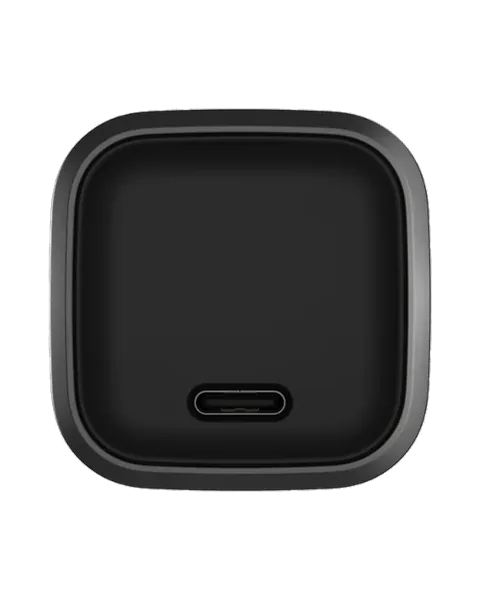
Every stage described above is inside the Fermi30, a 30 W GaN3 adapter for the iPhone 16 family, 49.6 × 32 × 32 mm and 42 g.
Its ratings are the kind worth reading: 100–240 V input, fixed rails from 5 V 3 A to 20 V 1.5 A, PPS from 3.3 to 11 V at 3 A, and protection against over-voltage, over-current, over-temperature and short-circuit. Idle, it draws under 0.05 W.
Step by step
- Read the input and output ratings on the label.
- Check for USB PD, and PPS if you use a Galaxy phone.
- Feel the weight: a well-built charger is dense.
- Buy from the brand or an authorised seller.
Questions people ask
Why do phone chargers have a transformer?
The transformer steps the voltage down and, just as importantly, isolates the low-voltage USB side from the mains. Energy crosses as a magnetic field rather than through a wire. Ken Shirriff's teardown notes the high and low voltage sides should be separated by at least 4 mm on the circuit board.
Does a charger use power when nothing is plugged in?
A little. Tom's Hardware measured idle draw of around 0.3 W for chargers without displays. USB-C chargers also keep their output switched off until a device connects, so the cable end is not live on its own. Unplugging a charger you do not need saves that small amount.
How does a charger know how much power my phone needs?
Through USB Power Delivery. After the charger detects a connection and supplies 5 V, the phone and charger exchange messages over the USB-C cable's configuration channel and agree a voltage and current. If the phone does not support PD, it stays at 5 V.
Why are new chargers so much smaller than old ones?
Higher switching frequencies let designers use much smaller transformers, and newer transistor materials like GaN waste less energy per switch, so less heat must be removed. The IEA 4E programme found GaN chargers achieved up to about twice the power density of silicon designs on average.
Sources
- Counterfeit MacBook charger teardown (Ken Shirriff's blog) · Mar 2016
- PECTA: Energy efficiency measurement of wide bandgap-based power supplies (IEA 4E) · Mar 2024
- Cable and Adapter Tips and Tricks (ChromiumOS developer library) · accessed 22 Nov 2026
- USB Charger (USB Power Delivery) (USB-IF) · accessed 22 Nov 2026
- India plug, socket and voltage (WorldStandards) · accessed 22 Nov 2026
- We tested 20 wall chargers from 15 W to 140 W (Tom's Hardware) · accessed 22 Nov 2026
GaN — Gallium Nitride
The semiconductor that let chargers shrink.
Read →Explainer · 4 min readHotel room charging: making one socket work
One socket behind the bed, three devices, a 7 am meeting. Here is the plan.
Read →Explainer · 5 min readGaN chargers: what changed and what did not
A new material shrank the charger. Your phone's charging speed stayed where it was.
Read →Explainer · 4 min readHow to charge a phone fast before a flight
Thirty minutes at the gate can be worth half a battery. Five steps to get it.
Read →Buying guide · 4 min readHow many watts does a 4-port desk charger really give each port?
The wattage on the box is a shared budget. Every extra cable takes a slice.
Read →Explainer · 5 min readCan a 100 W charger damage your phone?
The watts on the brick are a ceiling, not a push. Heat is what your battery remembers.
Read →