Journal · Explainer · 6 min read
What 'fast charging' means on each brand
The same two words on every box. Behind them, five different rulebooks.
Every phone box in India now says fast charging. On one phone that means 20 W; on another, 100 W. The same two words cover a five-fold gap. So what are you actually buying when a charger promises to be fast?
Short answerFast charging is a label, not a standard. Apple and Google use USB Power Delivery (USB PD). Samsung uses USB PD with its Programmable Power Supply mode (PPS) for Super Fast Charging. OnePlus and OPPO use their own SUPERVOOC system. Each phone reaches its top speed only when the charger speaks the same language.
Fast charging speeds by brand, in watts and minutes
Apple. Apple's support page lists the iPhone 17, 17 Pro and 17 Pro Max as reaching up to 50 percent in about 20 minutes with a 40 W or higher adapter. The iPhone 17e and iPhone Air reach 50 percent in about 30 minutes with 20 W or more. For the iPhone 18 Pro and 18 Pro Max, Apple quotes about 15 minutes to 50 percent with a 60 W-capable adapter, such as its 40 W Dynamic Power Adapter with 60 W Max.
Samsung. Samsung's US support page separates Fast charging from Super fast charging. Super fast charging is only on select models and needs a 25 W or 45 W Samsung-approved adapter. Samsung adds that not every device supports 45 W, and a phone picks its best supported speed on a higher-rated charger. Samsung's 45 W adapter page lists PPS output from 5 to 20 V at up to 2.25 A, fixed outputs of 9 V and 15 V at 3 A, and 20 V at 2.25 A.
Google. On Google's UK spec page, the Pixel 10 Pro reaches up to 55 percent in about 30 minutes with a 30 W USB-C PPS charger, and the Pixel 10 Pro XL reaches up to 70 percent in about 30 minutes with a 45 W PPS charger. In GSMArena's test of the base Pixel 10 with Google's 30 W charger, it reached 53 percent in 30 minutes and full in 1 hour 32 minutes.
OnePlus and OPPO. Android Authority's explainer traces SUPERVOOC from 10 V at 5 A (50 W) to 10 V at 6.5 A (65 W), and a later 240 W version that it says can fill a 4,500 mAh battery in nine minutes. ChargerLAB lists OnePlus's 100 W dual-port adapter as supporting 100 W SUPERVOOC and 65 W USB PD.
Xiaomi. Xiaomi's own page for 120 W HyperCharge on the 11T Pro claims about 17 minutes from 2 to 100 percent in its internal tests, and notes the charger gives 96 W on 100 to 120 V mains rather than 120 W. India runs on 230 V, so the higher figure applies here.
| Brand | System | Example figure |
|---|---|---|
| Apple | USB PD | iPhone 17: 50% in about 20 min with 40 W or more |
| Samsung | USB PD with PPS | Super fast charging at 25 W or 45 W |
| USB PD with PPS | Pixel 10 Pro XL: up to 70% in about 30 min with 45 W | |
| OnePlus, OPPO | SUPERVOOC | 65 W at 10 V and 6.5 A |
| Xiaomi | HyperCharge | 11T Pro: 2 to 100% in about 17 min at 120 W (Xiaomi's internal test) |
Source: Apple Support; Samsung US Support; Google Store; Android Authority; Xiaomi, accessed Nov 2026
Minutes to 50%
Source: Apple Support: Fast charge your iPhone, accessed Nov 2026
How fast charging works: voltage, current and who does the work
Power is voltage multiplied by current. A basic USB port gives 5 V at about 0.5 to 3 A. To go faster, a charger must either raise the voltage, raise the current, or both. That is the only real choice, and each brand picks differently.
USB PD, the open standard from USB-IF, offers fixed steps of 5, 9, 15 and 20 V. Its PPS mode, added in PD 3.0, lets the phone ask for any voltage from 3.3 to 21 V in 20 mV steps, with current in 50 mA steps. That fine control lets the phone push power almost straight into the battery, so less heat is made inside the phone. Samsung and Google lean on this.
SUPERVOOC goes the other way. It keeps voltage low, pushes high current, and moves much of the heat-making circuitry into the charger. Many of these phones split the battery into two cells in series to take the power. Xiaomi's HyperCharge also splits the battery, into two 2,500 mAh cells in the 11T Pro, and uses two charge pumps to convert the incoming voltage.
Think of it like filling a water tank. USB PD with PPS is a smart tap that opens exactly as far as the tank asks. SUPERVOOC is a wide pipe at low pressure, with the pump installed at the tap end, not inside the tank. Both fill the tank. But a wide pipe needs its matching fitting, and a smart tap needs a tank that knows how to ask.
Why a fast charger can still charge slowly
The phone, not the charger, decides the speed. If the two do not share a protocol, they fall back to the highest common mode, which may be ordinary USB PD or just 5 V. Android Authority notes that OPPO and OnePlus phones have historically accepted only 18 W or 27 W over standard USB PD, far below their SUPERVOOC figures.
Heat also slows things. In Android Authority's test of the Pixel 10 series, charging power began to fall at around 36 degrees Celsius, dropped sharply above 38 degrees, and could sit near 10 W for a few minutes while the phone cooled. Apple's page also says fast charging may not work when it is too hot or too cold.
What to check before you buy
Find your phone's own number. Look up the wattage and the protocol on the phone maker's spec or support page, not the charger box. For example, 30 W PPS for a Pixel 10 Pro, or 40 W for an iPhone 17 Pro.
Read the small print on the charger. For Samsung Super Fast Charging and Pixel phones, the label should list PPS, with a voltage range such as 3.3 to 21 V or 5 to 20 V. A charger that lists only 5 V, 9 V, 15 V and 20 V is USB PD without PPS.
Match the cable to the current. Under the USB PD standard, a cable rated 3 A carries up to 60 W, and anything above 3 A needs a 5 A cable with an electronic marker. For its 45 W adapter, Samsung recommends its own 5 A cable for best results.
Check the fallback speed. If you own a SUPERVOOC or HyperCharge phone, ask what it gets on a standard USB PD charger. If you share a charger at home, that common number matters more than the headline one.
Count the ports. On a multi-port charger, the headline wattage is shared. Check the per-port table on the box to see what one port gives when two devices are plugged in.
Myth corner
Myth: a higher-watt charger will force too much power into a phone. Fact: a USB PD charger only offers power levels, and the phone requests what it can take. Samsung's own support page says a phone uses the fastest speed it supports when connected to a higher-rated charger.
The right one for you
If your home mixes an iPhone and a Galaxy, the charger has to speak both USB PD and Samsung's PPS-based Super Fast Charging.
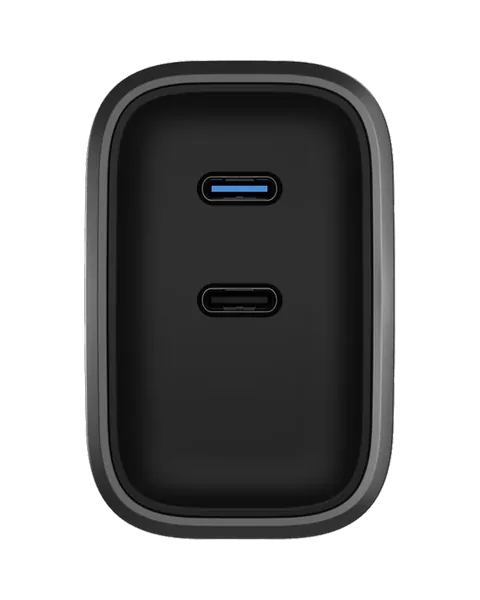
The Fermi45 does. It gives up to 45 W from one USB-C port, with fixed rails from 5 to 20 V, a PPS range of 5 to 20 V at 3 A, and Samsung Super Fast Charging 2.0. It is made for the iPhone 17 series and the Galaxy phones that take 45 W, and its second USB-C port shares the power when two devices charge together. A GaN power stage keeps it to 62.5 × 42 × 36 mm.
Step by step
- Find your phone's maximum charging wattage and protocol on the maker's support or spec page.
- Check the charger label for USB PD and, for Galaxy or Pixel, PPS with its voltage range.
- Use a USB-C cable rated 5 A if the charger delivers more than 3 A.
- For a multi-port charger, read the per-port power table on the box.
- Charge in a cool place so heat does not slow the phone down.
Questions people ask
Is Samsung Super Fast Charging the same as USB PD?
It runs on USB Power Delivery using the PPS mode added in PD 3.0. Samsung's 45 W adapter lists PPS output of 5 to 20 V at up to 2.25 A. A USB PD charger without PPS will still charge a Galaxy, but usually at the slower Fast charging level rather than Super fast.
Can I use a SUPERVOOC charger with an iPhone or Galaxy?
Usually yes, if the SUPERVOOC charger also supports USB PD. OnePlus's 100 W dual-port adapter, for example, lists 65 W USB PD alongside SUPERVOOC. The iPhone or Galaxy will charge at its own USB PD rate, not at the SUPERVOOC figure on the box.
What charger does a Pixel need for fast charging?
Google's support page recommends any PPS adapter rated 30 W or more, or Google's own 30 W, 45 W or 67 W chargers. Other USB PD adapters of 15 W or more also work, but more slowly. The Pixel 10 Pro XL needs 45 W PPS to reach Google's 70 percent in 30 minutes claim.
Does fast charging work in hot weather?
Phones reduce charging power when they get hot. Apple says fast charging may not work when it is too hot or cold, and Android Authority measured Pixel 10 charging slowing from about 36 degrees Celsius. Charge in a cool, shaded spot and remove a thick case if the phone feels warm.
Do I need a special cable for fast charging?
Under USB PD, a USB-C cable rated for 3 A carries up to 60 W. Above 3 A, such as 100 W laptop charging, you need a 5 A cable with an electronic marker chip. Samsung recommends its 5 A cable with its 45 W adapter. Proprietary systems like SUPERVOOC need their own cable to reach full speed.
Sources
- Apple Support: Fast charge your iPhone · accessed 22 Nov 2026
- Samsung US Support: How to fast charge your Galaxy phone or tablet · accessed 22 Nov 2026
- Samsung UK: 45W Super Fast Charger 2.0 (EP-T4511) · accessed 22 Nov 2026
- Google Store: Pixel 10 Pro and Pixel 10 Pro XL tech specs · accessed 22 Nov 2026
- Google Pixel Phone Help: Charge your Pixel phone · accessed 22 Nov 2026
- GSMArena: Google Pixel 10 review, lab tests · accessed 22 Nov 2026
- Android Authority: Pixel 10 charging test · accessed 22 Nov 2026
- Android Authority: SuperVOOC fast charging explained · accessed 22 Nov 2026
- ChargerLAB: Charging review of OnePlus SUPERVOOC 100W Dual Ports Charger · accessed 22 Nov 2026
- Xiaomi: 120W Xiaomi HyperCharge overview (Xiaomi 11T Pro) · accessed 22 Nov 2026
- Wikipedia: USB hardware (USB Power Delivery) · accessed 22 Nov 2026
USB-C Power Delivery
One connector, a negotiated contract.
Read →Explainer · 5 min readPPS: why Samsung phones care about it
Three letters on a charger label decide whether a Galaxy charges at full speed or half.
Read →Explainer · 4 min readDo original chargers matter?
The logo on the plug matters less than two words in its small print.
Read →Buying guide · 5 min readWhich charger does the Galaxy S26 need?
Three phones, three speeds, one protocol called PPS. Here is what to buy and what to skip.
Read →Buying guide · 4 min readWhich charger does the Galaxy S26+ need?
Samsung promises 69 percent in about 30 minutes. One word on the label decides it.
Read →Buying guide · 4 min readWhich charger does the Galaxy Z Fold8 need?
Samsung's foldables now charge at 45 W. Here is the charger that gets you there.
Read →