Journal · Explainer · 5 min read
The future of charging: what comes after 240 W
Phones have already shown 240 W. Why the next leap is about control, not size.
A few years ago, 65 W in a phone sounded extreme. Today USB-C reaches 240 W for laptops, and one phone maker has shown 240 W into a phone. So what comes next: 500 W phone chargers, or something else?
Short answerProbably something else. USB Power Delivery currently stops at 240 W, from 48 V at 5 A, and phone batteries cannot safely take much more without new chemistry. The next gains are likely to come from finer voltage control, smaller and cooler GaN chargers, and batteries and charging curves designed together, rather than ever-bigger watt numbers.
The numbers: where charging stands today
The USB Promoter Group's 2021 announcement of USB PD 3.1 lifted the old 100 W ceiling of 20 V at 5 A. It added fixed levels of 28 V, 36 V and 48 V, reaching 240 W, and an adjustable mode that lets a device request any voltage from 15 V upward in 100 mV steps. Larger notebook PCs were named as the target.
Phones took a parallel path. Wikipedia's history of Oppo's VOOC system runs from 5 V at 4 A in 2015's VOOC 2.0 to 20 V at 12 A, or 240 W, announced at MWC 2022 and advertised to fill a 4,500 mAh battery in about 9 minutes. That speed needs the bundled charger and cable. In the realme GT Neo5, the first phone to use it, three controller chips step 20 V down to 10 V before a final stage feeds the battery.
Apple's newest iPhones show the other direction. Apple's fast-charge page says iPhone 18 Pro models reach about 50 percent in 15 minutes with a 60 W-capable adapter that supports AVS over USB PD 3.2. MacRumors reported a test by the Xiaobai's Tech Reviews channel in which the 18 Pro Max peaked near 52 W. That is modest by Android standards, but it is delivered through the open standard.
| System | Volts and amps | Power |
|---|---|---|
| USB PD before 3.1 | 20 V, 5 A | 100 W |
| USB PD 3.1 EPR | 48 V, 5 A | 240 W |
| VOOC 2.0 (2015) | 5 V, 4 A | 20 W |
| VOOC 240 W (2022) | 20 V, 12 A | 240 W |
| iPhone 18 Pro Max, measured peak | Not published | About 52 W |
Source: USB Promoter Group, 2021; VOOC, Wikipedia; MacRumors
Why more watts is not the obvious next step
The battery is the bottleneck. Battery University explains that lithium-ion cells accept fast charge with little stress from empty to about 50 percent, but stress rises in the second half, and current should be reduced after about 70 percent. Above roughly 1C, a charge rate equal to the battery's capacity per hour, it warns that service life falls.
Push lithium in too fast and it cannot enter the graphite anode quickly enough. Battery University calls this lithium plating. It is worse in the cold, at high charge levels and in older cells, and in extreme cases plating can short a cell. Cells designed for 10-minute charging also store less energy for their size.
Think of it like a highway and a toll booth. You can widen the highway to ten lanes, but if the toll booth at the end, the battery, still processes cars at the same rate, traffic simply queues. Faster charging needs a faster booth, not just a wider road.
How the next gains will come
Finer control. Instead of fixed steps like 9 V or 20 V, chargers now let the device ask for exactly the voltage it needs, moment to moment. USB PD 3.1's adjustable mode uses 100 mV steps; Apple's AVS and Samsung's PPS follow the same idea. Less conversion inside the phone means less heat, and heat is what forces a phone to slow down.
Better power chips. IEEE Spectrum reports that gallium nitride became the incumbent in 25 to 500 W chargers from 2019, switching at several hundred kHz against about 100 kHz for silicon or silicon carbide. Early GaN chargers reached about 30 W per cubic inch, roughly double the silicon designs they replaced, with efficiency above 92 percent. Silicon carbide leads at higher voltages, 800 V and above, which matters for EVs and could matter for high-power multi-port desk chargers.
Smarter batteries. Some fast-charging designs split the battery into two cells in series. That doubles the battery voltage, so the same power flows at half the current, with less heat in the wiring. Wikipedia notes that VOOC's 2016 SuperVOOC charged a two-cell battery in series. New anode materials and heated-charging research, which Battery University describes as experimental, aim at the toll booth itself.
What this means for buying a charger now
For most phones, the next few years will not require more than a good 60 W to 100 W USB-C PD charger with PPS. For laptops, 140 W and 240 W EPR chargers already cover the largest models. Buying a charger that supports the open standard, rather than one tied to a single phone, keeps it useful as devices change.
What to check before you buy
Check for USB PD 3.1 or later if you need more than 100 W for a laptop, and an EPR cable rated for 240 W.
Check for PPS, and for AVS if you use recent iPhones, since fine voltage control is where phone charging is heading.
Check sustained output, not just peak. A compact high-watt charger may throttle when hot.
Prefer open standards over proprietary ones unless you will always use that one phone. A proprietary 240 W charger may fall back to slow charging on everything else.
Myth corner
Myth: a 240 W charger will make any phone charge in minutes. The phone sets the limit. A phone that accepts 25 W draws 25 W from any compliant charger, and even 240 W phones throttle as the battery fills, as Battery University's charging data explains.
The right one for you
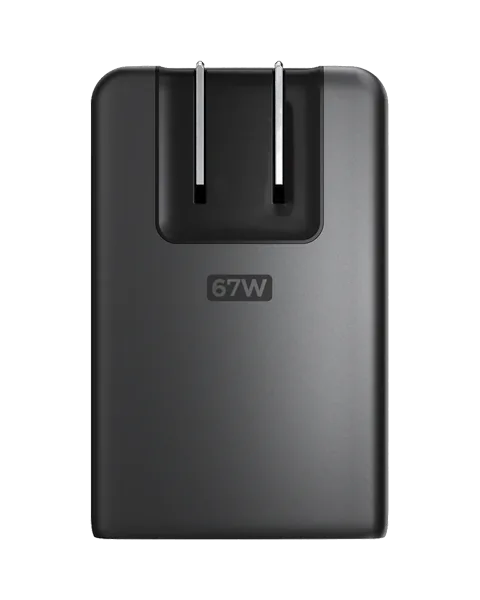
This guide pointed to fine voltage control on an open standard. For the phone, the Entropy67 lists PPS and AVS from 5 to 20 V at 3.35 A, with 67 W from one port: above the 60 W AVS adapter Apple names for iPhone 18 Pro, in a body 14 mm thin.
For the largest laptops, the Entropy140 gives 140 W over USB PD 3.1 EPR for MacBook Pro 16, with two more ports for the phone and the watch.
Questions people ask
What is the maximum USB-C charging power?
USB Power Delivery 3.1 supports up to 240 W, using 48 V at 5 A, according to the USB Promoter Group. Reaching it needs a charger, a device and an Extended Power Range cable rated for 240 W. Most phones draw far less, typically well under 100 W.
Is 240 W charging safe for phones?
It can be, in phones designed for it, but the battery limits how fast charge can go in safely. Battery University explains that stress rises after about 50 percent, current should fall after about 70 percent, and very high rates risk lithium plating. Designs use multiple cells and careful control to manage this.
Will future iPhones charge faster?
Apple has increased speeds gradually through the open USB PD standard. Its fast-charge page says iPhone 18 Pro models reach about 50 percent in 15 minutes with a 60 W-capable AVS adapter. Future speeds depend on battery design and heat, and should be checked on Apple's specifications after each launch.
What is the difference between GaN and silicon carbide chargers?
Both are wide-bandgap materials that waste less energy than silicon. IEEE Spectrum reports GaN dominates below about 400 V and is the incumbent in 25 to 500 W chargers, while silicon carbide leads at 800 V and above, as in many EV systems. For phone and laptop chargers, GaN is usual.
Sources
- USB Promoter Group: USB PD 3.1 announcement (240W) · 25 May 2021
- VOOC, Wikipedia · accessed 22 Nov 2026
- Battery University: Ultra-fast chargers · accessed 22 Nov 2026
- IEEE Spectrum: Gallium nitride and silicon carbide fight for green tech domination · accessed 22 Nov 2026
- Fast charge your iPhone, Apple Support · accessed 22 Nov 2026
- MacRumors: iPhone 18 Pro Max test shows much faster charging · 17 Sep 2026
USB-C Power Delivery
One connector, a negotiated contract.
Read →Explainer · 5 min readAVS and USB PD 3.2: what is new
A phone asked a power bank for 18 V. Here is the rule that made it possible.
Read →Explainer · 5 min readGaN chargers: what changed and what did not
A new material shrank the charger. Your phone's charging speed stayed where it was.
Read →Explainer · 4 min readUSB PD 3.1 EPR and 240 W, explained
Same USB-C plug, more than twice the power. The trick is voltage, not a thicker wire.
Read →Explainer · 5 min readMulti-port chargers and power sharing, explained
Why the laptop pauses when you plug in your phone, and the one table to read first.
Read →Explainer · 5 min readHow to charge two laptops from one charger
In one lab test, a 65 W charger gave the second laptop 0 W. Here is how to avoid it.
Read →